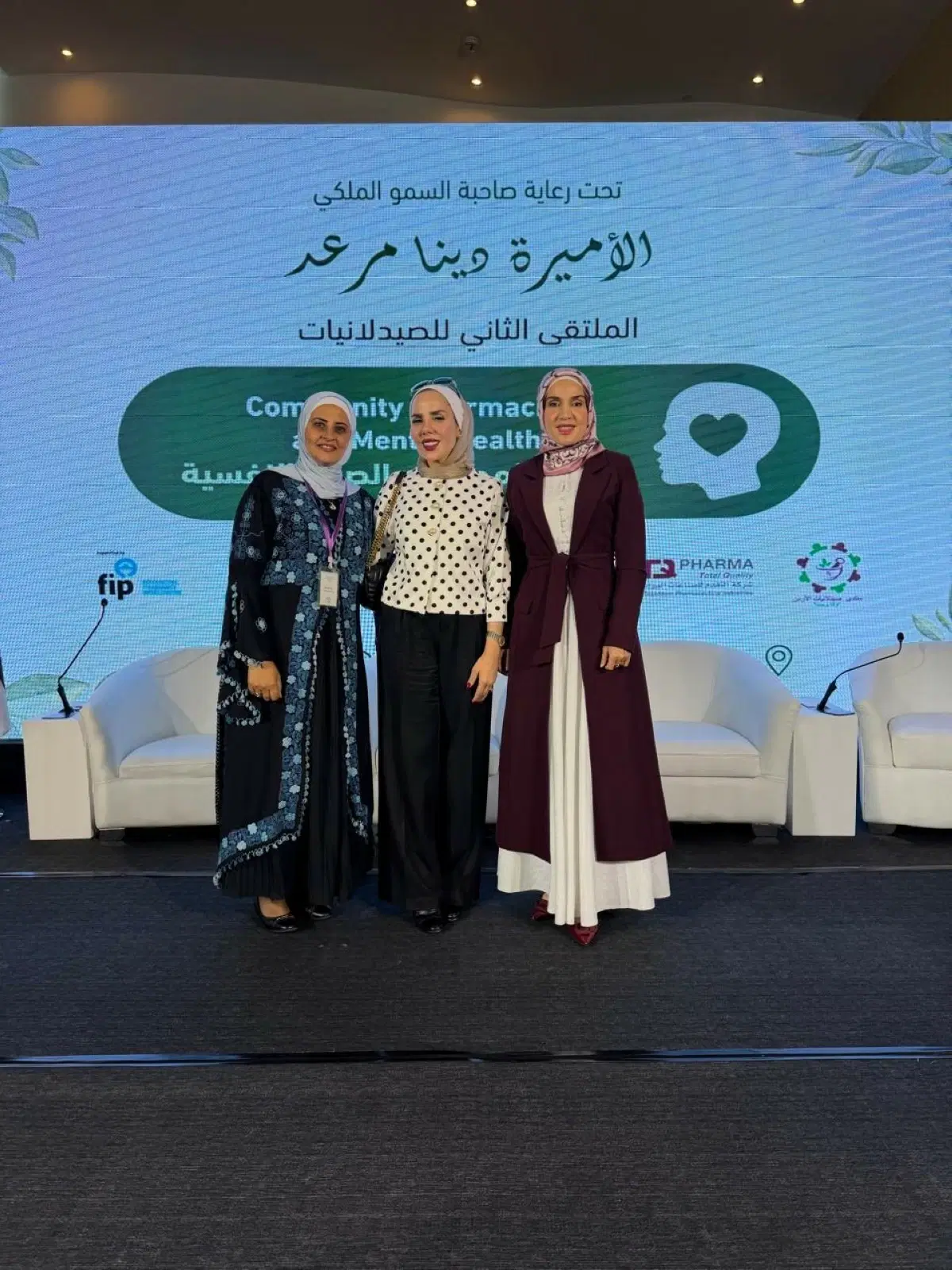
Conclusion of the 2nd Jordan Women Pharmacists Forum Titled "Community Pharmacists and Mental Health"
Amman6 min read
Share
The proceedings of the 2nd Jordan Women Pharmacists Forum concluded under the title "Community Pharmacists and Mental Health". The forum was held last week under the patronage of Her Royal Highness Princess Dina Mired, with broad participation from official, professional, and academic representatives to discuss the role of the community pharmacist in supporting mental health and promoting the safe and rational use of medicines.
Her Royal Highness Princess Dina Mired emphasized the importance of rethinking the role that community pharmacies can play as an essential access point for healthcare and mental health services, stressing the importance of governance, coordination, and cooperation among various relevant stakeholders to ensure the delivery of comprehensive, patient-centered care.
Her Royal Highness also pointed to a number of international experiences and practices that have repurposed the role of the community pharmacist within the mental health system, enhancing the utilization of the pharmacy's location, accessibility, and the trust the pharmacist enjoys in the community. She underscored the importance of leveraging international expertise and adapting it to suit the Jordanian context.
The forum's opening featured welcoming remarks by the Director General of the Jordan Food and Drug Administration (JFDA), Prof. Dr. Rana Obeidat; the President of the Jordanian Association of Psychiatrists, Dr. Alaa Al-Faroukh; Dr. Rami Sobeih, General Manager of Jordan River Pharmaceuticals; and the Jordan Women Pharmacists Forum gathering, delivered by pharmacist Maram Jamal Al-Haj Ahmed. This was followed by the distribution of honorary shields.
Dr. Obeidat emphasized that elevating the level of healthcare requires the integration of roles and the exchange of expertise among various stakeholders, noting that mental health is an integral part of the holistic concept of health.
Obeidat pointed out that the community pharmacist plays a pivotal role in supporting mental health and promoting the safe use of medication, being one of the first professionals patients turn to for health and pharmaceutical advice. She explained that their responsibility ranges from ensuring the proper and safe use of medication to observing indicators related to psychological stress and disorders, providing appropriate guidance, promoting the rational use of medicines, and referring patients to specialized medical entities when necessary.
Obeidat praised the distinguished role played by Jordanian women pharmacists across various fields of the health profession, their active contributions to serving patients and the community, and their roles in leadership, development, education, and scientific research. She underscored the importance of enhancing the capabilities of community pharmacists and developing their knowledge and skills in the field of mental health.
In her welcoming speech on behalf of the Jordan Women Pharmacists Forum gathering, Dr. Maram Al-Haj Ahmed expressed the forum's pride in HRH Princess Dina's patronage of the event for the second consecutive year. She noted that the forum seeks to establish Jordan's leadership in the region by opening this vital file, as a national and international task force was formed in cooperation with the Jordanian Association of Psychiatrists to translate the recommendations into a tangible action plan that effectively integrates pharmacists into the mental health system. She also thanked the partners and supporting companies, represented by Jordan River Pharmaceuticals and Al-Taqaddum Pharmaceutical Industries, for supporting this distinguished event.
The forum commended the active role played by the Jordanian Association of Psychiatrists, represented by its president Dr. Alaa Al-Faroukh, in supporting efforts aimed at developing the mental health system in Jordan and enhancing cooperation between psychiatrists and pharmacists.
Dr. Al-Faroukh's participation in the forum, alongside a number of specialists from the association, served as a model for open professional cooperation between the medical and pharmaceutical sectors. It contributed to enriching the discussion on psychotropic drug governance, improving access to care, and enhancing cooperation between physicians and pharmacists in dealing with patients.
Furthermore, the association's participation in the panel discussions, scientific sessions, and workshops reflected its readiness to develop this cooperation into a practical and sustainable partnership, particularly in the areas of early identification of psychological cases, referral, crisis management, and the safe use of psychiatric medications.
This cooperation stems from the importance of integrating the roles of various health professions to enhance patient access to appropriate care while safeguarding their safety and dignity.
In the panel discussions, moderated by Dr. Maryam Dajani, Head of the Scientific Committee and Project Coordinator, participants discussed the topic of "Psychotropic Drug Governance: Between Availability and Control." They addressed the balance between ensuring patient access to the psychiatric medications they need and protecting patients and society from the risks of misuse, dependence, and addiction. They also discussed the relationship between regulatory bodies, physicians, pharmacists, security agencies, and the community, and the importance of building a participatory system that leverages field information and expertise.
The second panel discussion, titled "Community Pharmacist Training: From the Classroom to the Frontlines," focused on developing the competencies needed by community pharmacists to address mental health issues, starting from university education and practical training to continuous professional development and referral pathways. This ensures the pharmacist's ability to recognize risk indicators, provide counseling, and identify cases requiring specialized medical intervention.
The forum also included specialized scientific sessions on mental health, psychiatric emergencies, psychotropic drugs, and addiction, in addition to regulatory frameworks, policies concerning controlled substances, and assessing their risks to mental and public health. Two workshops were also held on suicide prevention and crisis recognition in community pharmacies, as well as non-pharmacological treatments for mental disorders.
Project coordinator Dr. Maryam Dajani announced that a multi-sectoral task force core will be formed, including the Jordan Food and Drug Administration, the Ministry of Health, the Anti-Narcotics Department, the Jordan Pharmacists Association, the Jordan Medical Council, faculties of pharmacy, and the Association of Psychiatrists, reflecting the trend toward building a national partnership that transcends the boundaries of a single profession.
She also confirmed that the Jordan Women Pharmacists Forum gathering has prepared a draft mental health guide for community pharmacists, aimed at establishing a practical framework for the pharmacist's role, defining competencies, practices, patient management pathways, and medication dispensing. This runs parallel to the development of a specialized mental health training program for community pharmacists within the continuing professional development track, with aspirations to gradually develop it into a specialized track in community mental health for pharmacists.
The forum concluded by emphasizing that promoting community mental health requires shifting from viewing the pharmacy merely as a place to dispense medicine to seeing it as part of the healthcare network. The success of this transition depends on clear governance, institutional cooperation, specialized training, effective referral pathways, and genuine partnership among various sectors.