Al-Kharabsheh and members of the Energy Committees in the Senate and House of Representatives inspect the copper and gold mining project in Abu Khusheibah
Amman10 min read
Share
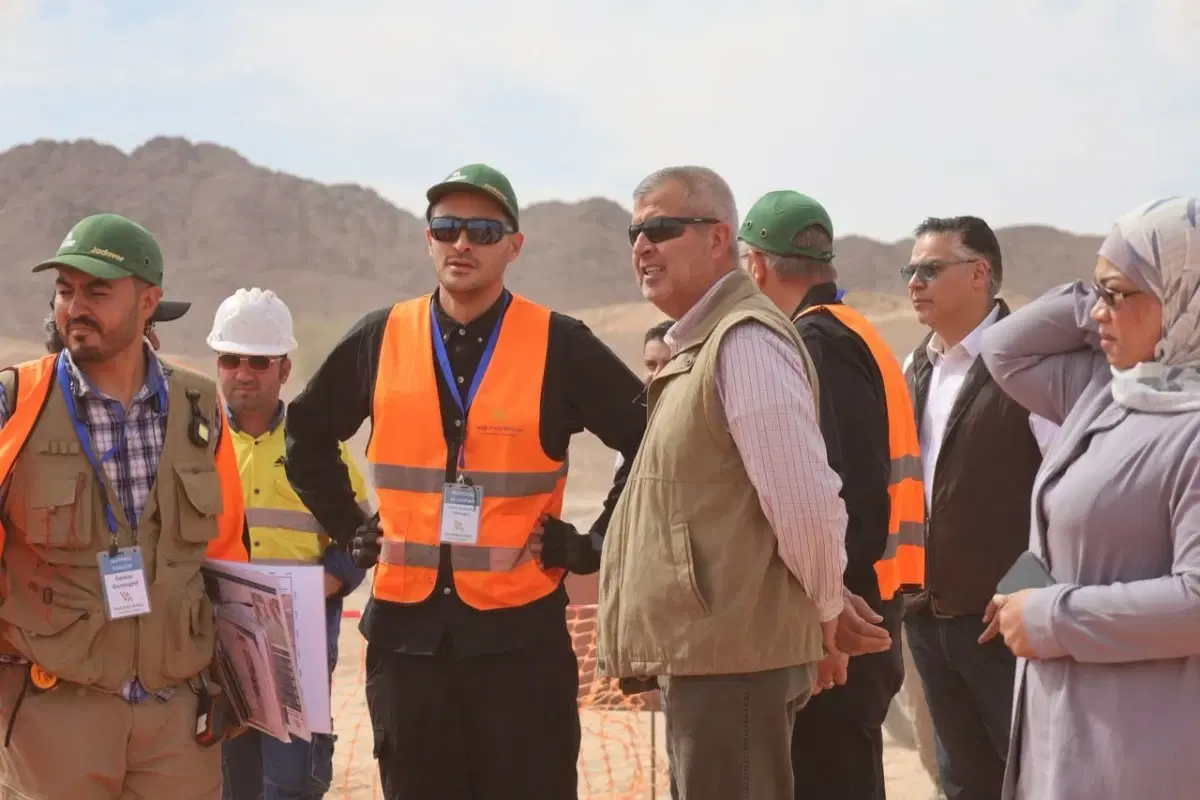
Minister of Energy and Mineral Resources, Dr. Saleh Al-Kharabsheh, inspected on Monday, accompanied by a number of members of the Energy and Mineral Resources Committees in the Senate and the House of Representatives, the project for mining and developing copper and associated minerals in the Abu Khusheibah area in the south of the Kingdom, which is being implemented by the Wadi Araba Minerals Company, to review the progress of exploration works, the progress made in implementing the project, and the stages of establishing the pilot production plant.
The visit was attended by the Chairman of the Energy and Mineral Resources Committee in the Senate, Engineer Farouk Al-Hiyari, the committee rapporteur Mamdouh Nabas, and committee members Adham Al-Shishani and Daifallah Al-Qallab, in addition to the committee secretary Samir Hawarat and Mohammed Al-Masri from the media.
Also participating from the House of Representatives were Engineer Khader Bani Khaled, Engineer Jamal Qammoh, Engineer Iman Al-Abbasi, and the committee secretary, Engineer Ahmed Al-Laimoun.
The visit began with a meeting at the company's field camp, during which a technical presentation on the project and its implementation stages was given, including a review of the results of geological studies, exploration and drilling works, and mineral resource estimates, in addition to future plans for developing the project and establishing facilities for processing copper ore and associated minerals.
Al-Kharabsheh emphasized that the Abu Khusheibah project represents one of the promising strategic projects in the mining sector, noting that the development of copper ore and associated minerals comes within the framework of the government's efforts to maximize the utilization of national mineral wealth, enhance the mining sector's contribution to the Gross Domestic Product (GDP), attract investments, and provide job opportunities, in line with the objectives of the Economic Modernization Vision.
Al-Kharabsheh stressed the importance of the expected economic return from the project, whether in terms of government revenues or direct and indirect job opportunities, as well as its role in stimulating economic and service sectors related to mining, and enhancing investment and development opportunities in the southern regions of the Kingdom.
He pointed to the importance of gradually transitioning from exploration stages to evaluating mineral resources and preparing economic feasibility studies, leading to commercial production, according to scientific and technical foundations and approved international standards, in a way that ensures the optimal exploitation of natural resources and achieves added value for the national economy.
Al-Kharabsheh explained that the copper exploration and development agreement signed with the Wadi Araba Minerals Company is the first of its kind in the Kingdom, stressing the importance of continuing to implement exploration and development programs in accordance with the executive agreement and approved work plans.
For his part, the General Manager of Wadi Araba Minerals Company, Hani Al-Asmar, reviewed the most prominent results of the technical works carried out by the company, noting that previous exploration studies included geological, geochemical, and geophysical surveys, remote sensing works, drilling trenches and exploration wells, and conducting the necessary laboratory tests and metallurgical experiments to evaluate copper and gold ore in the project area.
He explained that the preliminary studies of mineral resources showed different estimates according to the evaluation methodologies used, as the company's internal estimate reached about 20.9 million tons of ore with an average copper concentration of 0.38 percent, while an independent technical evaluation prepared by a specialized entity showed that mineral resources are estimated at about 9.4 million tons with an average concentration of about 0.50 percent, equivalent to about 46 thousand tons of copper.
He pointed out that these estimates represent the results of current studies, and that the drilling works carried out so far have covered the initial part of the areas bearing copper mineralization in the basin, which indicates the existence of opportunities to continue exploration and update mineral resource estimates in light of future drilling results.
Al-Asmar indicated that the company has made progress in implementing the exploration work program since the executive agreement came into effect last May, as the works completed during the current month of October included the analysis of 659 geochemical samples, the implementation of 53 exploration trenches, and the drilling of 65 wells, in addition to conducting laboratory and metallurgical experiments that included extraction and leaching tests using various techniques.
Al-Asmar pointed out that the company attaches importance to strengthening its partnership with the local community, providing training, qualification, and employment opportunities for the people of the region, in addition to supporting local suppliers and services and adhering to the requirements of environmental sustainability and social responsibility.
He added that the work plan for the next phase extends over 24 months and includes the implementation of a drilling program that includes more than 120 exploration wells using diamond core drilling, with the aim of expanding the scope of the studied areas, improving three-dimensional geological models, and raising the level of confidence in the classification of mineral resources, leading to the preparation of a final feasibility study for the project.
Regarding the pilot production plant, Al-Asmar explained that the company is working on establishing a plant to process copper ore on a pilot scale, with the aim of testing technical and metallurgical properties, determining the efficiency of processing and extraction operations, and providing the operational data necessary to design the future commercial production plant.
He pointed out that the results of the preliminary metallurgical tests showed encouraging indicators for the extractability of copper from oxidized ores, especially copper-bearing minerals such as malachite and chrysocolla, as some laboratory tests showed extraction rates exceeding 99 percent under specific operating conditions, which requires completing experiments on a larger scale to verify the efficiency of processing and its economic feasibility.
He added that the company has identified a number of sites that contain extractable copper ore, with preliminary estimates indicating the presence of about 400 thousand tons of ore in the targeted sites with an average concentration of nearly 1 percent, providing an initial base for studying pilot operation and future expansion.
The field tour included a visit to the construction site of the pilot production plant, where the Minister and members of the parliamentary delegation reviewed the stages of construction works, ore stockpiling plans, and proposed processing units, and listened to an explanation about the stages of pilot operation and its technical and economic objectives.
The delegation also visited the exploration drilling sites in the second and third sectors of the project area, reviewed the diamond core drilling works and the extracted samples, and listened to a technical explanation about the nature of the mineralization, geological structures, ongoing exploration programs, and their role in developing geological models and updating mineral resource estimates.
On the economic side, the company reviewed the initial perceptions of the expected returns from the project, including government revenues from royalties, taxes, and other financial contributions, as the company's preliminary economic estimates indicated that the government's share of total profit might range between 48 to 50 percent, with the emphasis that these estimates are linked to production, price, and cost assumptions and are subject to updating in light of the results of the final feasibility studies.
For his part, the Chairman of the Energy Committee in the Senate, Senator Engineer Farouk Al-Hiyari, emphasized during the tour the importance of expanding investment and mining projects in various regions of the Kingdom, noting that this visit comes to follow up on the progress of work in the field and to stand on the latest developments in exploration and prospecting works carried out by the Wadi Araba Minerals Company, especially in copper and gold ores, which constitute a main pillar of natural wealth in Jordan.
Al-Hiyari explained that advancing the mining sector directly reflects the strategic objectives of the "Economic Modernization Vision," which gave mineral wealth and extractive activities top priority to raise added value and stimulate economic growth.
The committee members praised the efforts made by those in charge of the Wadi Araba Minerals Company and the national cadres working in the field, appreciating the volume of achievement attained in the project.
They affirmed the Council's keenness to provide all forms of legislative and oversight support to overcome obstacles for investors and accelerate the pace of transition from the exploration stage to actual production, in a way that ensures maximizing the benefit from national resources and achieving sustainable development in the region.
For their part, the members of the Energy Committee in the House of Representatives emphasized the importance of following up on the implementation of mining projects and standing on their development stages, noting the role of these projects in strengthening the national economy, providing job opportunities, and stimulating investment in the governorates, and the necessity of adhering to technical and environmental requirements and achieving optimal utilization of mineral resources.
During the tour, plans related to developing national capabilities working in the mining sector were reviewed, including the project to establish a specialized vocational training center in the region in cooperation with the Vocational Training Corporation, with the aim of qualifying local cadres and providing them with the technical skills necessary to work in mining activities and related industries.
The visit concluded with a meeting during which the company's future plans were reviewed and the priorities of the next phase were discussed, including completing drilling and exploration works, updating mineral resource estimates, completing environmental, technical, and economic studies, and developing the pilot production plant in preparation for moving to the subsequent stages of the project.
The visit was attended by the Director of the Geology and Mining Directorate from the Ministry of Energy and Mineral Resources, members of the Technical Advisory Committee (TAC) concerned with following up on the work of the Wadi Araba Minerals Company, in addition to the Director of the Media Unit and the media team at the Ministry.
For their part, members of the Energy Committee in the House of Representatives emphasized the importance of following up on the implementation of mining projects and monitoring their development stages, noting the role of these projects in strengthening the national economy, providing job opportunities, and stimulating investment in the governorates, as well as the necessity of adhering to technical and environmental requirements and achieving optimal utilization of mineral resources.
During the tour, plans related to developing national capabilities working in the mining sector were reviewed, including a project to establish a specialized vocational training center in the region in cooperation with the Vocational Training Corporation, with the aim of qualifying local cadres and equipping them with the technical skills necessary to work in mining activities and related industries.
The visit concluded with a meeting during which the company's future plans were reviewed and the priorities for the next phase were discussed, including completing drilling and exploration work, updating mineral resource estimates, completing environmental, technical, and economic studies, and developing the pilot production plant in preparation for moving to the subsequent stages of the project.
Participating in the visit from the Ministry of Energy and Mineral Resources were the Director of the Geology and Mining Directorate, members of the Technical Advisory Committee (TAC) concerned with following up on the work of the Wadi Araba Minerals Company, as well as the Director of the Communication and Media Directorate and the ministry's media team.