7 hours restore an amputated leg after an accident in Aqaba
Speed of transport and preservation of the limb raised the chances of successful reattachment
Amman5 min read
Share
Two hours remained during which an amputated leg was in the waters of the Gulf of Aqaba before it was retrieved and the journey began, extending hundreds of kilometers to Amman. Between the amputation and reattachment, time and the method of preserving the limb were decisive factors in the possibility of restoring life to it.
After transferring the injured Mustafa to Abdul Hadi Hospital in Amman, he underwent an operation that lasted about seven hours to reattach the leg. Today, about eight days after the surgery, blood circulation has returned to the limb and sensation is beginning to appear in the fingers.
However, the journey to restore movement is still in its early stages, as doctors confirm that judging motor functions requires time and recovery of nerves and tendons, followed by rehabilitation and physical therapy.
Mustafa, an Egyptian expatriate who has been working in Aqaba for about 18 years, recalled for «$» the moment he realized his leg had detached from his body, saying that his exit from the water and not seeing his leg made him believe that his life as he knew it had stopped.
He said: “I said, life has stopped,” before the picture changed after he woke up from the operation and discovered that the doctors had managed to reattach his leg.
Days after the surgery, Mustafa confirmed that he began to feel the leg again, and that sensation returned to parts of it, while full recovery of movement still requires time.
Vascular surgery consultant Dr. Jean Shishani explained to «$» that when the medical team was informed of the accident, they assumed a high probability that the amputated limb might not be suitable for reattachment, especially since the accident occurred in Aqaba, and the time required to rescue the injured person and transport him to Amman.
He explained that the injured person arrived within about six hours, while the amputated limb was well preserved and cooled, noting that several factors increased the chance of attempting to reattach it, including the fact that the injured person is young and does not suffer from chronic diseases, and that the amputation occurred at a single level, in addition to the fact that the amputated part was not damaged.
He pointed out that the “golden period” in cases of complete amputation is usually less than six hours, but good preservation of the limb by cooling may extend the period during which an attempt to reattach it can be made to about 10-12 hours.
According to Shishani, the leg's stay in the sea for about two hours was not the only factor determining its fate, as the assessment of the tissue condition and the method of preserving it after retrieval and the time until surgery were key elements in making the decision.
Orthopedic and joint surgery consultant Dr. Malek Ghonimat explained to «$» that the operation took about seven hours, starting with the fixation of bones using external fixation, before moving on to reattaching the arteries and veins to restore blood flow to the limb.
He continued that after confirming the return of blood flow, orthopedic surgeons proceeded to suture the tendons, muscles, and nerves.
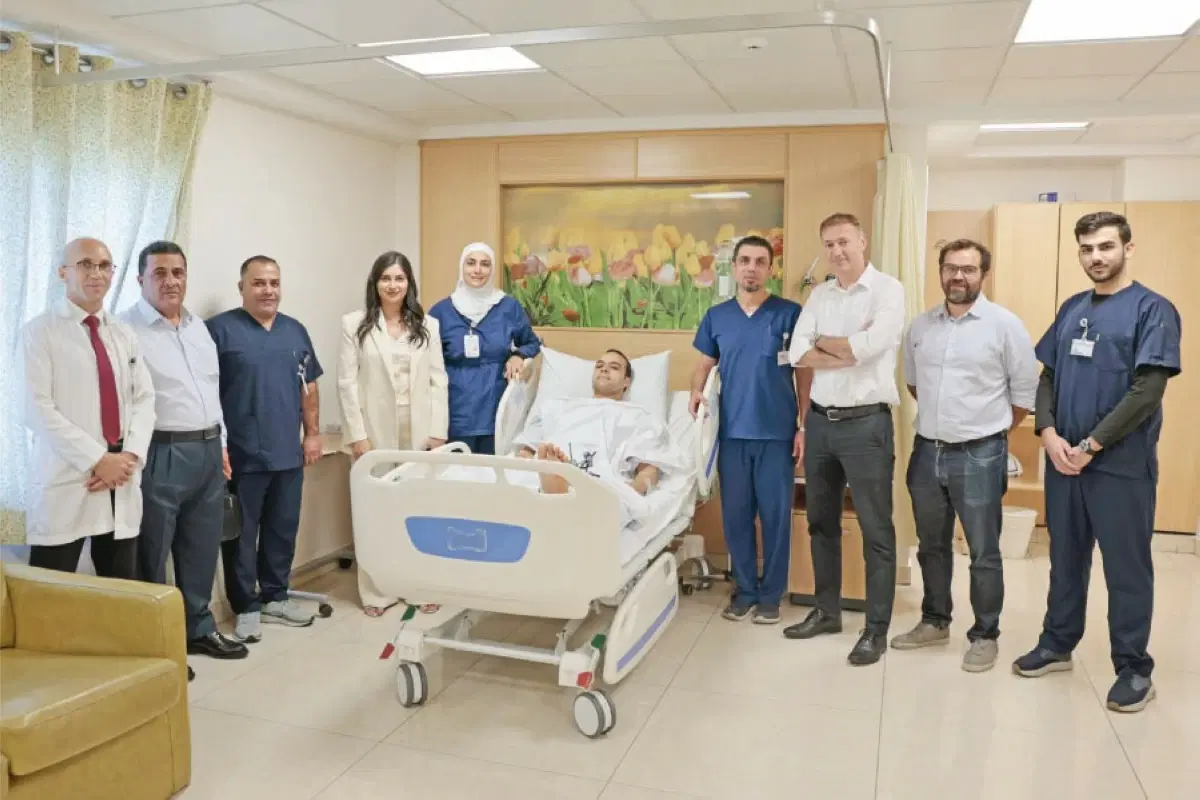
In addition to Ghonimat, the operation was participated in by vascular surgery consultants Dr. Jean Shishani and Dr. Mohanad Jaloukh, and anesthesia consultants Dr. Mohamed Saleh and Dr. Tariq Al-Bourrini, as part of a medical and nursing team prepared for the operation.
Ghonimat pointed out that one of the most important things to monitor after reattaching the limb is the continuation of blood circulation and the absence of wound infections, explaining that the circulation after about eight days was “excellent,” and the condition of the skin and wound is reassuring so far, noting that the indicator that gave the medical team more optimism appeared on the fourth day, with the beginning of the return of sensation to the toes.
He confirmed that it is not possible at this stage to determine when Mustafa will be able to walk, explaining that the sutured tendons need to heal and return to their function, while the nerves need a longer period to recover.
After that, the physical therapy and rehabilitation phase begins, in which physical therapy specialist Dr. Sahm Al-Othamneh participates, as part of a treatment journey that may take time before assessing the extent of the limb's recovery of its functions.
In return for the long recovery journey, Mustafa today bears an indicator that he did not imagine in the initial moments of the accident, as he pointed out that he can feel his leg and lift it, while the doctors continue to monitor the circulation and the development of sensation day by day.
Ghonimat emphasized that the way the amputated limb is handled in the first minutes and hours may affect the chance of its reattachment, explaining the need to place it in an insulated bag and preserve it cooled, without direct contact with water or ice.
He confirmed that two key factors increase the chances of success of such operations: the speed of transporting the injured person and the amputated limb, and preserving the limb in the correct medical manner.
Between the moment Mustafa thought his previous life was over, and the gradual return of sensation to his leg, the final functional result still requires time, but the most difficult step has been achieved: restoring circulation and preserving the limb after reattachment.