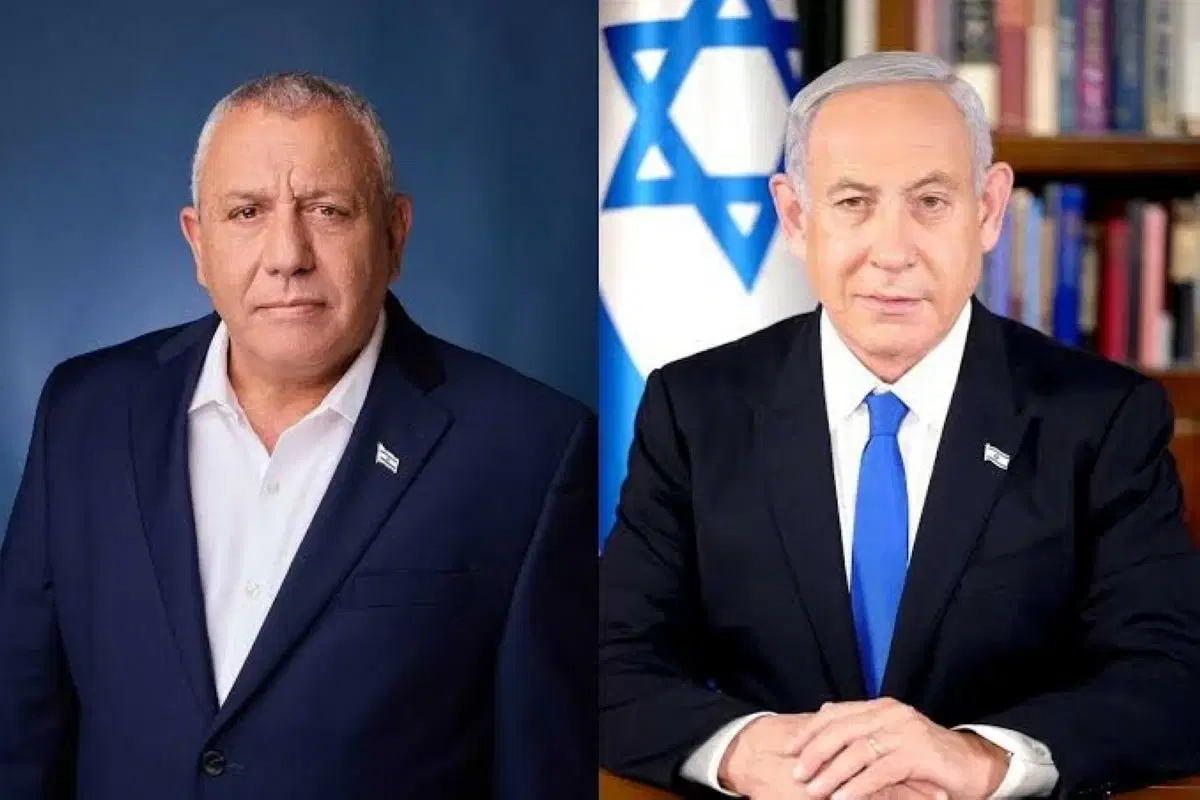
Nine days before the 26th Knesset elections, political competition in Israel is transcending the traditional confrontation between Benjamin Netanyahu's camp and his opponents, focusing instead on the identity of the figure capable of leading the alternative and ending the Prime Minister's rule.
In this context, Gadi Eisenkot is seeking to reshape the electoral battle, leveraging the failures of the "change camp" in the 2022 elections and betting on attracting voters from within the right, rather than merely redistributing votes among opposition parties.
Eisenkot's strategy is based on turning the election into a competition between major forces, thereby reducing the chances of small parties draining votes from Netanyahu's camp or complicating the calculations necessary to form a new government.
He hopes to present himself as an alternative with a security background and institutional legitimacy, without being associated with the political and personal legacy that made some opposition leaders repulsive to segments of right-wing voters.
This approach is based on the lessons of the 2022 elections, when the fragmentation of votes contributed to weakening the change camp. According to an analysis published by Israel's Channel 12 on October 18, the failure of the Meretz and Labor parties to unite their efforts led to the waste of about 300,000 votes, equivalent to seven seats, after one of them failed to cross the electoral threshold; this bolstered the chances of Netanyahu's camp in securing a parliamentary majority.
Eisenkot is attempting to avoid repeating this scenario by pushing voters toward larger parties and reducing the influence of small right-wing forces that might fail to enter the Knesset or win seats that make coalition formation more complex. Instead of competing with his partners for the votes of the anti-Netanyahu camp, he is betting on attracting voters from the Likud itself, presenting the election as a confrontation over the identity of the next leadership.
However, this strategy faces criticism from within the opposition camp. Avigdor Lieberman described Eisenkot in a post on the "X" platform on October 15 as "Gantz 2.0," considering that his call to vote for a large party might lead to shifting votes between opposition parties rather than attracting Netanyahu's voters. He also accused him of seeking to form a government that includes Netanyahu, Aryeh Deri, and Yitzhak Goldknopf.
Conversely, Iris Leal, in an analysis published by the newspaper "Haaretz," believes that the comparison between Eisenkot and Benny Gantz ignores fundamental differences between their experiences. Gantz participated twice in governments headed by Netanyahu, which weakened his image as a decisive alternative and raised doubts about his ability to commit to a political confrontation that would end the Prime Minister's rule.
As for Eisenkot, he is trying to leverage his military background and his lack of association with a similar experience of alliance with Netanyahu to present himself as an acceptable option to segments of Likud voters.
He hopes that they will be able to support him without feeling that they are moving to a political camp hostile to them, also relying on his Moroccan roots and his ability to address segments of the right-wing base.
These bets are gaining importance in light of the Likud's decline in opinion polls to about 18-20 seats, compared to an average of about 35 seats during the four electoral rounds between 2019 and 2020. However, the party's decline does not necessarily mean its voters will move to the opposition, as some may prefer to remain within the right if they find an alternative that possesses security experience and is not linked to traditional alliances with the left.
The calculations do not stop at the size of the parties, but extend to the possibility of forming a sustainable government. An analysis published by the "Jerusalem Post" on October 15 indicated that the total number of seats for parties opposing the continuation of Netanyahu's rule, including Arab parties and other parties, could reach about 67 seats, according to the analysis's classification. However, this figure does not guarantee the formation of a unified government, given the political differences and varying positions regarding the premiership and the composition of the coalition.
Therefore, Eisenkot is seeking to prevent Netanyahu from reaching the 61-seat threshold necessary to secure a parliamentary majority and to strengthen his position as the candidate most capable of forming an alternative government. However, his success will remain linked to his ability to reconcile different forces, not just to leading the election results.
In the event that a majority cannot be secured, Israel may enter a phase of prolonged negotiations and uncertainty. According to the scenarios presented, the procedures for tasking a candidate to form a government may take weeks, while the tasked candidate is granted an initial period of 28 days, extendable by 14 days. During this period, the new Knesset may turn into a primary arena for the struggle for influence, even before an agreement on the next government is reached.
The election of the Knesset Speaker emerges as one of the potential points of confrontation, given that his election is by a simple majority, while his subsequent removal requires the support of 90 members.
The change camp possessing 61 votes might allow it to influence the presidency of the council and the formation of committees and legislative priorities, even if it cannot quickly agree on a new government, while Netanyahu's outgoing government may continue to act as a caretaker.
In parallel, Naftali Bennett is keen to maintain a political margin of maneuver, as he has not given Eisenkot explicit support as the sole candidate for the opposition, nor has he joined Lieberman's attack on him.
This position reflects his desire to maintain an influential negotiating position, especially in light of expectations that give his party about 13-14 seats, which may make him a key partner in any coalition negotiations.
Thus, Eisenkot finds himself facing two intertwined challenges: attracting voters from within Netanyahu's camp and convincing his partners in the opposition that he is the most capable of leading the next phase. Competition between leaders of the same camp may weaken the chances of change if parties are preoccupied with undermining each other instead of expanding their base of supporters.
Eisenkot is betting on presenting himself as an alternative that combines security experience and institutional legitimacy, and is capable of changing the leadership without asking right-wing voters to abandon their political identity. However, the success of this bet will not be measured by the number of seats alone, but by his ability to turn the results into a cohesive parliamentary majority.
While he seeks to set an electoral trap for Netanyahu, the possibility of this trap backfiring on him remains if he fails to overcome the divisions within the camp he aspires to lead.