Turkey refers joint defense agreement with Saudi Arabia and Pakistan to Parliament
Agencies3 min read
Share
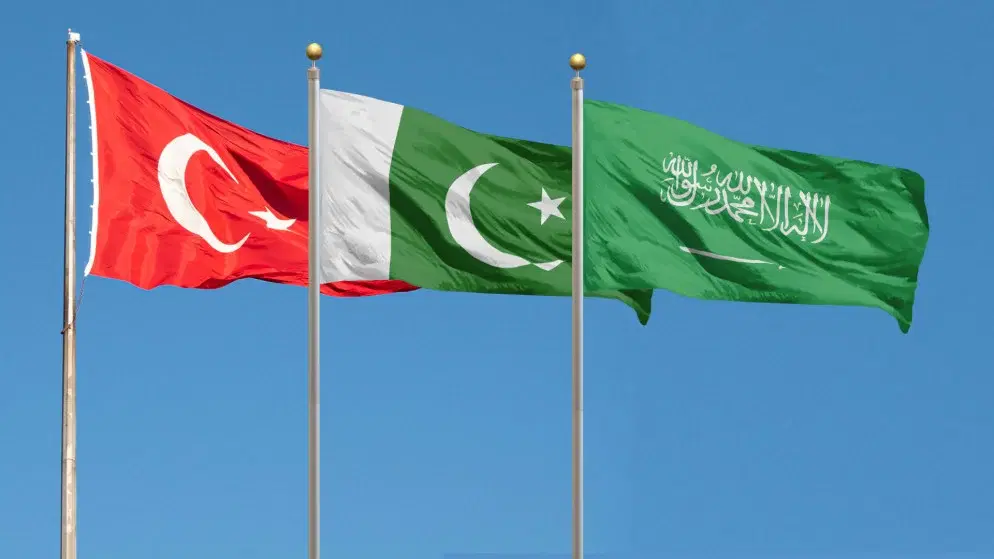
Three parliamentary sources said that Turkey has referred the Makkah Joint Defense Agreement, signed with Saudi Arabia and Pakistan, to Parliament for ratification, a move that brings Ankara closer to approving formal mutual defense obligations at a time when Saudi Arabia is facing attacks from the Houthi militia.
The three countries signed the agreement on August 7, which stipulates that any armed attack on one of its parties is considered an attack on all, without the statement issued at the time of signing specifying the nature of the military obligations for each country.
Two sources said that the Speaker of the Turkish Parliament, Numan Kurtulmuş, who is currently in Kyrgyzstan, will refer the agreement to the Foreign Affairs Committee upon his return to Turkey, while a third source stated that the committee may discuss it starting Friday. The agreement must be ratified by the Turkish Parliament to officially enter into force.
A Turkish official, who requested anonymity, was quoted as saying that Ankara's contribution is expected to be limited to military equipment, intelligence sharing, and weapons systems, adding that no decision has yet been made regarding any other form of military deployment within the alliance.
Turkish Foreign Minister Hakan Fidan, in response to a question about how his country would help Saudi Arabia face Houthi militia attacks in Yemen, said that the agreement is not an "offensive agreement," stressing that Turkey will not send troops to another country to launch attacks.
Saudi Arabia, Pakistan, and Turkey held an emergency meeting of the Political and Defense Strategic Committee of the Makkah Defense Alliance in Riyadh on Monday to discuss security developments and threats facing Saudi Arabia.
The committee decided, according to a joint statement, to move immediately to the practical implementation of collective defense obligations, and to take the necessary measures to provide the agreed-upon forces and military capabilities and ensure their rapid deployment in Saudi Arabia, in accordance with the approved arrangements and the national legislation of the three countries.
The parties affirmed that the security of each country is an integral part of the collective security of the three countries, considering that transforming the agreement into practical measures enhances readiness, military integration, and collective deterrence in the face of threats.
The three countries condemned the attempt to target Makkah and Madinah, along with the ongoing attacks targeting cities and civilian and economic facilities in Saudi Arabia, confirming their rejection of any attack or threat to the Kingdom's security and territorial integrity. Pakistan and Turkey also praised the readiness of the Saudi armed forces and their ability to confront threats.
The committee decided to appoint retired Pakistani Lieutenant General Numan Mahmood as the first Secretary-General of the alliance for a period of three years.
The three countries had agreed, during the first meeting of the Political and Defense Strategic Committee in Istanbul on August 31, to enhance defense cooperation, develop military capabilities, and establish a secretariat for the agreement in Saudi Arabia. The chiefs of staff of the three countries' armies also held a meeting in Riyadh on September 25, during which they condemned the Houthi militia's attacks on Saudi Arabia.
The agreement is based on the principle of joint defense, which stipulates that an attack on one party is considered an attack on all parties, a principle similar to that stipulated in Article 5 of the North Atlantic Treaty Organization (NATO) treaty, although the details of the obligations and mechanisms for their implementation between the three countries have not been fully announced.