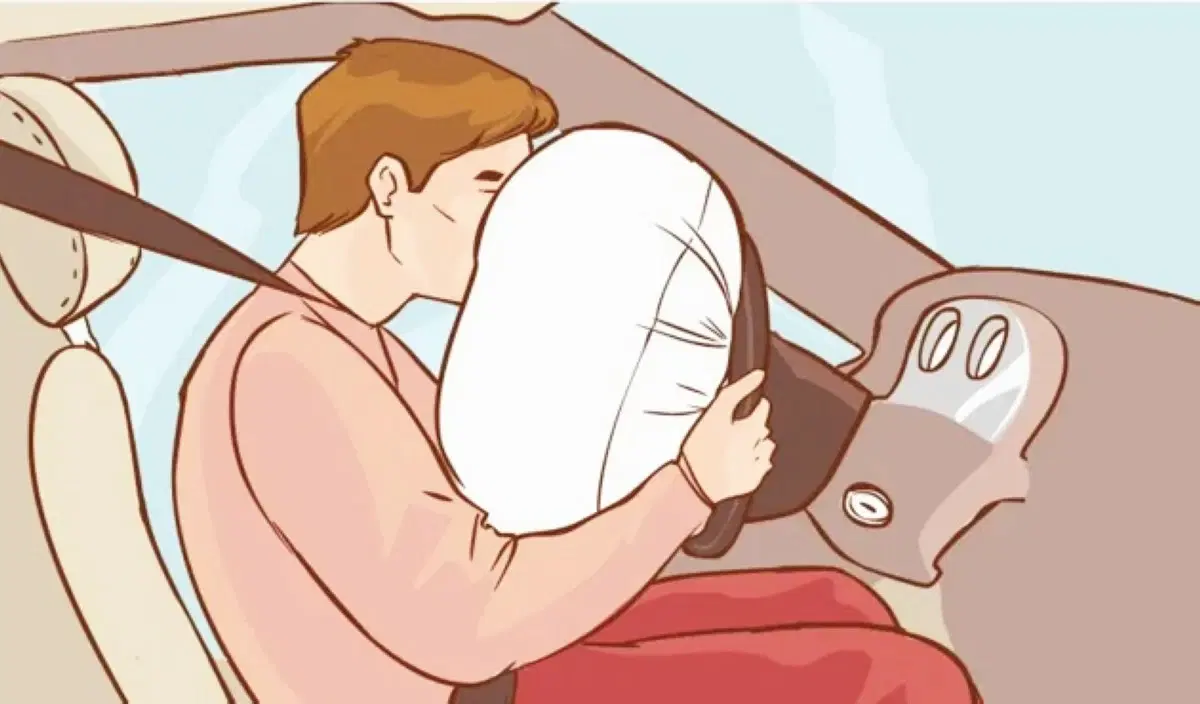
The airbag alone is not enough.. the seat belt saves your life
Monitoring5 min read
Share
Airbags are among the most prominent safety features in modern cars, as they are designed to reduce injuries and protect the head and chest in the event of accidents. However, the belief that they are capable of protecting the driver and passengers without using a seat belt may put their lives at greater risk, contrary to what many think.
Guidelines from the U.S. National Highway Traffic Safety Administration (NHTSA) and the Insurance Institute for Highway Safety (IIHS) confirm that airbags are a supplemental restraint system that works in conjunction with the seat belt and cannot replace it.
Seat belt.. the first line of defense
The seat belt plays a fundamental role in securing the passenger's body and preventing it from being thrown forward during a collision, and it also helps keep them in the proper position to receive the airbag safely.
According to estimates by the U.S. National Highway Traffic Safety Administration, seat belt use reduces the risk of death among front-seat passengers by up to 45%.
Modern belts rely on additional technologies to enhance protection, most notably belt pretensioners that tighten them within moments of detecting a collision, and force limiters that allow for a calculated amount of extension to reduce pressure on the chest and limit injuries.
How does an airbag work?
When a collision occurs that exceeds the severity the system was designed to respond to, sensors send a signal to the control unit to activate the airbag, which inflates in fractions of a second.
The airbag works to absorb part of the impact force and reduce the impact of the head and chest against the steering wheel or dashboard, but it relies on the passenger remaining in a proper position to perform its function, a task that the seat belt helps achieve.
If the driver or passenger is unbuckled, their body may be thrown forward before the inflation process is complete, becoming very close to the airbag when it deploys. Given the speed and force at which they operate, this position can lead to serious injuries to the head, face, neck, and chest.
What happens when relying on the airbag alone?
Data and studies related to car accidents show that using an airbag without a seat belt does not provide the same level of protection achieved by using both systems together.
In a study published in the journal "Spine" involving about 12,700 people with spinal injuries, cervical spine fractures were recorded in 54.1% of drivers who relied on the airbag alone, compared to 42.1% of those who used the seat belt and airbag together.
According to the study's findings, relying on the airbag alone was associated with a 70% higher risk of cervical spine fractures compared to using the belt and airbag together, after adjusting for other factors that might affect the results.
Other studies have also shown that combining seat belts and airbags provides greater protection against life-threatening injuries, although injury patterns may vary depending on the severity and circumstances of the accident.
These results do not mean that airbags are dangerous in themselves, but rather clarify that using them in the way they were designed requires wearing a seat belt and sitting in the correct position.
Why is neither system a substitute for the other?
Safety features inside the car work in an integrated manner; the seat belt limits body movement and maintains the passenger's position, while the airbag provides an additional surface to absorb the impact and reduce its effect on the head and chest.
Without the belt, the body may move forward rapidly, so the airbag may not reach the passenger at the right time and position, and its deployment could become a factor that increases the severity of the injury in some cases.
Furthermore, the danger of not using a seat belt is not limited to the front seats; passengers in the back seats need it as well, as they can be injured or thrown forcefully toward other passengers in the car during a collision.
Simple steps to enhance safety
To reduce the risk of injuries in car accidents, safety guidelines recommend adhering to a number of basic measures:
Fasten your seat belt on every trip, even if the distance is short.
Adjust your seating position so that your back is against the seat, while maintaining a reasonable distance from the steering wheel and dashboard.
Ensure the belt is used correctly, with the lower part passing over the pelvis and the upper part across the middle of the chest and shoulder.
Require all passengers to fasten their belts, in both the front and back seats.
Adhere to the manufacturer's instructions regarding airbag systems and child seats, and do not place children in the front seats except in accordance with appropriate safety requirements.
Seat belt and airbag.. protection is only complete together
Despite the continuous development in safety technologies, no single measure can prevent all injuries in accidents. Seat belts and airbags remain among the most important means of reducing the risk of death and serious injury when they work together correctly.
The most important rule that every driver and passenger should remember is that the airbag is not a substitute for the seat belt, but a system that complements it. Therefore, fastening the belt before starting is not a formality, but a fundamental step that could make a decisive difference between injury and survival.