Supporting the transportation costs of 414 students from the southern Jordan Valley and enhancing transportation lines in the governorates
Amman6 min read
Share
The Board of Directors of the Land Transport Regulatory Commission approved a package of decisions and procedures aimed at enhancing public transportation services and improving the level of service in governorates and underserved areas, including supporting the transportation costs of 414 students from the southern Jordan Valley studying at Mu'tah, Al-Hussein Bin Talal, and Tafila Technical Universities, with an estimated annual cost of about 156 thousand Jordanian Dinars.
Dr. Obela Al-Washah, Director of the Communication and Media Unit and the official spokesperson for the Commission, said in an interview with «Al-Rai» that the student support program includes three public transportation lines and five vehicles, noting that the buses covered by the program will be linked to the smart transportation system, allowing for monitoring the operation and verifying the arrival of support to eligible students.
She added that the decision comes within the Commission's approach to directing public transportation services according to the actual needs of citizens and enhancing students' access to educational institutions, noting that the Board of Directors of the Commission also approved the terms and conditions for granting licenses and permits to provide passenger transportation services to underserved areas for the year 2026, based on the geospatial study prepared by the Commission.
Updating the airport line
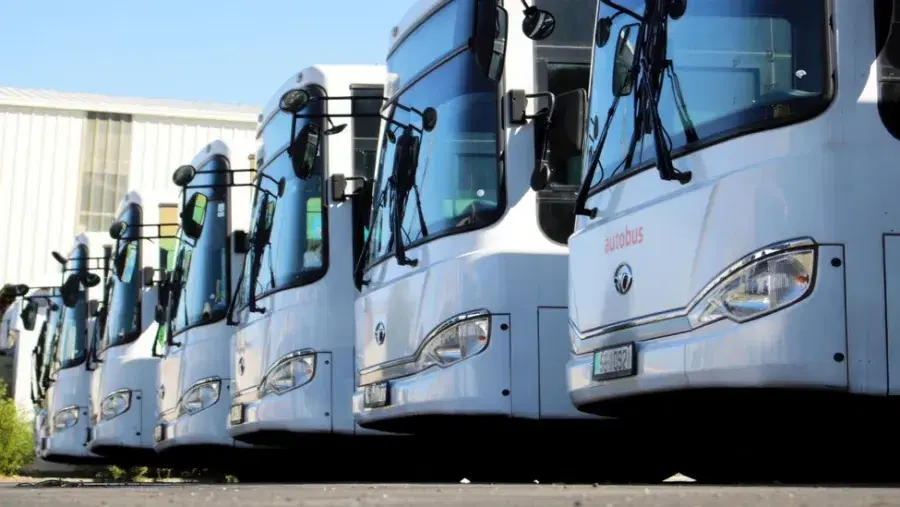
Regarding the Northern Complex–Queen Alia International Airport line, Al-Washah explained that the Commission renewed the line's operation contract for ten years, with the operation of six new buses from the 2025 model and above, equipped to serve people with disabilities, alongside the removal of current buses from service according to the approved procedures and legislation.
She confirmed that updating the line's fleet comes within the framework of raising the efficiency of the service and improving the level of transportation provided to citizens and travelers, alongside enhancing the oversight of the operation processes.
Enhancing governorate lines
Al-Washah explained that the Commission's procedures included a number of transportation lines in the governorates, so in Ajloun, it was decided to add the Applied University of Al-Balqa to the Irbid–Anjara line and enhance it with four medium buses, alongside converting one bus line to serve the Ajloun–Princess Haya Military Hospital route, and enhancing the Kufeir–Jerash line with a medium bus.
In the field of university transportation, a service was launched to transport Yarmouk University students via the «Jet» company, from the company's offices in the Seventh Circle to the university's new buildings, using three buses.
In Mafraq and Tafila, the procedures included licensing a medium bus to serve areas in the Northern Badia District, and licensing a bus to operate on the Hisa–Qutrana line, alongside organizing the lines of Mafraq, Um Al-Na'am Al-Gharbiya, and Mansheya Bani Hassan.
The procedures in Zarqa included unifying the Zarqa–Al-Kamsha and Zarqa–Al-Maidan lines into one line under the name «Zarqa–Al-Kamsha and its suburbs», with a change in the route and fare, while the Shuna Al-Janoubi–Al-Karamah line was reorganized and a company was established to organize its work.
International transportation
On the international transportation front, Al-Washah pointed out that the procedures included operating 18 buses on the Jordan–Syria line, and enhancing the Amman–Syria line with five new buses, alongside extending the operational contract of the Nshaami International Transportation Company for three years.
She added that the Commission is working to enhance electronic oversight of the international transportation sector by obligating buses to install electronic tracking devices, which contributes to monitoring the movement of buses and improving the level of operational compliance.
Al-Sarhan: Supporting transportation is an investment in human capital
For his part, financial and economic expert Dr. Muhammad Al-Hadab Al-Sarhan confirmed that the decision to support the transportation costs of about 414 students from the southern Jordan Valley represents a social and developmental investment in human capital, not just a support for transportation fares, due to the fact that reducing the cost of reaching the university alleviates the burden on families and helps students continue their education and enhances equality of opportunity between the governorates.
Sarhan said that the importance of the decision goes beyond the value of the fare provided, as transportation is directly linked to the student's ability to regularly reach their university, especially in remote areas that suffer from limited transportation options.
He explained that educational equality is not only related to university admission, but also to the student's ability to reach and continue in the educational institution, pointing out that the distance and high transportation cost can be an additional burden on families and students.
He pointed to World Bank estimates indicating that transportation deficiencies in Jordan cost the economy about 3 billion dollars annually, or at least 6 percent of the gross domestic product, reflecting the importance of public transportation as a factor affecting productivity, education, employment, and access to economic opportunities.
He added that reducing transportation expenses allows families to redirect part of their income to other needs, such as food, books, communications, housing, and educational needs, which enhances the social impact of the program, especially for low- and middle-income families.
Transportation and local development
Sarhan pointed out that improving transportation services between governorates and universities contributes to reducing the impact of geographical distance on educational opportunities and linking investment in education to local development policies, considering that the student who receives education and training represents a future human resource for their family, governorate, and the national economy.
He pointed to the importance of linking the buses covered by the support to the smart transportation system, considering it a tool for oversight and measuring the efficiency of spending, as it allows for monitoring the operation and verifying the arrival of the service to the beneficiaries.
He emphasized that the program's evaluation should be based on clear indicators, including student attendance, the number of trips implemented, the percentage of service use, the cost of operation, and the extent to which transportation contributes to reducing problems associated with difficulty reaching universities.
He called for any future expansion of student transportation support programs to be based on actual need, prioritizing areas suffering from distance, weak transportation alternatives, and high university access costs, and benefiting from the geospatial study prepared by the Commission in identifying underserved areas.
He explained that the experience of supporting student transportation in the southern Jordan Valley can be evaluated after one academic year by measuring its impact on student attendance, service use, and operational cost, before expanding similar programs in other areas.
He confirmed that developing transportation lines connecting governorates to universities, hospitals, and centers of economic activity represents part of the infrastructure supporting development and helps citizens access education, work, services, and markets.
Sarhan concluded by affirming that the success of transportation support programs is not measured by the number of beneficiaries alone, but by their ability to alleviate burdens on families, enhance student attendance in education, improve access to opportunities, while ensuring the allocation of public spending towards the most needy groups and areas.