Abu Al-Samn: Taking urgent measures to ensure public safety and facilitate citizens' movement
Creating alternative routes and installing warning signs and traffic diversions to serve road users
Follow Al Rai

Minister of Public Works inspects the damage and directs immediate repairs
Abu Al-Samn: Taking urgent measures to ensure public safety and facilitate citizens' movement
Creating alternative routes and installing warning signs and traffic diversions to serve road users
Field efforts to remove debris and construct additional drainage outlets
Minister of Public Works and Housing, Engineer Maher Abu Al-Samn, inspected yesterday, accompanied by the Ministry's Secretary-General for Technical Affairs, Engineer Waseem Al-Adwan, a number of roads and sites that were damaged as a result of the heavy rains and floods witnessed by the Kingdom. He examined the extent of the damage and the necessary measures to address it on the ground, directing the adoption of urgent measures to ensure public safety and facilitate the movement of citizens.
Abu Al-Samn began his tour by inspecting the Rama Bridge on the Rama-Jofah road, which the Ministry closed after the worsening of cracks that appeared in it as a result of the floods and heavy rains, in order to preserve the safety of road users.
The Minister examined the structural condition of the bridge, which is one of the old facilities previously included in the Ministry's plans for reconstruction, directing the acceleration of the implementation of the necessary procedures to remove it and reconstruct new concrete box culverts, according to a hydrological study that takes into account the quantities of flowing water and the nature of the site, in order to ensure the efficiency of floodwater drainage and the safety of the road in the future.
In the context of mitigating the effects of the road closure on the residents of the area, it was agreed during the tour to construct a temporary side road adjacent to the existing bridge, including water drainage culverts and concrete protections, to secure local traffic and pedestrians until the reconstruction of the bridge is completed and the road is permanently opened.
Abu Al-Samn emphasized the need to accelerate the implementation of the temporary road, while continuing to divert truck and transit vehicle traffic to alternative routes, including the Al-Kafrain road, the Baptism Site road, and the Al-Rawda road, according to the available traffic paths.
He also directed, in coordination with the Balqa Governorate and the Al-Aghwar District Administration, to expedite the removal of services and facilities located on the bridge, as the concerned authorities have already begun the work of removing the services suspended on it, in preparation for starting demolition and reconstruction works.
He also inspected the Siyagha road connecting Madaba and Rama, which witnessed soil erosion in various locations within the governorates of Madaba and Balqa, as a result of the flow of rainwater and floods from the surrounding mountainous areas.
The Minister directed the immediate commencement of addressing these sites, including removing dirt and erosion from the road surface, and cleaning the entrances to rainwater drainage culverts, to ensure the smooth flow of water and prevent its accumulation on the road.
He also instructed the implementation of precast water drainage culverts in new locations where the floods showed the need to create additional drainage outlets, especially in areas where new paths for water flow coming from the highlands were formed, which enhances the road's ability to absorb water flows and reduces the recurrence of damage in the future.
During the tour, Abu Al-Samn emphasized that the safety of citizens and road users is at the forefront of the Ministry's priorities, stressing the need for a rapid response to damage caused by weather conditions, and intensifying field work and coordination with relevant authorities to complete the required treatments as quickly as possible.
He pointed out that the Ministry, through its technical and field staff, continues to monitor the conditions of roads and water facilities, and take the necessary measures to address damaged sites, while giving priority to sites that affect public safety and the movement of citizens, and working to implement sustainable engineering solutions that enhance the efficiency of infrastructure and its ability to deal with exceptional weather conditions.
For his part, the media spokesperson for the Ministry of Public Works and Housing, Omar Al-Maharmah, said that the Ministry dealt with 17 reports resulting from the state of atmospheric instability that affected the Kingdom from the morning of the day before yesterday, Tuesday, until the dawn of yesterday, Wednesday, in addition to a number of routine reports related to lighting and traffic signal malfunctions and traffic accidents.
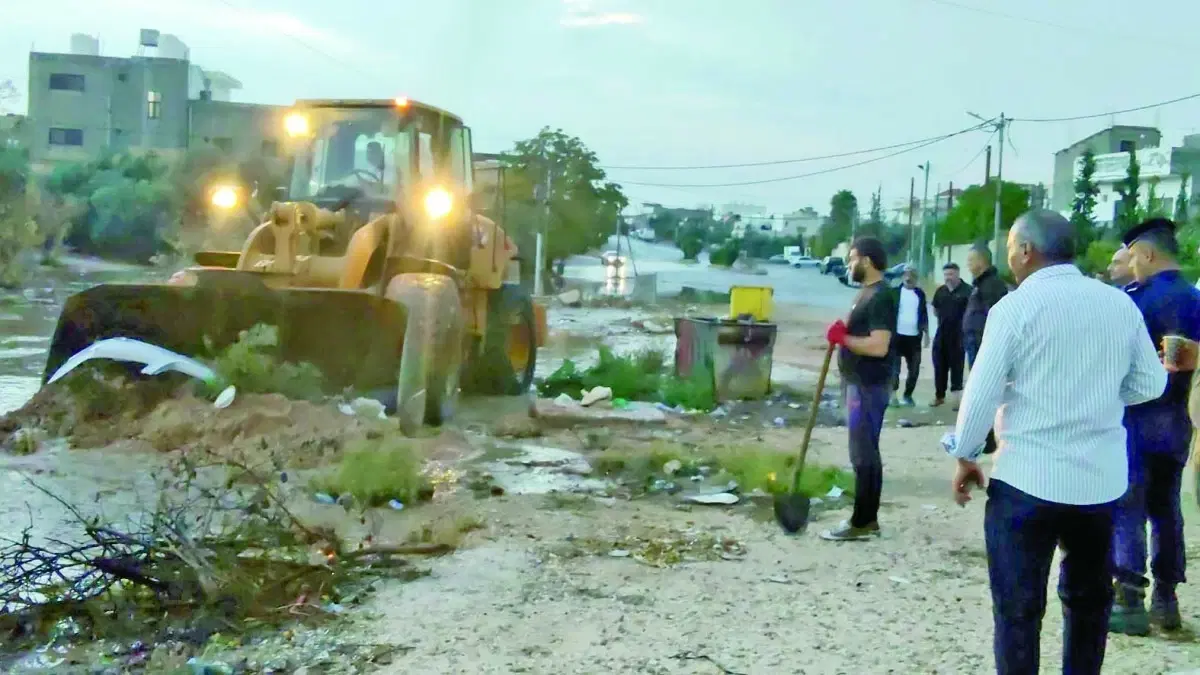
Al-Maharmah confirmed that the reports included rising water levels and the erosion of dirt, silt, and stones on a number of roads, noting that the Ministry's staff dealt with them in the field using the necessary machinery, according to the nature of each case, in addition to carrying out inspection tours around the clock to monitor the condition of roads and culverts within their areas of jurisdiction.
He explained that the Irbid Public Works Directorate dealt with rising water levels on the Petra road towards Ramtha in three locations extending for a distance of approximately 400 meters, where two loaders and a government grader were moved, a side trench was created to drain water, and the adjacent service road was closed as a precaution to preserve the safety of citizens until the works are fully completed.
The staff also dealt with rising water levels and the erosion of dirt and stones on the Al-Aghwar – North Shuna road in the Waqqas area, and dirt and silt erosion in the Mashari, Sheikh Hussein Bridge, and Koura areas, where the erosion in the Koura area extended for a distance of about 200 meters, while water was drained at the Bir Al-Sulta culvert in Ramtha using a government loader.
In the governorates of Ajloun and Jerash, the staff dealt with dirt erosion in three locations on the Anjara and Kufranja roads, which were cleaned using a government grader and loader, while a traffic accident on the Amman – Jerash road in the Al-Sail area led to the fall of three lighting poles and a partial and temporary closure of the road.
In the Balqa Governorate, the observations included dirt erosion on the side of the road at the beginning of the Wadi Shuaib road before the purification station, due to culverts belonging to the Water Authority, where it was dealt with by the concerned authorities, in addition to minor silt and stone erosion on the Mahis – Wadi Shuaib road, and dirt and stone erosion on the Saqi Mahis road, where the specialized staff dealt with it using a government loader and the staff of the Mahis office.
In the capital, the Ministry's staff dealt with dirt erosion on a dirt road that hindered traffic, using a backhoe loader for support and in cooperation with the Naour Public Works office staff, in addition to the accumulation of muddy dirt at the Adasiya market, where the site was cleaned using a government grader.
In the Southern Ghor, structural subsidence in the Rama Bridge necessitated its complete closure in cooperation with the administrative governor, and the creation of alternative routes and the placement of warning signs and traffic diversions to serve road users, until the reconstruction works are completed.
In Madaba, the staff dealt with dirt erosion in several locations on the Siyagha road and a collapse in one of the locations on the same road, where a government grader and loader were sent accompanied by the field team, and the observation was addressed and the road was reopened.
Mud erosion on the Malouki – Al-Laiban road in Tafilah Governorate was also cleaned using a government grader.
Al-Maharmah pointed out that the Ministry also dealt with rising water levels and silt erosion on the Sweimeh road near Samara Mall and on the Hotels road in three locations, where a government loader and a rented one were moved, while the Ma'an and Petra regions witnessed flood flows without recording any observations, in addition to floods in Wadi Araba in the Aqaba Governorate without recording any observations.
The Ministry of Public Works and Housing closed the Rama – Jofah road at dawn yesterday, Wednesday, from the Rama signal located on the Dead Sea road to the Jofah roundabout on the Al-Kafrain – Jofah road, to preserve public safety, after cracks appeared in the bridge located on the road, which worsened due to the very heavy rains witnessed by the area.
The Ministry explained that the existing bridge is very old, and was originally included in the Ministry's plans for reconstruction, due to its age and the existence of previous defects and cracks in it, which did not pose a danger to road users, but the heavy rains witnessed by the area led to the worsening of these cracks, which necessitated closing the road to preserve the safety of citizens.
The Ministry confirmed that it will begin taking the necessary immediate measures to reconstruct the water drainage facility above the valley in implementation of its previous plans in this regard, stressing that it will work to accelerate the implementation procedures and complete the required works as quickly as possible, to reopen the road to traffic as soon as the works are completed and its safety is ensured.
Furthermore, the municipalities of Irbid Governorate, the Public Works Directorate, and the Joint Services Council dealt during the recent weather condition with many observations and reports resulting from heavy rainfall in a short record time that exceeded the capacity of some culverts and water drainage channels.
The head of the Greater Irbid Municipality Committee, Imad Al-Azzam, confirmed that the municipality did not record any observations or hot spots within Irbid during the depression, as they were dealt with and addressed previously during the summer. He explained that early preparations for this year's winter began months ago; where rainwater drainage projects worth more than two million dinars were implemented, in addition to the continuation of work on paving roads, improving their flow, and opening new manholes for water drainage, which contributed to ending all the problems and observations that the municipality's streets were suffering from.
He pointed out that the field teams were present in the field 24 hours a day to follow up on weather forecasts, weather conditions, and road emergencies.
For his part, the head of the Joint Services Council in Irbid, Engineer Firas Al-Hazaymeh, confirmed that the council's staff were deployed in the field in cooperation and coordination with all municipalities, especially the peripheral municipalities in the Al-Aghwar region.
Al-Hazaymeh explained that the crews worked in cooperation with the Tabaqat Fahl Municipality to open the main street, and also dealt with observations and developments in the Sheikh Hussein Bridge area, noting that all teams and emergency crews are still in the field to follow up on any emergency.
In a related context, the Irbid Governorate Public Works Directorate dealt with the repercussions of the rising rainwater levels on Al-Batro Street, where technical teams opened the side medians to drain the heavy water that flowed in large quantities.
Bani Obeid Municipality: Dealing with observations in Al-Sarih and Al-Husn due to heavy rainfall and silt
In the Bani Obeid Municipality, field crews dealt with several observations and reports in the Al-Sarih and Al-Husn areas. The head of the Bani Obeid Municipal Committee, Riyad Al-Jarrah, confirmed that the intensity of the rain exceeded the capacity of the rainwater drainage channels, noting that the rain was accompanied by mud and dust as it was the "first winter" of the season, as technical and field teams worked to address all blockages and ensure the restoration of water flow.
Muath bin Jabal Municipality: Dealing with landslides and silt in the Waqqas area
In the Muath bin Jabal Municipality, Engineer Moatasem Al-Omari confirmed that the municipality's crews had been dealing since yesterday until this afternoon with several observations, most of which were concentrated in the "Waqqas" area near the shrine of the noble companion.
Al-Omari explained that the crews dealt with power outages and the drifting of dirt and silt on the main road and other secondary roads, and they were fully reopened. He indicated that the intensity of the rain, which came in record time, exceeded the capacity of the culverts due to them pulling in silt; the culverts were open and working well, but the accumulation of mud led to their closure.
For his part, the Mayor of Tabaqat Fahl, Engineer Hamza Al-Momani, stated that the municipality's crews continued to work continuously for long hours until the morning to remove mud and silt from various areas. Al-Momani pointed out that the area witnessed a strong rainstorm that caused some trees to be uprooted in the Sheikh Hussein Bridge area, where field teams dealt with the uprooted trees, opened main and secondary roads, and removed silt to ensure the safety of traffic.
For his part, the head of the Ramtha Municipal Committee, Engineer Jamal Abu Obaid, stated that the amounts of rain were heavy and came in an exceptionally short time, which caused the capacity of the pipe culverts to be exceeded in some locations.
He pointed out that the municipality's crews dealt immediately with 24 complaints and observations during the depression by activating the emergency plan and deploying 6 field teams that worked around the clock, supported by the necessary machinery such as loaders, suction pumps, and water drainage vehicles to address accumulations and reports.
Abu Obaid indicated that the field tours included monitoring valley streams and gathering sites, in addition to dealing on the ground with 4 cases of rainwater entering citizens' homes and yards and addressing them within the available capabilities.
Meanwhile, specialized committees from the Northern Jordan Valley Agriculture Directorate began field inspection work to assess the damage caused by the winds and heavy rains witnessed in the district's areas yesterday evening, Tuesday, to the agricultural sector.
The Director of Agriculture for the Northern Jordan Valley, Engineer Mohammed Al-Naeem, told the Jordan News Agency (Petra) that three committees, including two committees to assess plant production damage and one committee for the livestock sector, began their field work to determine the extent of the damage sustained by the agricultural sector as a result of the recent wave of winds, floods, and rains.
He indicated that initial indicators show that the damage is concentrated more in the areas of Al-Mashare', Sheikh Hussein, and Wadi Al-Rayan, as it affected vegetable areas planted in greenhouses and open fields, irrigation networks, and citrus trees.
Furthermore, the Agricultural Extension Department at the Mafraq Governorate Agriculture Directorate called on farmers and livestock breeders to take the necessary preventive measures to deal with floods and sudden rains, emphasizing the importance of early preparation to protect plant and animal production and reduce losses that may result from weather fluctuations and rainwater accumulation.
Agricultural Engineer Tariq Al-Nawafleh, from the directorate's extension department, confirmed that prior preparation for the rainy season is a fundamental factor in protecting crops, agricultural facilities, and barns, stressing the need to follow weather forecasts, avoid traveling in low-lying areas and flood paths, and seek the assistance of the competent authorities when needed.
Regarding plant production, he stressed the importance of opening drainage channels to ensure the rapid disposal of excess water and avoiding its stagnation for long periods around plant roots, due to the damage this may cause to crops and soil. He called for monitoring soil erosion and treating it when necessary, inspecting plants after rainfall to ensure the safety of roots, stems, and leaves, removing damaged parts, and using appropriate preventive measures against fungal and bacterial diseases.
Regarding livestock production, he called for ensuring the integrity of barn roofs and facilities, repairing any leaks or damage, raising barn floors and walkways or preparing them to allow water drainage and prevent its accumulation, in addition to providing elevated and dry places to protect animals from wetness and cold.
Know more about this story?Send us a tip
Ask about this report — answers stay grounded in its text.