Population Census: A National Responsibility and a Foundation for Future Planning
Amman8 min read
Share
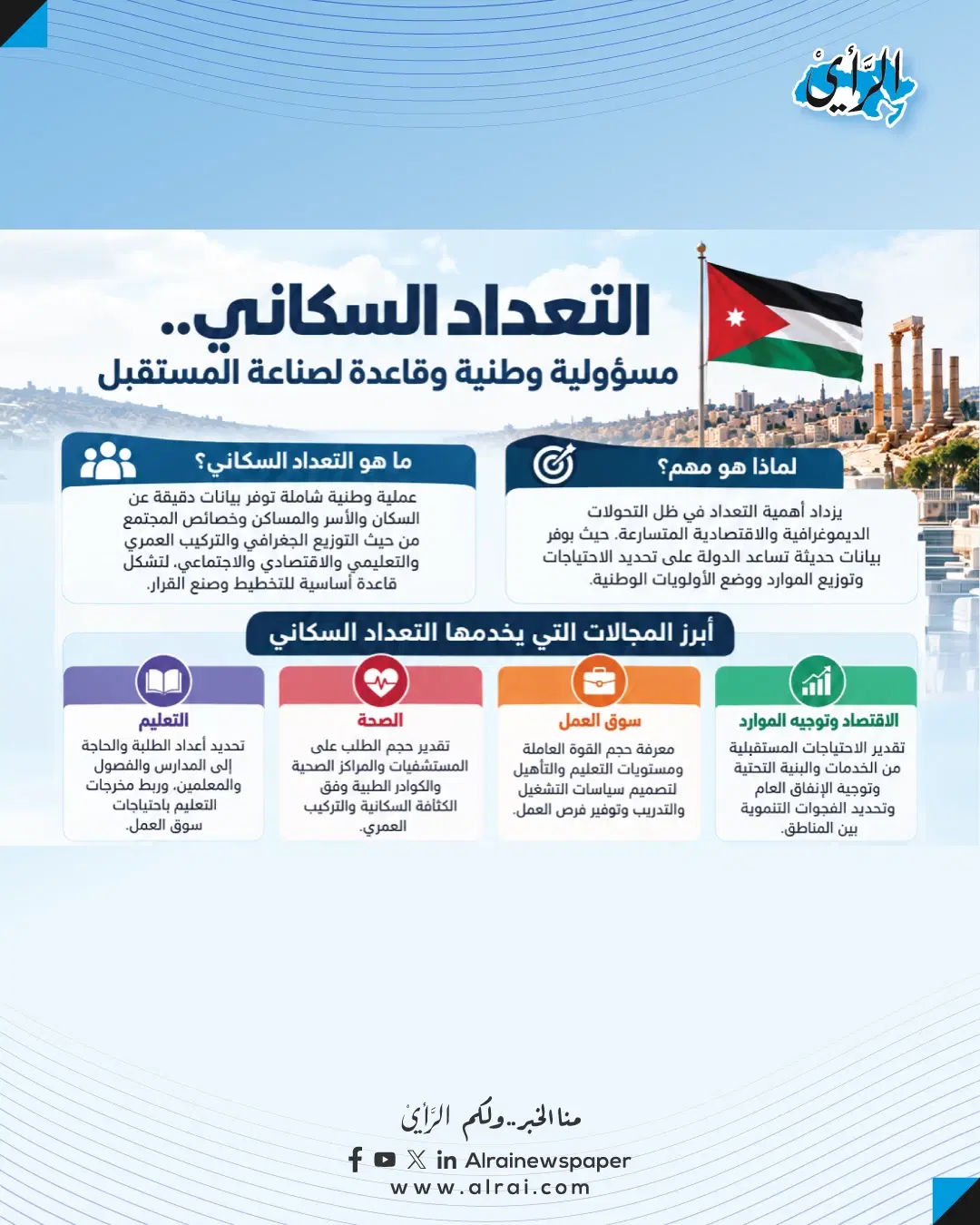
The comprehensive population census is one of the most important tools that countries rely on to understand the reality of their societies and plan for their future, as it provides an accurate picture of the population size, geographical distribution, age and social, economic, educational composition. In Jordan, the general census of population and housing is of particular importance at this stage, in light of the demographic, economic and social transformations that society has witnessed, and the accompanying changes in population growth, migration, urbanization, labor market and demand for services. Planning for the next phase requires a modern database that reflects the population reality and helps the state determine needs and direct resources according to national priorities.
Knowing the community as it is
The census is essentially a national process that goes beyond counting the population, as it provides comprehensive data on the population, households, housing and community characteristics, including geographical distribution, age groups, education and employment levels, social status, family size and housing patterns. This information gives decision-makers a more accurate picture of reality and helps them move from general estimates to evidence-based planning.
The census also allows for monitoring the transformations taking place in society when comparing its results with previous censuses and surveys, which helps to understand trends in population growth, migration, urbanization and changes in family size and population age structure. This is increasingly important with the rapid demographic and economic transformations that make modern data a key factor in setting national priorities.
Economy and resource allocation
The quality of economic planning is linked to knowledge of the population size, characteristics and locations, as this data helps to estimate demand for services, goods and infrastructure, and determine future needs for schools, hospitals, roads, water, electricity, transportation and housing.
Census results also help direct public spending to areas that need more investment, measure development gaps between governorates, districts and different regions, as well as estimate the size of the workforce, dependency rates, consumer demand and future employment needs.
Education, health and labor market
In the education sector, population data helps to know the number and distribution of children and youth, and determine the need for schools, classrooms, teachers and educational facilities, as well as planning for university, vocational and technical education and linking education outputs to labor market needs.
In the health sector, census data helps to determine the demand for health services and the distribution of hospitals, health centers, medical and nursing staff according to population density and age structure. It also helps to estimate future needs and keep pace with demographic changes that affect the nature of health care demand.
As for the labor market, the census provides a picture of the working-age population, education and qualification levels, economic participation and geographical distribution of the workforce, which helps to design more realistic employment and training policies and determine areas that need more job opportunities and investment.
Housing and infrastructure
Census data is directly linked to housing policies and urban planning, as knowledge of the number of households, household sizes, housing patterns and population distribution helps to estimate demand for housing units and plan for new areas and related infrastructure.
It also helps to identify areas experiencing rapid population growth and needing expansion of road, transportation, water, sewage, electricity and communication networks. When population data is combined with digital maps and geographic information systems, it is possible to build a more accurate picture of current and future needs.
Social protection and local development
Population data provides a basis for designing social protection programs and identifying categories and areas that need more support, and helps to improve the targeting of social programs and increase the efficiency of aid and service distribution.
This data is even more important at the local level, as governorates and municipalities need accurate knowledge of population numbers, characteristics and needs to prepare realistic development plans and link budgets and projects to the actual priorities of local communities.
Investment and demographic changes
The benefits of the census are not limited to the public sector, as the private sector and investors need information on market size, population distribution, age, household patterns, education and employment levels to make decisions related to setting up projects and expanding economic activities. Reliable data provides a better basis for market research and reducing uncertainty for investors.
The census also helps to understand demographic changes, migration, urbanization and changes in family size and population age structure, which affect education, health, housing, employment and social protection. This understanding allows for early preparation for future needs, including those of young people, the elderly and different social groups.
Water and food security and crisis management
When a country knows its population size, growth trends and distribution, it becomes better able to estimate its future needs for water, energy and food, and link population data with economic and environmental data to build more accurate planning scenarios.
The importance of data is also evident in crisis and emergency management, as knowledge of the population size, composition, household and housing distribution helps to prepare evacuation and disaster response plans and identify areas and groups most in need of intervention.
Census and digital transformation
The population census is undergoing a transformation with technological development, as government databases, administrative records, geographic information systems, digital maps and artificial intelligence can be used to analyze data and discover demographic patterns and changes more quickly.
The value of the census increases when its results are transformed from numbers issued every few years into a database that can be updated continuously through administrative records and specialized surveys, while maintaining privacy and information security.
From census to decision
The real value of the census is revealed when its results are translated into measurable policies, budgets, projects and programs. If the data shows population growth in a certain area, this should be reflected in education, health, transportation, housing and water plans, and if it shows an increase in the number of young people, planning should respond to this through education, training and employment opportunities.
In this sense, the census becomes a tool to guide the state towards the future and help it move from dealing with results after needs appear to preparing for them in advance.
The citizen is a key partner
In this equation, the citizen is at the heart of the census process, as the accuracy of the results depends largely on the accuracy of the information provided by households and individuals. Providing accurate data about household members, housing, education, employment and required characteristics helps to paint a more accurate picture of the community and the region in which the citizen lives.
Citizen cooperation with census teams is not a formality, but a direct national participation in building the information base on which the state's plans will rely in the coming years. Every accurate piece of information can contribute to estimating the need for a school, health center, road, water network, transportation service or development project.
Therefore, citizens' response to census teams and the accurate and clear provision of required information is a key element in the success of the process. Raising awareness of the importance of the census is a shared responsibility involving the media, municipalities, civil society institutions and public and private institutions, alongside the official implementing authorities.
The benefit goes to the citizen
The citizen is the ultimate beneficiary of the quality of the census, as accurate data helps the state improve planning for schools, health centers, roads, water, transportation and housing, develop employment and training programs, direct investments and support local development.
Not all of these results may be immediately apparent, but they form the basis for decisions and projects that affect citizens' lives for years. Therefore, when a citizen provides accurate information, they are not just providing a number, but contributing to determining needs, prioritizing and building a more realistic picture of the region in which they live.
The census is a national investment
The comprehensive population census represents a national investment in knowledge and decision-making, as the return from the information it produces extends to various sectors for many years. Decision-making based on accurate data helps to improve spending efficiency, set priorities and reduce resource misallocation, and gives the government, private sector and researchers a common base for understanding society.
In conclusion, the population census is a mirror of Jordan and the basis for planning its future. Its importance extends from knowing the population size to understanding their characteristics, needs and distribution, and from planning for daily services to building long-term economic and social policies.
The census is a shared national responsibility; its success starts with an institution that plans, implements, verifies, and protects data, and is completed by a citizen who cooperates and provides the correct information. The census is not just numbers collected and placed in tables, but national knowledge that transforms into planning, and planning transforms into policies, and policies transform into services, projects, and opportunities. Every citizen who participates in this process contributes to building a more accurate image of Jordan and helps in shaping a future that is more capable of responding to the needs of society.