Census accuracy supports the equitable distribution of development and services among regions
Census data reduce the cost of feasibility studies and investment decision risks
Follow Al Rai

From counting the population to reshaping the state's priorities
Census accuracy supports the equitable distribution of development and services among regions
Census data reduce the cost of feasibility studies and investment decision risks
Data privacy is a condition for increasing trust and accurate participation
The General Census of Population and Housing does not stop at recording population numbers or enumerating households and dwellings, but goes beyond that to form a national knowledge base on which the state relies in reading population, social, and economic transformations, determining the actual needs of regions, and converting data into policies, programs, and services more closely linked to reality.
In this context, Dr. Tamara Al-Zaraqat, a researcher in political science at the Center for Strategic Studies at the University of Jordan, confirmed that the population census cannot be reduced to being a statistical process limited to population numbers, pointing out that its importance in the political context is that it forms a national knowledge base that helps the state understand society and make accurate and reality-connected general decisions.
She said that politics in its broad sense goes beyond the subject of elections or representation, and includes the making of public policy, which goes through a gradual institutional path starting with the collection of data through the population census, then converting them into information, analyzing them, and reading their trends to reach options, policies, and programs that are feasible.
Al-Zaraqat explained that the importance of the census is reflected in providing this path with accurate data, pointing out that the clearer and more comprehensive the information, the greater the ability of institutions to formulate priorities and arrange them more objectively, and to direct services, investments, and programs according to the real needs of the population in the governorates and villages.
She pointed out that the data help, for example, to reveal the increase in the number of households in a certain area, or the increase in the number of young people, or urban expansion in a specific area, which provides practical signals to the decision-maker about the need for greater infrastructure, schools, health centers, transportation networks, and public services.
She added that the census thus transforms from a mere process of counting numbers into a tool that helps transition from reaction to proactive planning, and enables institutions to monitor social and developmental changes.
Al-Zaraqat pointed out that the importance of the census is also linked to the political dimension related to the legitimacy of the decision, as building policies on comprehensive, neutral, and accurate data makes them more consistent with the distribution of the population and their needs, and enhances the citizens' feeling that they are present in the calculations, planning, and decision-making process, which increases trust in institutions and investments, and consolidates the principle of equitable distribution of development, resources, services, and opportunities.
She emphasized that the population census represents an important pillar of knowledge in modern states, linking the social reality with the political decision, which gives institutions the ability to build more efficient policies based on an accurate understanding of population changes, and serves society on a clear and thoughtful basis.
For his part, economic expert Eias Al-Shuaibi confirmed that the General Census of Population and Housing is not just a process of counting individuals, but is the most important economic document produced by the state every ten years, due to the link between public spending decisions and investment plans with it, in addition to the numbers related to unemployment, poverty, and per capita income.
He pointed out that the last census was conducted in 2015, and since then planning has been based on estimates that become outdated year after year, while the population map in Jordan during the past decade has witnessed changes, including waves of refugees, the transition from the outskirts to the cities, and urban expansion on the outskirts of Amman, Zarqa, and Irbid, in addition to changes in the size of the family, the age of marriage, and childbearing.
Al-Shuaibi explained that the population represents the base on which most economic indicators are built, such as the unemployment rate, per capita income, poverty rate, and the number of beds per thousand citizens, and therefore these indicators become less accurate when the base is estimated.
He pointed out that the census also forms the 'sampling frame' from which samples of household surveys are drawn during the next ten years, including the labor and unemployment survey and the household income and expenditure survey, stressing that any flaw in the census is transferred to the surveys that follow it, and that the accuracy of information related to spending and consumption patterns and the standard of living is linked to the accuracy of the census.
In the field of public spending, Al-Shuaibi explained that the census helps determine the locations of building schools and hospitals and directing investments, especially in light of the limited financial space and high indebtedness, pointing out that spending in the wrong place means leaving the real need unmet.
He pointed out that the census shows where people actually live, their ages, and how they are distributed, which turns capital spending from responding to pressure into planned investment, noting the importance of this in the water and energy sectors, especially since Jordan is one of the poorest countries in the world in terms of water, and major projects in these sectors are designed for decades to come.
He also discussed the importance of the census in moving from general support to targeted support, explaining that it is not used to determine the entitlement of a specific family, because its data are confidential by law, but it draws a map showing the locations of concentrated pockets of poverty, the size of families, the conditions of their housing, and who works in them, which helps design social protection programs with higher efficiency.
In the labor market, Al-Shuaibi pointed to the importance of knowing the number of young people who will enter the labor market in the coming years, their geographical distribution, and their educational levels, as this affects the direction of vocational education, investment incentives, and targeted sectors, in addition to the importance of the age pyramid in actuarial studies for social security and estimating the cost of future health care.
He emphasized that accurate data also serve the private sector, as investors need to know the size of the market, its density, age composition, and family size, explaining that the published census data provide a public good that benefits everyone, and reduces the cost of feasibility studies and decision risks, especially for small and medium-sized companies.
Al-Shuaibi linked the importance of the census to the vision of economic modernization, decentralization, and international financing, explaining that the goals of the economic modernization vision need a correct baseline to measure progress, and that the governorate councils need fair criteria for distributing allocations, while the population provides one of the most important of these criteria.
He pointed out that Jordan, at the international level, bears the cost of hosting large numbers of refugees and non-Jordanians, and the international community requests documented numbers, noting that accurate counting strengthens Jordan's negotiating position in sharing burdens, and moves the argument from estimation to reality.
Regarding privacy, Al-Shuaibi confirmed that census data are protected by the General Statistics Law, and are used in aggregate form that does not show a specific household, pointing out that the Statistics Department has confirmed that it will not share the data with any government or non-governmental entity.
He said that a citizen's refusal to answer or provide inaccurate information affects services, as an area that is not properly counted may appear smaller in the figures, and thus receive fewer schools, clinics, and services than it deserves, stressing that accurate data is the price of fair service.
In contrast, he emphasized that the government must explain the reasons for asking questions and publicly commit to never using census data in a tax decision or determining individual entitlement, and to publish the results in a timely and transparent manner, so that the citizen sees the return on their participation, explaining that trust is built through practice, and that it is a real economic asset, as the more trust there is, the higher the quality of the data and the better the decisions based on it.
He pointed out that the cost of the census is modest compared to the size of the decisions it will guide over ten years, noting that the adoption of electronic self-counting for nearly 2.5 million households for the first time represents a step that reduces the cost and increases accuracy if used properly.
For her part, the educational supervisor at the Second Directorate of Education in Zarqa and a trainer at the General Statistics Department, Dr. Khatam Radwan, confirmed that the General Census of Population and Housing 2026 is a shared responsibility between the state and society, and not just the task of statistical researchers, but a direct contribution to building a more accurate picture of Jordan and helping decision-makers plan for a better future based on reliable data.
She said that accurate numbers are not just data collected and preserved, but the basis for sound planning, decision-making, and drawing up general policies, explaining that knowing the population numbers and their distribution helps determine the actual needs of regions for schools, health centers, services, and infrastructure, and supports directing development programs more equitably among different regions of Jordan.
Radwan pointed out that the real value of the census lies in providing a picture closer to reality for the decision-maker, in terms of population concentration areas, age groups, household and housing distribution, and the nature of population and service needs, noting that this information is used in planning for education, health, infrastructure, and services.
She explained that the General Census of Population and Housing forms the basis on which the Statistics Department relies in estimating population numbers annually and making future population projections, and that the data collected from households, after being processed, are transformed into indicators that help understand the population, social, and economic reality, and provide a basis for comparison and planning for the future.
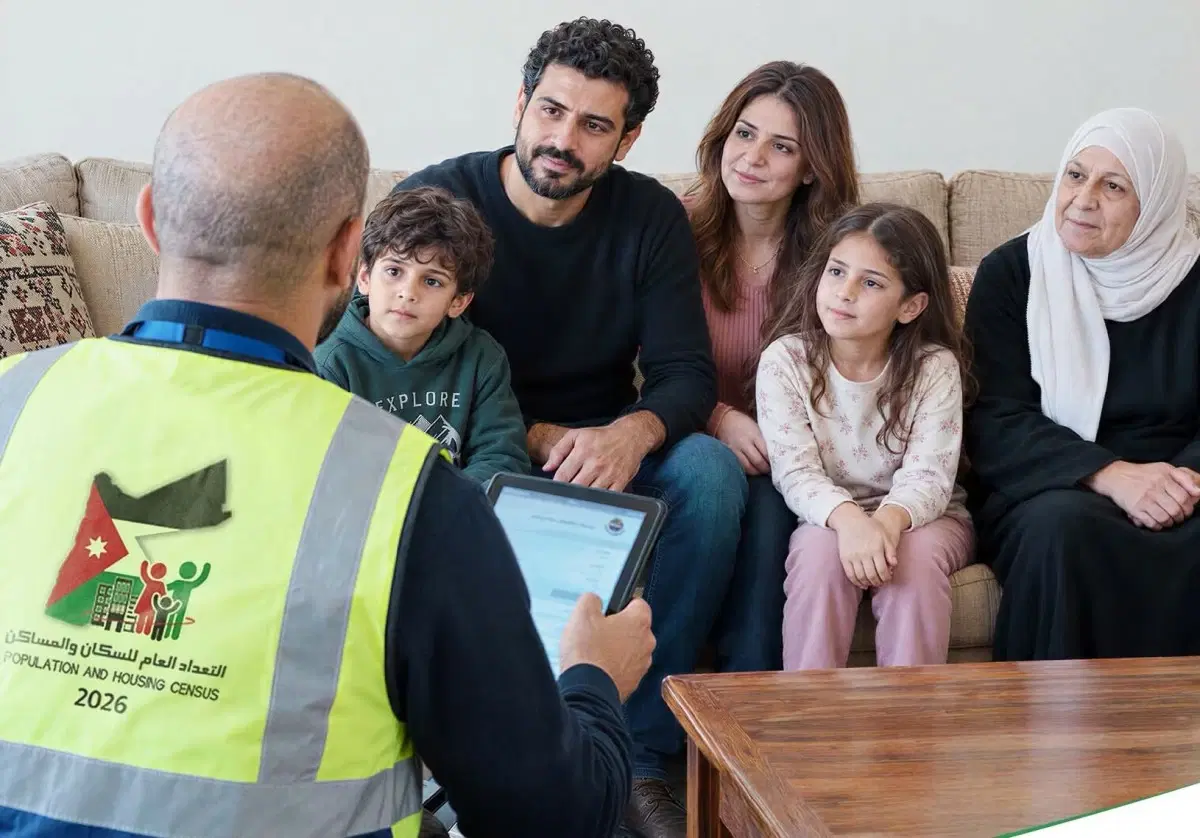
She emphasized that the cooperation of citizens with researchers is a fundamental element in the accuracy of the results, because the citizen is the source of information, while the statistical researcher can ask, record, and verify according to census procedures, but cannot know the number of family members, their characteristics, or the details of the dwelling without the answers of the relevant parties.
She added that not answering or providing incomplete information means that part of the reality may not appear in the data, pointing out that each family forms part of the national picture, and when information from all families is gathered, the Department of Statistics forms a picture of the city and the governorate and then of Jordan as a whole.
Radwan stressed that the family's response, listening to the questions in the population census form, providing clear and correct answers, and facilitating the data collection process, all reduce errors and help complete the census efficiently. Cooperation also means representing the family and the community correctly, so that their characteristics and needs are reflected in the general statistical picture.
Thus, the 2026 General Population and Housing Census stands out as a national process that goes beyond collecting numbers to building a more accurate picture of society, allowing for the reading of demographic changes, determining needs, and directing resources, services, and investments on clear bases. The participation of each family in providing accurate information forms a basic building block in the database on which planning decisions will be based in the coming years.
Know more about this story?Send us a tip
Ask about this report — answers stay grounded in its text.