Over 60,000 perform Friday prayers at Al-Aqsa Mosque
Despite strict measures imposed by the Israeli occupation
Amman7 min read
Share
11 Palestinians arrested under the pretext of entering Jerusalem without military rule permits
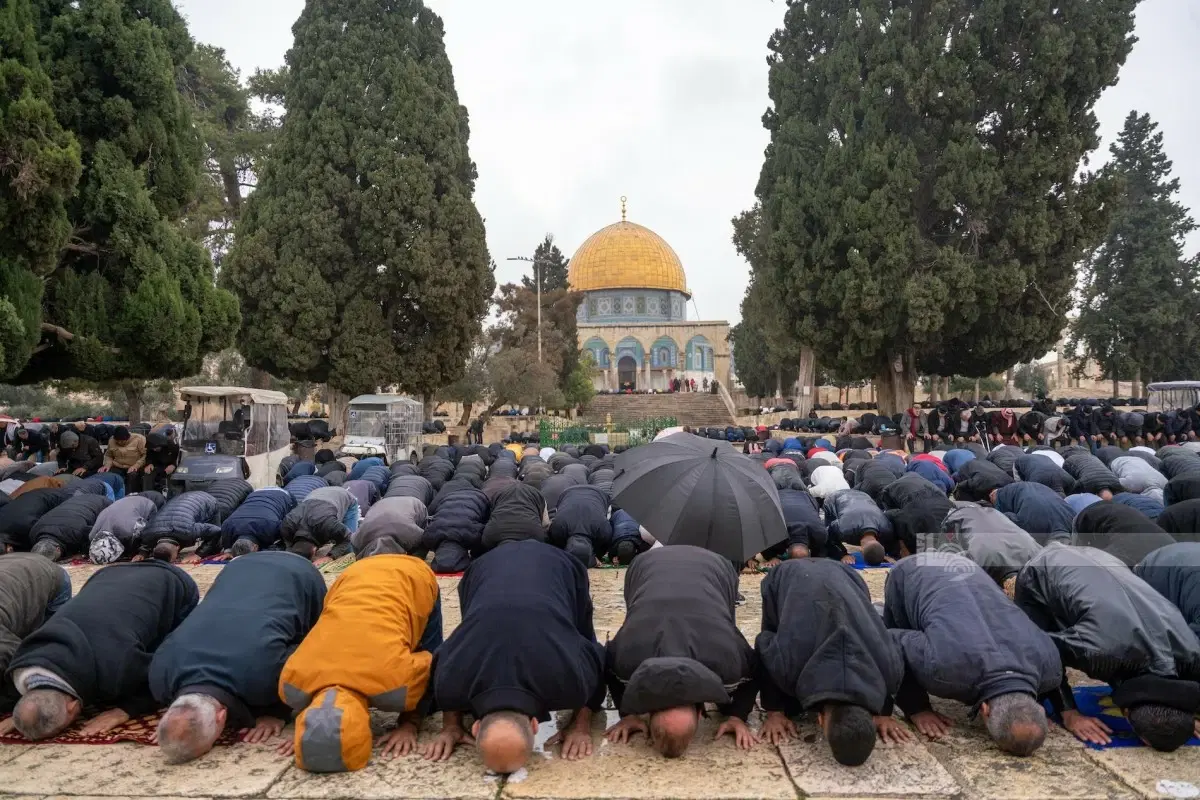
Tens of thousands of worshippers performed Friday prayers in the courtyards of the blessed Al-Aqsa Mosque, amid strict Israeli military measures imposed by the occupation forces at the entrances to the city of Jerusalem and the roads leading to Al-Aqsa Mosque, in an attempt to restrict the access of worshippers.
Occupation forces stopped and searched dozens of young men at the mosque's gates in a provocative manner, and assaulted three of them.
The Islamic Awqaf Department in Jerusalem stated that more than 60,000 worshippers managed to perform Friday prayers at the blessed Al-Aqsa Mosque, despite the strict restrictions imposed by the occupation forces on those coming from various Palestinian regions.
It added that worshippers flocked to Al-Aqsa Mosque from the early morning hours, defying the military checkpoints and iron barriers set up by the occupation forces at the entrances to the city of Jerusalem and around the Old City.
Occupation forces imposed tight security measures at the military checkpoints surrounding Jerusalem, especially the Qalandiya crossing with Al-Bireh and Ramallah, and Bilal Mosque at the southern entrance with Bethlehem, hindering the arrival of thousands of worshippers to Al-Aqsa Mosque, while preventing dozens of young men from continuing their way there after stopping them at the checkpoints and iron barriers deployed around the city and the Old City.
Eyewitnesses said that occupation forces stopped dozens of young men at the Qalandiya checkpoint north of Jerusalem, the Bethlehem checkpoint to the south, and the Hizma checkpoint, and forced them to turn back, while checking the IDs of worshippers whom they allowed to pass.
For its part, the occupation police said in a brief statement that it arrested 11 worshippers from the city of Jerusalem under the pretext of entering Jerusalem without obtaining permits from the military government.
Later, it stated that it had extended the detention of 5 of them to complete the investigation with them, including a 70-year-old elderly man.
These measures come within the context of the restrictions imposed by the occupation authorities on the access of Palestinians to Al-Aqsa Mosque, exacerbating the difficulties faced by worshippers wishing to perform their religious rituals.
Jerusalemite bodies and Palestinian factions had called in recent days to flock to "Al-Aqsa" and engage in Ribat (steadfastness) there, in the face of the occupation's attempts to impose new facts on the ground in the mosque.
In the Friday sermon, His Eminence Professor Dr. Ekrima Sabri, preacher of the blessed Al-Aqsa Mosque, addressed the difficult economic situation experienced by the occupied city of Jerusalem, warning against usury (Riba) and its dangers, and affirming its absolute prohibition in Islamic Sharia.
Dr. Ekrima Sabri began his sermon by praising and glorifying Allah, seeking His help, guidance, and forgiveness, and seeking refuge in Allah from the evils of souls and bad deeds, and the preacher reviewed a number of Quranic verses that urge the fear of Allah and being mindful of Him.
The preacher said: "Among the principles of Islamic Sharia is the obligation to seek that which is lawful (Halal) when earning a livelihood and to avoid unlawful (Haram) earnings in all their forms. Sharia has permitted numerous forms of lawful earnings such as trade, agriculture, industry, jobs, and permissible businesses, while at the same time forbidding foul earnings in all their forms, such as consuming usury, consuming the property of an orphan and disposing of it without regard for his interest, gambling, betting, fraud in sales, attacking people's properties, and consuming their money unjustly."
He added that consuming usury is considered one of the things prohibited by Islam, emphasizing "its absolute prohibition, indeed Allah the Almighty has declared war on the consumer of usury," citing the Almighty's saying: "O you who have believed, fear Allah and give up what remains [due to you] of interest, if you should be believers * And if you do not, then be informed of a war [against you] from Allah and His Messenger."
Commenting on this, the preacher stressed that consuming usury is considered one of the major sins, citing the saying of the Prophet, peace and blessings be upon him: "Avoid the seven destructive sins." They said: O Messenger of Allah, what are they? He said: "Associating partners with Allah, magic, killing the soul which Allah has forbidden except by right, consuming usury, consuming the property of an orphan, fleeing on the day of battle, and slandering chaste, believing, unaware women."
The preacher analyzed and criticized the contemporary capitalist system, saying: "The contemporary capitalist system has produced usurious transactions regulated by laws and regulations practiced through usurious banks, lending institutions, and financing companies. These institutions have used new terms to embellish falsehood; usury is called interest, usurious lending is called banking facilities, easy lending, funding ceilings, credit card lending, and comfortable installment plans. Bank accounts have come to be called fixed-term deposits, savings accounts, and other names whose basis of dealing is usurious lending and borrowing."
The preacher warned that dealing in usury harms society economically and morally, manifesting exploitation and control over debtors, saying: "Usury is one of the main causes of economic recession and inflation, and causes wealth to be concentrated in the hands of a class of the affluent who grow richer at the expense of others."
He added: "Today, usurious loans have become a malicious tool in the hands of major powers to control the decisions of weak countries, as these countries become increasingly poor and stumbling with these loans, stripped of their will and unable to make their sovereign decisions."
The preacher continued: "These loans are also used through lending institutions associated with international institutions at the individual level to keep people occupied with them, and are promoted in a way that creates the illusion that they provide assistance to needy groups while exploiting people's need to entrap them in these loans."
He added: "In addition to funding suspicious projects with a social dimension related to so-called economic empowerment of women through usurious loans aimed at dismantling families and providing economic alternatives to the family maintenance system."
The preacher touched upon some of those who deal in usury and try to justify their behavior by claiming they need money or are forced to do so, saying: "We say: Usury was prohibited even when the majority of those borrowing with usury were people in need of borrowing, and despite that, the prohibition stood. Here it must be noted that many borrowers make luxuries such as modern cars and luxurious apartments necessities, and they expand their borrowing to cover life requirements such as marriage, travel, and others, and this is considered a transgression and negligence regarding Sharia rulings, stripping blessings and tranquility from homes."
Sheikh Sabri said: "While usury was prohibited in our Sharia, it opened the way for legitimate alternatives of benevolent loans (Qard al-Hasan), installment sales, and partnerships to meet the various needs of people." He cited the Almighty's saying: "Who is it that would loan Allah a goodly loan so He may multiply it for him many times over?"
The preacher moved on to an important issue concerning the blessed Al-Aqsa Mosque, saying: "Among the Sharia rulings related to the blessed Al-Aqsa Mosque, which must be observed, is the continuity of congregational rows within it. It is observed that many worshippers pray in separate groups, while the original rule is that the rows should be continuous and connected like the rows of angels. Let us be keen to adorn our Aqsa with regular rows that indicate our love for Aqsa and our revival of one of our devotional rituals."
Following Friday prayers, the markets and alleys of the Old City witnessed severe crowding.