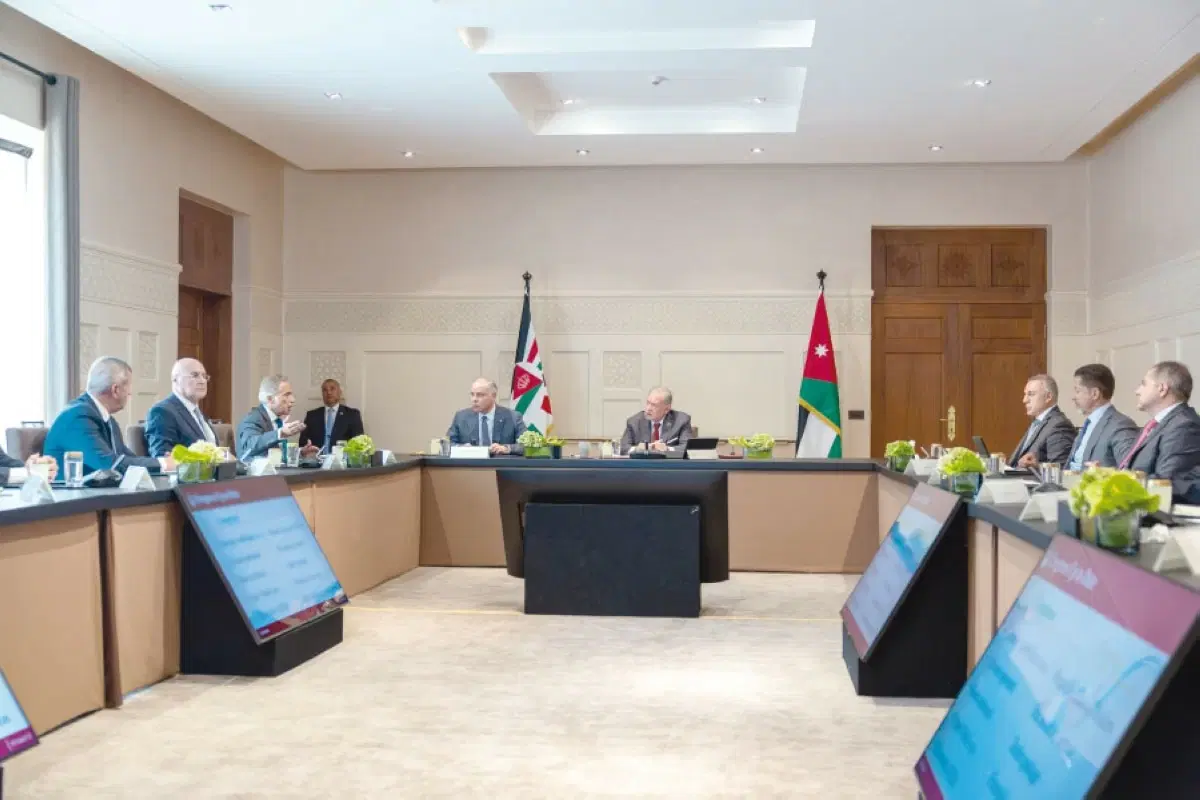
King Abdullah II chaired a meeting at Al-Husseiniya Palace on Tuesday to follow up on the government's work in the gas sector and its development plans, which support energy security and enhance the competitiveness of the national economy.
During the meeting, attended by His Highness Prince Faisal bin Al Hussein, Chairman of the National Policy Council, Prime Minister Dr. Jafar Hassan, and a number of relevant officials, His Majesty reviewed the progress of the implementation of the Al-Reesha field development plan and its increased productivity, and the developments of linking it to the Arab Gas Pipeline to enhance gas supplies and support the needs of the energy sector.
His Majesty listened to an explanation presented by the Minister of Energy and Mineral Resources, Dr. Saleh Al-Kharaibsheh, about the comprehensive plan for the gas sector, developments in the Jordanian gas market, gas import and export plans, and the natural gas distribution project in Amman and Al-Zarqa, which contributes to expanding its use locally.
The meeting was attended by the Director of the King's Office, Engineer Alaa Al-Bata'ineh, Deputy Prime Minister and Minister of State for Economic Affairs, Muhannad Shuhada, and Minister of Investment, Dr. Tariq Abu Ghazaleh.
Economic expert Hussam Aaish said that the King's follow-up on the energy sector, especially the development of the Al-Reesha field and its connection to the Arab Gas Pipeline, comes within the framework of the importance His Majesty attaches to this sector, and reflects a clear royal awareness of the strategic position of the energy sector.
Aaish pointed out that the costs Jordan bears as a result of the high energy import bill mean that the royal care for this sector comes on more than one level; the first is national, through the development of the energy sector and gas energy and the details related to it, and the second is linked to the royal message towards this sector, including what is related to strategic reserves of oil and oil derivatives, which leads to reducing Jordan's exposure to the burdens and costs resulting from energy prices, in light of the upcoming changes.
Aaish pointed out that the energy file for Jordan and King Abdullah is no longer an issue linked to securing the needs of power generation plants and providing fuel, but has become part of the overall ability of the economy to continue, grow, and face crises and regional fluctuations.
Aaish explained that the royal follow-up at the highest level gives this file a strategic dimension that goes beyond the daily management of the sector to future planning for energy security, and therefore the royal follow-up of the developments of the Al-Reesha field is of particular importance; because the economics of gas are not only measured by the size of production, but also by what the local production can entail in terms of supply costs, diversification of energy sources, reducing the risks of dependence on external sources, and most importantly, improving the Kingdom's ability to manage its energy needs.
Economic expert Wajdi Makhamara pointed out that King Abdullah II's chairmanship of the gas sector follow-up meeting carries an important strategic and economic significance, and reflects giving the energy file priority at the state level, considering it one of the main factors in the security of the economy and the competitiveness of productive sectors.
Makhamara added that the development of the Al-Reesha field, increasing its productivity, and linking it to the Arab Gas Pipeline is of particular importance because it allows Jordan to increase its reliance on local energy sources, reduce the risks and fluctuations of imports, and enhance gas supply security.
He pointed out that plans to expand the distribution of natural gas in Amman, Al-Zarqa, and industrial cities can contribute to reducing energy costs for the industrial and commercial sectors, and improving the competitiveness of Jordanian products, especially for energy-intensive industries.
On the investment side, Makhamara pointed out that the development of the gas sector opens the door to new investments in exploration and production operations, the establishment of pipelines, distribution operations, industry, and electricity generation, which turns this sector from just an energy source into part of the economic growth system.
He added that the meeting indicates a government trend towards diversifying energy sources and building a more flexible system that combines local and imported gas and renewable energy.
Financial and economic expert Dr. Muhammad Al-Hadb Al-Sarikhan confirmed that King Abdullah II's follow-up on plans to develop the gas sector reflects that the energy file is no longer viewed only from the supply angle, but as one of the variables affecting growth, the trade balance, the current account, and the competitiveness of the economy. The energy strategy aims to increase the production of the Al-Reesha field to about 418 million cubic feet per day by 2029, and then to more than 800 million cubic feet per day by 2035, which is a transformation that can significantly change the structure of dependence on imported gas.
Al-Sarikhan explained that the first impact will be on the import bill and the demand for foreign currencies. Crude oil and its derivatives imports increased by 45.8% during the first seven months of 2026, which shows the sensitivity of the Jordanian economy to global energy market movements.
He added that increasing the contribution of local gas does not mean canceling the need for imports, but it reduces part of this sensitivity and helps reduce pressure on the trade balance and the current account, which recorded a deficit of about 2.2% of GDP in the first quarter of this year.
He pointed out that there is another aspect related to growth and prices, as energy enters the cost of industry, transport, services, and electricity production, and therefore providing a more stable local source reduces the exposure of Jordanian products to external fluctuations.
He added that this is important at a time when the economy is recording real growth of about 2.9%, because raising growth to higher levels requires improving the productivity of sectors and reducing their costs, especially industries that compete in foreign markets. Every sustainable reduction in energy costs reflects on the ability of companies to expand, employ, and export.
Al-Sarikhan explained that linking the Al-Reesha field to the Arab Gas Pipeline by 2029 represents a fundamental part of the economic equation, because increasing production alone is not enough if the quantities do not reach factories, power plants, and consumption centers.
Expanding gas networks in Amman and Al-Zarqa can also create a larger local market for natural gas and encourage industrial and commercial establishments to switch to it, while the strategy aims to reach industrial demand for gas to about 173 million cubic feet per day by 2035.
Al-Sarikhan added that the greatest value of Al-Reesha gas will appear when it turns from a local resource into an element that changes part of the equation of the overall economy.
Instead of part of the energy bill going abroad, a larger part of the spending can remain within the economy and go to investment, operation, and services linked to production, transport, and processing.
If the targeted expansion is achieved in parallel with renewable energy, Jordan will not only have enhanced its energy security, but will have also reduced one of the most important sources of its economy's exposure to external shocks, and opened up more space for growth and investment in the coming years.