"Karak, the Guardian of Memory": A Heritage Evening on the Sidewalk that Brought Literature and Folk Heritage Together
Organized by "Karak Culture" and the Knights of the City"
Amman7 min read
Share
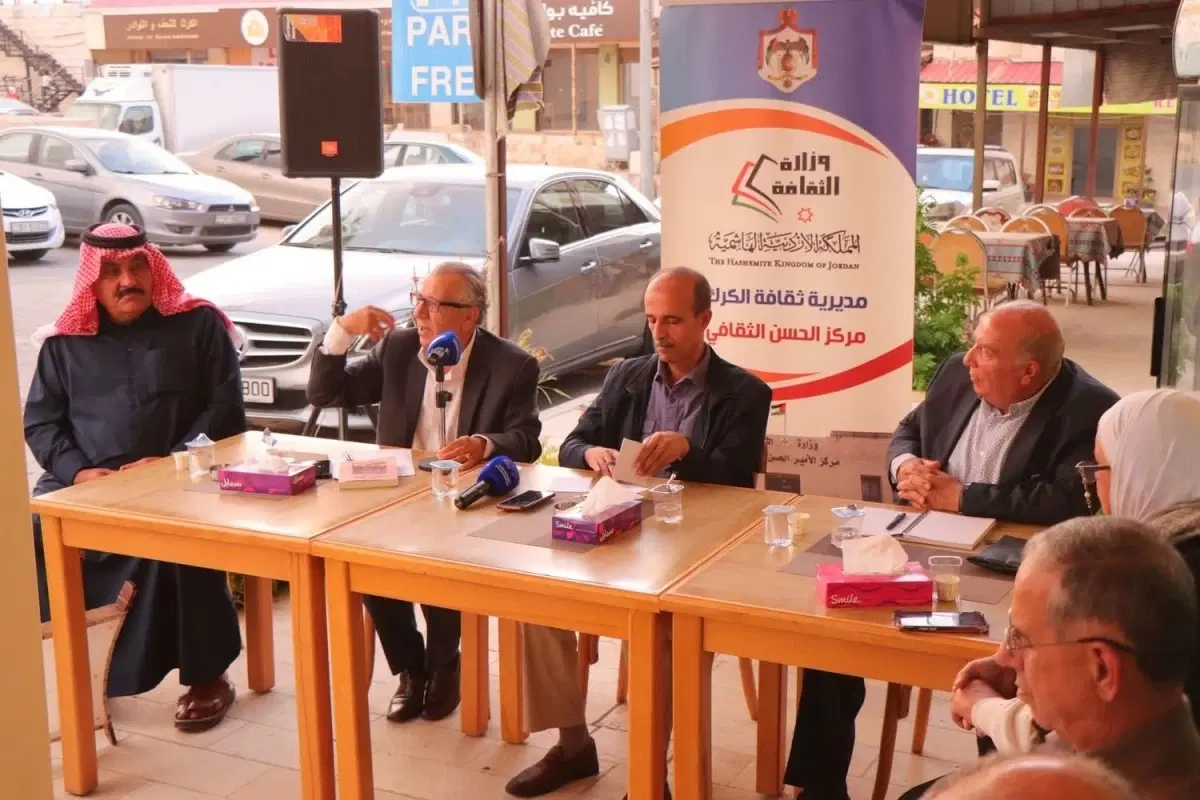
On the sidewalk separating the old Karak Municipality building from what remains of the Ottoman government complex of the Saraya, and the embrace of the ancient Karak Castle, the fragrance of the past intertwined with the vibrant present, full of authenticity and warmth, in a scene that brought back memories of the heritage evenings that formed part of social life for decades. This was in a heritage evening titled (Karak, the Guardian of Memory) organized by the Karak Culture Directorate, in cooperation with the Knights of the City Association, in the presence of the Assistant Secretary-General of the Ministry of Culture, the Director of Karak Culture, Orouba Al-Shammaile, and a group of intellectuals, writers, and those interested in cultural affairs. In a scene
The evening, which featured novelist Dr. Abdul Hadi Al-Madadha, artist and writer Imad Al-Madanate, and was moderated by Dr. Abdul Hai Al-Jabasha, and included a performance on the strings of the Rababah by poet Salah Al-Shammaile, brought together literature, heritage, and folk heritage, evoking pages from the rich history and living memory of Karak, and emphasized the importance of using folk stories and local memory in the novel, as a rich source of creativity and cultural documentation.
Dr. Al-Madadha discussed his novel experience, talking about his novels (Karak Mobile) and (The Tremor of the City), and what they contain of historical, social, and cultural features that draw inspiration from the memory of Karak, and evoke the details of life there, with its events, stories, and characters that formed part of the identity and spirit of the place. He also highlighted the role of the novel in re-reading history and presenting it to future generations in a literary style that connects the past with the present and preserves its details from being forgotten.
In his speech, he recalled the features of the old city and its market, which was abundant with the blessings of the countryside surrounding the city, and also abundant with goods coming from Sham, Hijaz, Iraq, and Palestine, and merchants from Sham, Hijaz, and Palestine who melted into the national crucible and were touched by history and sealed on their hearts with the name of Karak merchants, and state employees from soldiers, teachers, and directors of departments from all corners of the Arab world, who all drank from the waters of Ein Sarah and breathed the air of Karak, and thus became its people.
Al-Madadha recalled the memories of when he was a child at the age of eight, saying "I would cross that street on my way to school or the market, letting my eyes wander high to see the edges of the lower castle, then I would raise them to the top to see the middle of the fortified walls and the huge stones, and the clouds touching the edges of the southern guard tower in the great castle. I would return my gaze to my dusty feet and my shoes that had lost their shine and the school bag hanging on my shoulder, and I realized how very small I was in front of this great fortress and this historical city, and I also realized how great those who built the city, the fortress, the five towers, and the surrounding walls were, and how they drove away the invaders."
Al-Madadha read a few lines from the Moabite King Mesha Stele, in which he glorifies his victories over his enemies, saying "I am from the builders of the palace, I am from those who dug the two water cisterns in the rock, I am from those who dug the southern trench and I am from those who opened the road of Wadi Arnon," and then he moved on to the Nabataeans and Romans and their legions that spread in the area of Al-Lajjoun in Karak and in Aqaba, Eilat at that time, and the role of the Arabs and Muslim Arabs in the conquest of Mu'tah, reviewing the historical periods that passed through Karak since the era of the Crusaders, the Ayyubids, the Mamluks, and the Ottomans, up to the era of the Hashemites.
At the end of his speech, he affirmed that Karak has never let down those who felt its strength and status, and it has never been anything but a unifying force, and it has only carried the Arab cause, and it is our mother who has nursed us with pride and dignity.
For his part, the artist and writer Al-Madanate said that the place has always been the first influencer in the creative process, as it is the cradle of all the dimensions and values on which the events that the artistic work is woven from are based. He reviewed his experience in his novel (The Tenderness of the Well), in which he dealt with the place with all its heritage, characters, and events in a different way, where the heroism was not distributed to specific characters, but rather the place was made the hero, and every event was a hero, and the characters in the novel, despite their fatigue, pain, and sadness, were strongly present in the joints of the novel.
He pointed out that "The Tenderness of the Well" is a southern novel that formed a moral code with all its elements and belongs to the place and loves it despite the pain and fatigue of living, and it also sided with the marginalized who were taken by life to the shadows and fatigue, but they excelled in belonging to the soil of the south and the city that embraced them with love and affection, and thus Karak has been a city in love with its children throughout history, and a cradle of every good, heroism, and noble positions in all its stages.
Al-Madanate reviewed what the novel carries of the heritage and social dimensions of the Karak villages and their local environment, and what it reflects of the features of popular life, human relations, and the authentic values that have distinguished the Karaki society over time.
For her part, Al-Shammaile said that this evening comes within the framework of the Directorate's keenness to activate local cultural movement, and enhance the presence of literature and heritage in open spaces, by holding the evening on the sidewalk, as a embodiment of the idea of (sidewalk culture) which seeks to bring culture out of closed halls to public spaces, making it closer to people and more interactive with their daily lives, and making the sidewalk an open space for creativity, and culture a living practice that beats in the heart of the city, and evokes the memory and history of Karak and its cultural specificity.
She continued that the evenings organized by the Directorate periodically in their general content aim to revive heritage traditions as a space for meeting, dialogue, and exchanging stories and ideas, and provide an opportunity for creators and those interested in direct communication with society, which enhances cultural participation
The evening provided a space for dialogue and exchange of opinions among the attendees about the importance of the heritage novel in preserving the national memory and the role of writers in documenting oral narratives and inherited stories, and turning them into literary works that preserve the features of the place and the details of social life for future generations, in addition to addressing the need to pay attention to popular vocabulary, old names, and historical landmarks, as they are living witnesses to the depth of the cultural heritage that Karak Governorate is rich in