Jordan and Iraq agree to activate agreements and academic memorandums of understanding
Amman5 min read
Share
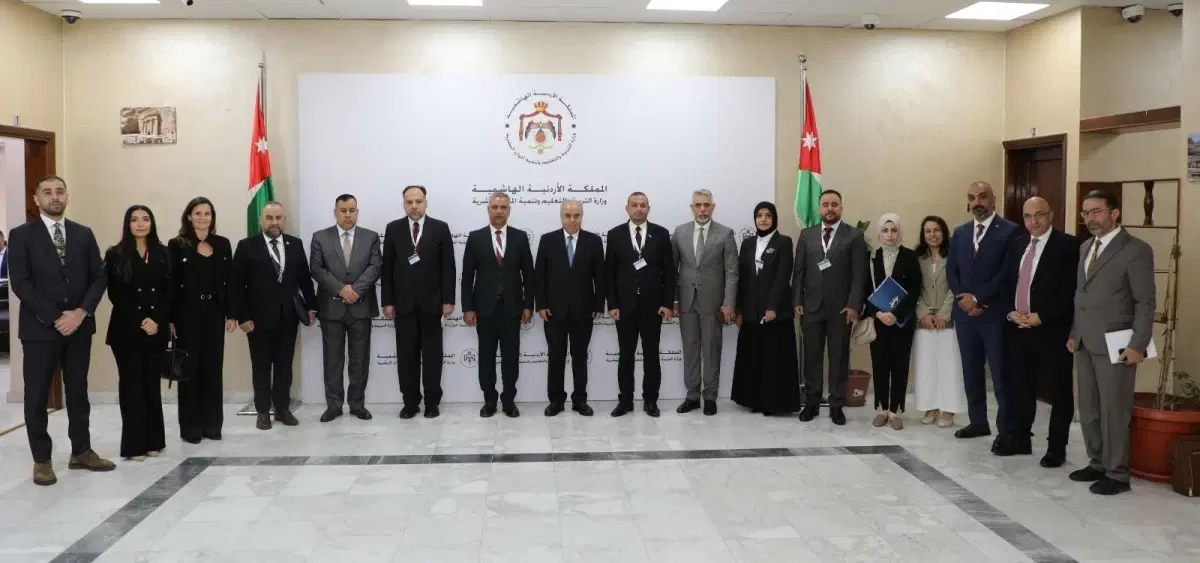
The Minister of Education and Human Resource Development, Dr. Azmi Mahafzah, discussed with a high-level Iraqi delegation, which included presidents of Iraqi technical universities and representatives from the Ministry of Higher Education and Scientific Research in the Republic of Iraq, ways to enhance academic, scientific, and training cooperation between the two countries, and to expand the scope of partnership in the fields of higher, technical, and vocational education, contributing to the development of educational outcomes and aligning them with labor market requirements.
This meeting was part of a study visit to the Hashemite Kingdom of Jordan, organized by the TAWASOL project in Iraq, funded by the Government of Canada and implemented by the Worldwide Universities Network in Canada (WUSC) in partnership with Canadian Leaders (CLIC), as part of its efforts to enhance the capabilities of Iraqi technical and vocational education and training institutions, develop institutional partnerships, and exchange successful regional experiences and expertise, supporting the modernization of the technical and vocational education system and strengthening its connection to labor market needs.
During the meeting, Dr. Mahafzah emphasized the depth of the historical and fraternal relations between Jordan and Iraq, praising the distinguished academic and scientific role played by Iraqi universities and competencies throughout history, and the importance of building on these relations to develop areas of joint cooperation and exchange experiences between educational institutions in both countries.
Dr. Mahafzah presented an overview of the development of the Jordanian higher education system, explaining that it includes about 10 public universities and 21 private universities, including two universities established by special law, namely Al-Hussein Technical University and the International Islamic University of Science, in addition to the Arab Open University as a regional university, as well as 78 higher education institutes.
He pointed out that the total number of students enrolled in Jordanian higher education institutions is about 470,000 students and students, taught by nearly 14,000 faculty members, within 644 academic specialties, noting the increasing shift towards applied and technical education, and the expansion of the establishment of technical universities and specialized colleges to respond to economic and technological developments and labor market requirements.
Dr. Mahafzah also addressed the establishment of the Ministry of Education and Human Resource Development, within the framework of the economic modernization vision and the public sector development map in Jordan, with the aim of achieving integration between different stages of education, starting from kindergarten and general education to higher education, while maintaining the administrative and academic independence of universities through specialized frameworks and councils.
For their part, members of the Iraqi delegation, headed by the President of the Middle Technical University, Dr. Wadah Hatem, and including presidents of the Southern and Northern Technical Universities and the Middle Euphrates, along with representatives from the Ministry of Higher Education and Scientific Research and the Directorate of Scholarships and Cultural Relations, expressed their appreciation for the warm reception, praising the academic level and development achieved by Jordanian higher education institutions, especially in the fields of applied and technical education.
The Iraqi delegation presented the most significant developments in the technical and vocational education sector in Iraq, and the efforts made to develop educational programs and curricula and strengthen their connection to the actual needs of the labor market, emphasizing the importance of expanding cooperation with Jordanian academic institutions and benefiting from successful experiences in developing technical and applied education.
The discussions included a number of areas of mutual interest, most notably activating academic and research exchange, facilitating the movement of faculty members and students between the two countries, developing joint programs and scholarships, and benefiting from national initiatives, including the "Study in Iraq" program, as well as exploring mechanisms to facilitate student admission to educational institutions in both countries.
The two sides also discussed opportunities for exchanging expertise in areas such as academic accreditation, quality assurance in education, and curriculum development, especially in modern specialties such as artificial intelligence, cybersecurity, and advanced technologies, in addition to developing vocational and technical training programs and enhancing the skills of students and graduates to keep pace with the rapid changes in the labor market.
The discussions also addressed the importance of women's empowerment programs and enhancing their participation in technical and vocational education, and developing life and professional skills (Soft Skills), as they are essential skills that contribute to increasing the readiness of graduates and improving their transition from education to work.
This visit comes within the framework of the efforts made by the TAWASOL project to support the development of the technical and vocational education and training system in Iraq, by enhancing cooperation between educational institutions, government agencies, and the private sector, developing institutional capacities, and encouraging the exchange of knowledge and expertise at the national and regional levels. It also reflects the importance of international and regional partnerships in supporting educational reforms and enhancing employment opportunities and responding to economic development requirements.
At the end of the meeting, the two sides agreed to move forward in forming a joint committee to coordinate areas of cooperation and follow up on the outcomes of the discussions, as well as to intensify meetings and communication with the Higher Education Accreditation and Quality Assurance Authority, and to activate agreements and academic memorandums of understanding, converting them into practical programs and initiatives that serve the common interests of the two brotherly countries.
This meeting represents an important step towards expanding the scope of academic and technical cooperation between Iraq and Jordan, and enhancing institutional experience exchange, supporting efforts to develop higher, technical, and vocational education, and contributing to preparing qualified cadres who possess the necessary skills and knowledge to keep pace with labor market needs and economic and technological developments.