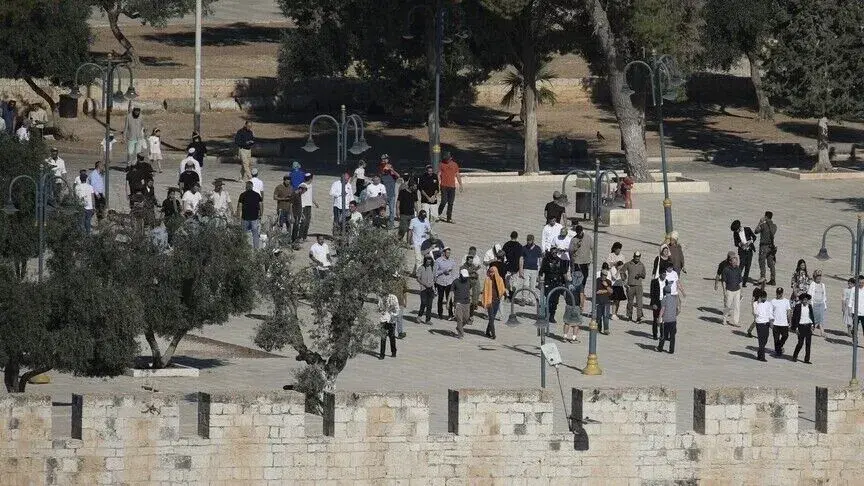
The clip shows "placing religious prayer sheets and performing full prayers, along with holding educational circles in the eastern area of the mosque", according to the statement.
The Jerusalem Governorate pointed out that "religious prayer sheets were allowed to be brought into Al-Aqsa Mosque for the first time in April last year".
It considered this "an additional shift in the nature of the practices imposed during the incursions".
These practices, according to the governorate, come in the context of repeated attempts to turn the eastern area of Al-Aqsa Mosque into a permanent religious site for settlers.
It explained that "demands to hold public prayers and designate sites within the mosque were previously raised by settler groups, before gradually turning into a recurring practice on the mosque's land".
The Jerusalem Governorate added that this is happening amid attempts to describe the eastern area as a designated prayer site or an "unannounced synagogue" within Al-Aqsa Mosque.
With the start of Jewish holidays, Israeli incursions into Al-Aqsa Mosque have recently increased, which are carried out under the protection of the army, in conjunction with Israeli media blackout and strict security measures witnessed in the Old City of occupied Jerusalem and the vicinity of the mosque, and an extensive deployment of Israeli forces.
The Jewish holidays began with the Hebrew New Year on September 12 and 13, and continue with Yom Kippur on September 21 of the same month, then the Feast of Tabernacles between September 26 and October 2, leading to the completion of the Torah on October 3.
Since 2003, the Israeli police have allowed settlers to storm Al-Aqsa Mosque unilaterally, while the Islamic Endowments Department in Jerusalem repeatedly calls for a halt to these incursions, without a response from the Israeli authorities.