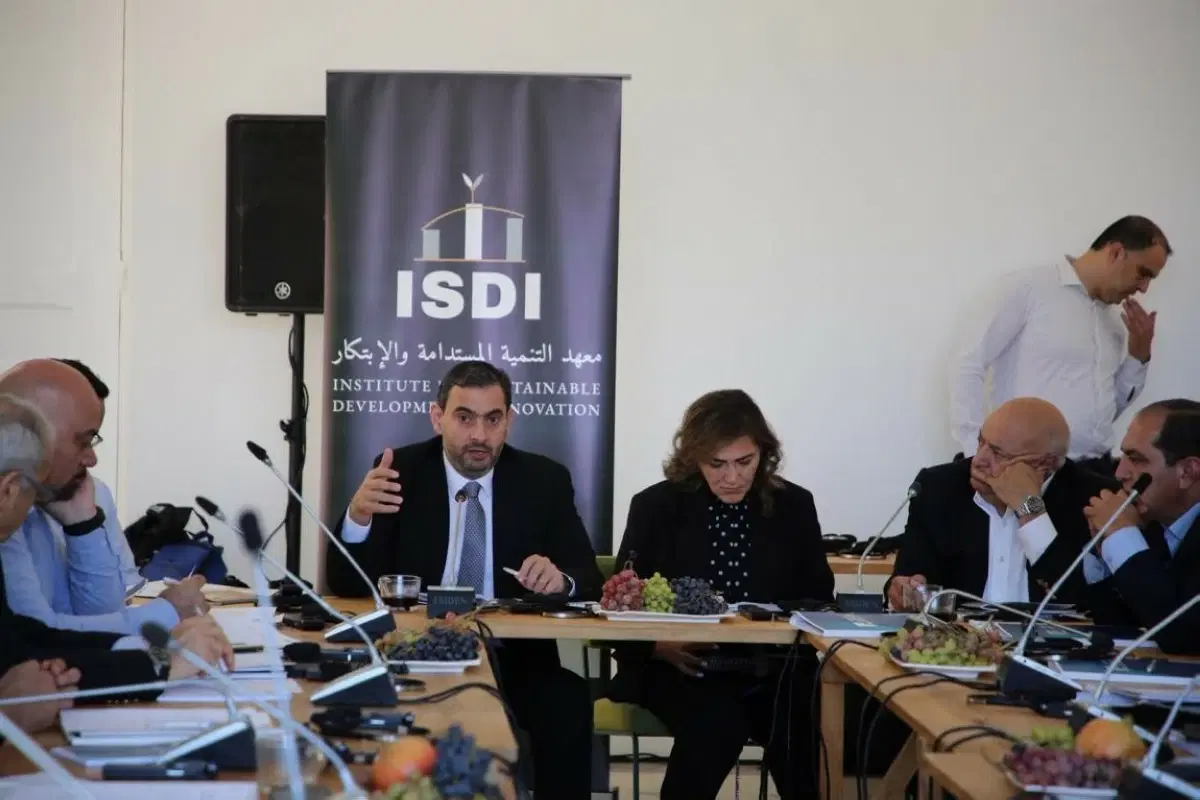
During the event, the Institute presented itself as an independent research institution focused on producing studies and research directed towards policy-making, choosing its first work to be a study addressing the file of the resilience of the agriculture and food system, as it is one of the most sensitive files at the national stability level. The event was opened with welcoming speeches, including one by the Resident Representative of the Konrad Adenauer Foundation in Jordan, Veronika Ayrtel, who expressed her happiness with the launch of the Institute, describing independent research institutions of this type as models that have proven successful globally as they enable decision-makers by providing them with the necessary research and figures, wishing success to those responsible for the Institute, expressing her pride in the partnership between the two sides, and looking forward to future work that supports decision-making in Jordan.
The event's activities were divided into two dialogue sessions. The first session addressed the diagnostic study of the agriculture and food system in Jordan, reviewing the main areas of vulnerability, challenges, and opportunities available to enhance the resilience of the system from the perspectives of the economy, investment, industry, and trade, with the participation of several former ministers and specialized experts. The second session was dedicated to presenting a policy paper on agricultural land certificates in Jordan, discussing the challenges facing this file, and discussing the gap between the legislative text and field application and the administrative burdens on farmers and directorates, with official participation from the Ministry of Agriculture and representatives of the agricultural sector alongside the Institute's team.
Dr. Yousef Mansour stressed the need to support farmers in Jordan to continue production, citing the French model, where farmer support reaches 140% of their agricultural production, confirming that the risk of fragmentation of agricultural holdings negatively affects food security.
In his intervention, Dr. Tariq Al-Hommori recalled the period of the Corona pandemic with the audience, explaining that the biggest role in dealing with this global crisis was in securing the stock in advance, relying on the early warning system available at the Ministry of Agriculture, which accurately indicated the available and scarce commodities in the Jordanian market, enabling the government at the time to prepare plans and deal with the crisis through partnership with the private sector, which provided the needs of the market.
For his part, Engineer Thabet Al-War, former Chairman of the Investment Authority, explained that resilience is built in advance during periods of prosperity, not when crises occur, recalling the late martyr Waṣfī al-Ṭal, who translated the royal directives to support agriculture and farmers through the decision to establish the Faisal Nursery in 1962 to provide agricultural seedlings in Jordan, after the Kingdom had previously relied on the Khuduri College Nursery in Tulkarm. He explained that this decision was what protected the production of seedlings in Jordan after the 1967 war, noting that the nursery is still in operation today as a witness to the decision that protected farmers and agricultural production.
As part of the official participation of the Ministry of Agriculture, Dr. Nada Freihat, Secretary of the Supreme Council for Food Security, presented a presentation on the achievements of the Supreme Council and the National Committee for Food Security.
The event concluded with a networking session between the attendees, allowing for the exchange of views between decision-makers, researchers, and representatives of the concerned sectors on the paths to enhance the resilience of the agriculture and food system and the reality of agricultural holdings, contributing to achieving sustainable development in Jordan. The organizers confirmed that the launch of this study represents the first link in a research path that the Institute intends to continue in the files of sustainable development, innovation, and resource management, noting that all works are published on the official website of the Institute www.theisdi.org.