Industrial production growth extends its impact to various sectors
Industry strengthens its position as a key engine of the economy
Amman8 min read
Share
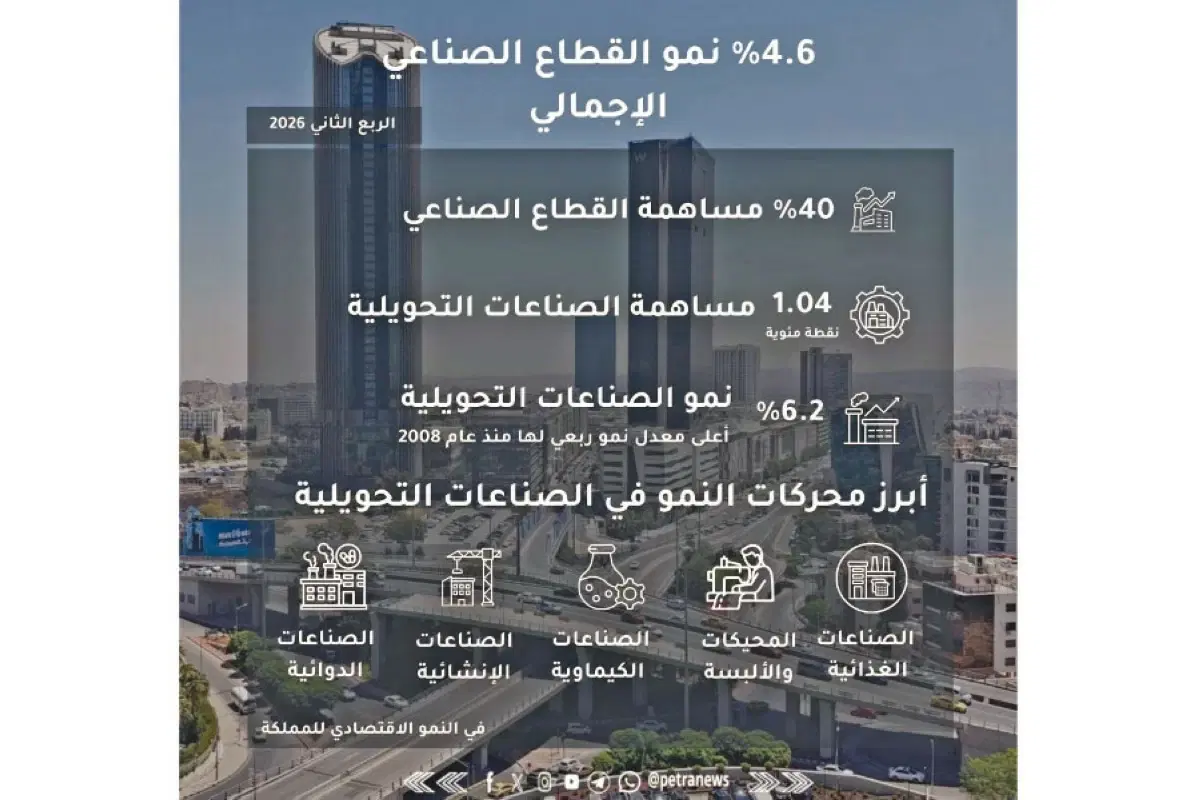
Economic experts believe that the growth of the Jordanian industrial sector by 4.6% during the second quarter of 2026 is a positive indicator of improved production activity, especially since the sector contributed about 40% of the economic growth achieved in the Kingdom, amounting to 3%.
Experts pointed out in interviews with (Alrai) that the growth of industry more than double the rate of national economic growth enhances the quality of economic growth, as the expansion of industrial activity does not stop at the value of production within the establishment, but extends to the transportation, storage, financial services, insurance, packaging, maintenance, and local suppliers sectors.
The industrial sector grew by 4.6% during the second quarter of this year, contributing about 40% of the economic growth achieved in the Kingdom, according to the Jordan Chamber of Industry.
Manufacturing industries recorded a growth of 6.2% compared to the same period last year, the highest quarterly growth rate since 2008, according to a statement from the Chamber.
The growth of manufacturing industries exceeded twice the rate of national economic growth of 3% during the second quarter, contributing 1.04 percentage points to the total economic growth, equivalent to about 35% of it.
Manufacturing industries maintained their position as the largest economic activity in terms of contribution to gross domestic product at constant prices, with a share of 17.2%.
Economic expert Wajidi Makhamara said that the growth of the Jordanian industrial sector by 4.6% during the second quarter of 2026 is a positive indicator of improved production activity, especially since the sector contributed about 40% of the economic growth achieved in the Kingdom, amounting to 3%.
He added that the manufacturing sector stands out as one of the main drivers of this improvement, after recording a growth of 6.2%, the highest quarterly growth rate since 2008, and contributed about 1.04 percentage points to economic growth. The sector also maintained its position as the largest economic activity in terms of contribution to gross domestic product, with a share of 17.2%.
Makhamara explained that this performance reflects an improvement in the industrial sector's ability to increase production, support exports, and generate foreign currency, noting that the continued growth of industrial exports enhances the role of industry in improving the external trade position.
He pointed out that the importance of this growth also lies in the indirect effects of industry on other sectors, such as transportation, logistics, energy, and finance, thereby expanding the economic impact of industrial activity.
Makhamara added that maintaining this momentum requires focusing on reducing energy, transportation, and production costs, facilitating access to financing, stimulating industrial and export investments, and increasing productivity and competitiveness.
He said that the performance of the industrial sector during the second quarter represents a positive signal of a gradual shift towards growth more dependent on productive and export sectors, explaining that the importance lies not only in recording a growth of 4.6%, but also in the increase in the contribution of industry to the overall economic growth.
He added that the next phase requires converting this momentum into new industrial investments, increasing exports and local value addition, so that industry becomes one of the sustainable drivers of growth, employment, and foreign currency generation.
For his part, financial and economic expert Dr. Muhammad Al-Hadab Al-Sarhan said that the growth of manufacturing industries by 6.2% during the second quarter of 2026, the highest quarterly since 2008, is important beyond recording a high growth rate, as the manufacturing industry accounts for about 17.2% of gross domestic product, making it the largest single economic activity in terms of contribution to output.
He added that the manufacturing industry alone contributed 1.04 percentage points to the total economic growth of 3%, or about 35% of it, while the industrial sector as a whole contributed about 40% of the achieved growth.
Al-Sarhan explained that the importance of industry to the overall economy lies in its ability to combine production, export, employment, and foreign currency generation at the same time, noting that this is clearly evident in industrial exports, which amounted to about 5.17 billion dinars during the first seven months of the current year, an increase of 7.3% and an increase of about 350 million dinars compared to the same period in 2025.
He added that nine out of ten industrial sectors recorded growth in their exports, which is an important indicator that the improvement is not concentrated in one product or industry only.
He added that the growth of industry more than double the rate of national economic growth enhances the quality of economic growth, as the expansion of industrial activity does not limit its impact to the value of production within the establishment, but extends to transportation, storage, financial services, insurance, packaging, maintenance, and local suppliers.
He added that increasing the contribution of industry to growth creates an opportunity to expand the interconnection between sectors, so that a large industrial company becomes a driver of the activity of dozens of small and medium-sized companies that supply it with materials and services.
Al-Sarhan pointed out that the priority in the current phase is to convert industrial momentum into sustainable investment expansion, by targeting industries that import a large part of their inputs from the Jordanian industry, and working to produce what can be produced locally in a competitive manner, in parallel with reducing energy and transportation costs and providing long-term financing for industrial and export expansion.
He added that the expansion of local gas production and renewable energy, along with the development of transportation and logistics networks, can give the Jordanian industry a greater advantage in external competition, if this is actually reflected in production costs.
Al-Sarhan said that the current figures provide a good basis to build on, but the most important thing in the coming years is the transformation of industrial growth into a continuous increase in production capacity, exports, and new investments.
He explained that the increase in the share of products with local value addition, the expansion of the network of Jordanian suppliers, and the entry of the national product into new markets, will enhance the impact of industry on the trade balance, growth, and job opportunities.
He added that the growth of manufacturing industries by 6.2% should not be treated as an exceptional figure for one quarter, but as an opportunity to strengthen the position of industry as one of the main drivers of the Jordanian economy.
The former representative of the clothing and textiles sector in the Jordan Chamber of Industry, Qadri, said that the growth of the industrial sector by 4.6% during the second quarter of 2026 represents an important signal that the industry is playing an increasing role, not only as a productive sector, but also as a driver of economic growth itself.
He added that the sector's contribution of about 40% of the achieved growth, along with the growth of manufacturing industries by 6.2%, the highest quarterly since 2008, reflects the importance of the shift towards growth led by real production, investment, and exports.
He explained that the significance of these figures increases when considering that manufacturing industries account for 17.2% of real gross domestic product, and contributed about 1.04 percentage points to the growth rate, meaning that raising the economic growth rate in Jordan is largely dependent on its ability to expand its industrial base and increase its productivity and competitiveness.
He pointed out that this trend is consistent with the essence of the economic modernization vision in the transition towards higher value-added sectors and greater export and job creation capabilities.
He explained that the most important thing is the quality of this growth and its ability to continue, as the increase in industrial production in conjunction with the growth of exports provides a more significant indicator than growth based solely on consumption, since the industry has a multiplier effect that extends to transportation, services, logistics, finance, supply chains, and employment.
Qadri added that the challenge now is to convert this performance from a strong quarterly result into a long-term structural path, by accelerating industrial investments, deepening value chains and local content, expanding the base of exporters, increasing productivity and employing technology, and addressing energy, transportation, and financing costs.
He said that the target should not be limited to maintaining industrial growth, but rather using the sector to raise the ceiling of possible growth for the Jordanian economy as a whole, because achieving higher and more sustainable growth rates requires real expansion in production capacity, investment, exports, value addition, and job opportunities.