Hashemite Charity: Documenting the arrival of aid contributes to combating rumors
Amman3 min read
Share
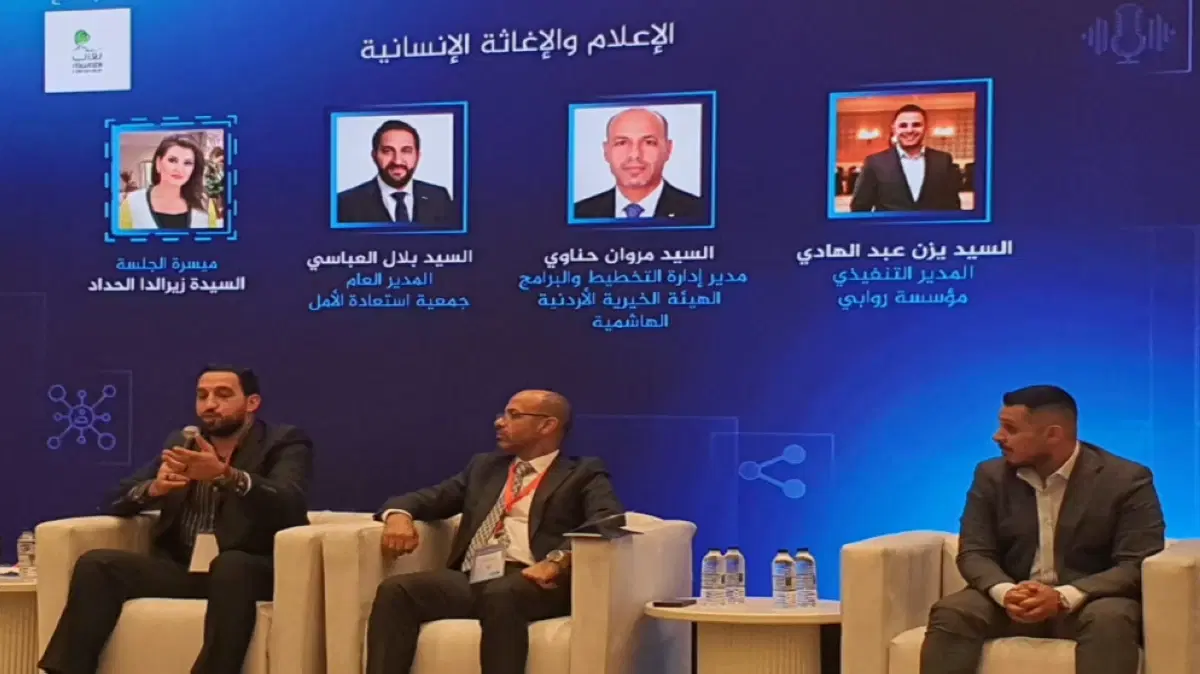
The Director of Planning and Programs Department at the Jordan Hashemite Charity Organization (JHCO), Marwan Hannawi, said on Sunday that the organization coordinated with journalists during the Israeli war on the Gaza Strip to brief them on the stages of transporting aid to the Strip.
This came during a session titled "Media and Humanitarian Relief," held within the Future of Media and Communication Forum.
Hannawi stressed the importance of keeping journalists informed about the relief work steps from the beginning until sending the aid, pointing out that documenting its arrival contributes to combating rumors.
He emphasized the importance of transitioning to the recovery and rebuilding phase in the Gaza Strip and not limiting efforts to sending meals, explaining that the organization is working on sending aid alongside building caravans and tents.
He pointed out that there is disruption in the entry of caravans, which prompted reliance on entities inside the Gaza Strip to build them, stressing that Jordan's work is not limited to sending aid.
Regarding the role of the media, Hannawi called for the presence of journalists in the field alongside relief work teams to convey the truth without compromising the dignity of those in need, stressing the need to highlight the need rather than the needy person, in order to preserve people's dignity.
He explained that Jordan puts alternative plans in place when sending aid to Gaza, but they might not succeed sometimes, saying: "Because you are dealing with a brutal entity that has no humanity."
For his part, the General Manager of the "Restore Hope" Association, Bilal Al-Abbasi, emphasized the need to consider the humanitarian dimension when dealing with the media, and that the media should understand the story before writing about it.
He pointed out that the Gaza Strip needs continuous support and the development of a plan to mobilize aid, noting that humanitarian institutions are part of a major action plan, which calls for cooperation with them to help the people of the Strip away from individual action, considering that turning to humanitarian institutions operating in the field is the correct choice to deliver aid.
Al-Abbasi pointed out that the approaching winter season brings back the importance of sending caravans to the Strip, despite the occupation's ability to prevent the entry of this aid, noting the role of the media in mobilizing support for Gaza and highlighting the needs of its people.
In turn, the Executive Director of the Palestinian Rawabi Foundation, Yazan Abdel Hadi, called for intensifying media coverage that provides solutions, instead of entrenching the image of suffering and turning it into a habitual scene. Abdel Hadi had been delayed in attending the session due to Israeli occupation procedures at the bridge.
Abdel Hadi believed that a large part of the Arab media is politicized and does not focus on the details that should be highlighted, while noting at the same time that the media has refocused on the humanitarian tragedy in the Gaza Strip and highlighted it.
He stressed the necessity of distinguishing between conveying people's suffering and respecting their dignity, and not exploiting their images and tragedy, affirming that humanitarian work does not wait for anyone's thanks, but goes beyond that.
Regarding the situation in Gaza, Abdel Hadi explained that the people of the Strip do not want to live on aid forever, but rather seek job opportunities and a dignified life, pointing out that confronting displacement is achieved by providing the elements of survival, including job opportunities and reconstruction.