GAIF 35 Conference Discusses Emerging Risks, Parametric Insurance, and Artificial Intelligence on Its Second Day
Amman10 min read
Share
The 35th General Conference of the General Arab Insurance Union (GAIF 35) continued its second day at the King Hussein Bin Talal Convention Center in the Dead Sea, discussing emerging risks, parametric insurance to face disasters, and applications of artificial intelligence and machine learning in actuarial work.
Three scientific sessions addressed the development of modeling and underwriting tools, accelerating liquidity provision post-disasters, and enhancing the integration between human expertise and technology, alongside intensive bilateral meetings among participants.
Emerging Risks: Developing Modeling and Underwriting and Expanding Coverages
The first session of the day, and the second in the conference's general program, addressed the complexities of emerging risks and methodologies for modeling and underwriting them, and how to develop insurance solutions for hazards that lack sufficient historical data, and expanding coverages in response to economic shifts and customer needs.
The session was moderated by Dima Shattarah, Partner and Risk Consulting Manager at ETG, who raised questions about the limits of relying on historical data, changes in the insurance system, and factors accelerating the transition of emerging risks into conventional insurance fields.
Belhassan Tounat, Underwriting Chief at Riyadh Re, said the absence of historical data does not mean the impossibility of developing insurance solutions, reviewing experiences in modeling terrorism risks and designing solar panel performance guarantees, which required searching for tools and methods beyond traditional analysis.
He explained that solar panel performance guarantees evolved gradually with the accumulation of knowledge and experience, reaching durations of 25 years, after coverages started with shorter durations, an example of the industry's ability to expand protection in response to technical developments.
Tounat pointed out that cyber insurance embodies the transformation of some excluded hazards into independent insurance branches, explaining that its global premiums amount to about $18 billion, with expectations to reach about $30 billion by 2030.
He added that corporate needs are moving towards protecting intangible assets, such as systems, customer relationships, reputation, and the ability to continue business, which calls for the creation of coverages that go beyond focusing on physical property.
He stressed that the development of these solutions is done by establishing initial coverage frameworks and then expanding them as data becomes available and understanding of risks improves, noting that the insurance of some intangible assets is still an area under development.
He pointed out that the prioritization of risks varies by market, geographical conditions, and timing, and that reading the results of surveys requires considering these factors to understand what concerns companies and stakeholders in each market, and to identify the differences between local challenges and global trends.
For his part, Elie Abi Raached, Global Operations CEO at Chedid Re, said the insurance system has moved from a traditional chain to a network that includes data, analytics, modeling, and digital solutions companies, alongside insurance, reinsurance, and brokerage companies.
He noted the growing role of insurance comparison and purchase platforms in the region, by facilitating individuals' access to products and simplifying their purchase procedures, and providing additional data that helps companies assess risks, improve underwriting, and develop their businesses.
Abi Raached explained that technology, artificial intelligence, and predictive modeling tools have contributed to accelerating the understanding and pricing of emerging risks, confirming that cooperation between specialized entities, knowledge exchange, and leveraging the expertise of engineers and hazard surveyors are key factors in this transformation.
He pointed out that the industry has become more capable of building assumptions and scenarios for the development of potential hazards, and using them in assessment and pricing, alongside learning from claims, accumulating data, and experiences.
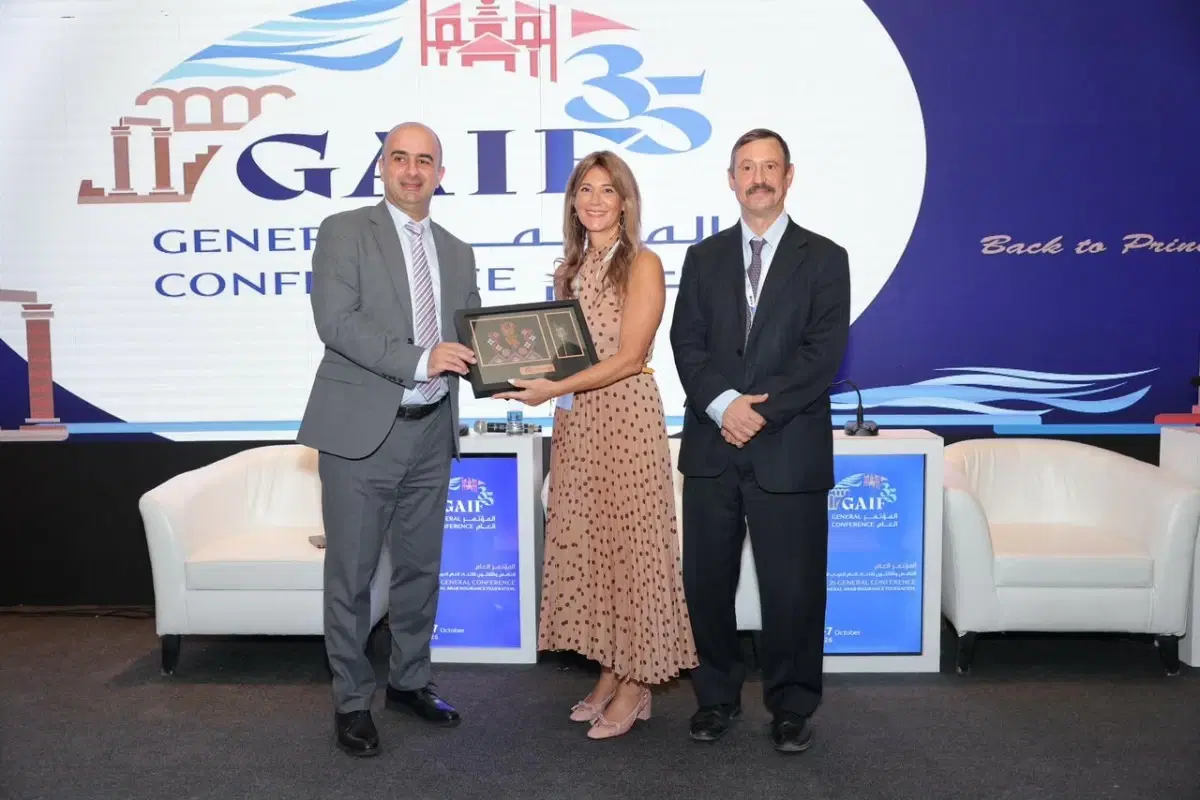
At the end of the session, Dr. Mu'ayyad Kloub, CEO of the Jordanian Insurance Companies Union, honored the speakers and the session chair in appreciation of their participation and contribution to enriching the conference discussions.
Parametric Insurance: Accelerating Liquidity Provision and Reducing the Protection Gap from Disasters
The second session of the day, and the third in the conference's general program, discussed the role of parametric insurance in facing disaster risk challenges, providing liquidity to affected companies, and reducing the protection gap through solutions that complement traditional insurance and respond to business interruption losses.
The session was moderated by Kristina Challita from NASCO, who pointed to the repercussions of climate events and natural disasters on economic activities, and the need for tools that help companies restore their cash flows and continue their businesses, especially in the agriculture and industry sectors.
Andrey Izyel, Business CEO at Trigger Parametric, said the increasing severity and frequency of disasters, along with the concentration of populations and assets in cities, multiplies the challenges of risk assessment and exposure accumulation, and highlights the need for more flexible means of risk transfer.
He explained that parametric insurance is based on defining a measurable index and pre-agreed activation conditions, such as an earthquake reaching a specified intensity or rainfall reaching a certain level, whereby the payment entitlement is linked to the fulfillment of the conditions specified in the policy.
He pointed out that this mechanism helps expedite the disbursement of benefits, without going through the traditional damage estimation procedures, providing liquidity that institutions can use to deal with the effects of the event, while completing the settlement of their claims under other coverages.
He affirmed that combining indemnity insurance and parametric solutions enhances protection, as each plays a different role, with the possibility of designing coverages according to customer needs and the nature of their exposures, including some losses that may remain outside their traditional policies.
In explaining the impact of business interruption, he presented a hypothetical example of a factory whose facilities remain intact, but loses revenue due to a disaster affecting the region where most of its customers are located, explaining that parametric coverage may help it face these financial losses.
He pointed out that the scope of application can include earthquakes, floods, hail, fires, and rainfall, depending on the index used and the coverage structure, and that the clarity of activation conditions and payment values gives the customer a prior idea of what they may receive upon the occurrence of the event.
Conversely, he warned of the importance of understanding basis risks, which arise when the index response does not match the actual loss, as the institution may be damaged without reaching the required threshold to activate coverage, necessitating care in designing indices and linking them to real exposures.
Challita's intervention also addressed the differences between these solutions and traditional coverages for financial losses and political violence, and Izyel explained that the difference is related to the policy structure and payment entitlement mechanism, with the possibility of adopting graduated payments according to the specified index levels.
He stressed that the design of solutions requires an understanding of the nature of the client's activity and potential loss sources, and the use of objective data to determine appropriate indices, supporting rapid response, clarity of protection, and helping to narrow the insurance gap.
He pointed to the importance of developing more customized products that take into account the nature of economic activities and the diversity of institutional needs, and help face the effects of disasters and business continuity.
At the end of the session, Bashar Akroush, Assistant CEO of the Jordanian Insurance Companies Union for Development Affairs, honored the speaker and session chair in appreciation of their participation in the conference.
Actuarial Expertise and Artificial Intelligence: Integrating Skills and Assessing Model Reliability
The day's sessions concluded with the fourth session in the general program, which addressed actuarial expertise and its applications in artificial intelligence and machine learning, focusing on the integration of professional judgment with technical tools, and the role of the actuary in evaluating models, understanding their results, and the limits of their use.
The session was moderated by Dr. Moataz Al-Dabaei, Professor of Artificial Intelligence and Emerging Technologies, from Pure Analysis Company, with the participation of Dana Barhouma, Chief Actuary and Actuary Consultant at Iktiwaria Consulting, in a dialogue about the transformations taking place in actuarial practice within companies.
Al-Dabaei said that artificial intelligence is now affecting the ways of understanding, measuring, pricing, predicting, and managing risks, and that the core value lies in combining the machine's ability to learn from data and the actuary's expertise in dealing with risks and uncertainty.
He emphasized that the discussion should focus on how to employ this integration to make faster, better, and more responsible decisions, noting that leveraging technology requires appropriate data, a technical infrastructure, and human capabilities capable of using it.
For her part, Barhouma explained that machine learning and deep learning are not new to the actuarial field, and that the transformation has been gradual, from using statistical and predictive models to tools that benefit from large and complex data and allow the discovery of relationships and patterns.
She pointed out that traditional modeling relies on the actuary defining the model structure and variables, then using data to estimate coefficients, while machine learning tools help discover complex and non-linear relationships that may not be apparent to the practitioner when building the model.
She pointed to the continued importance of traditional actuarial methods, due to their comprehensibility, interpretability, and ability to work with limited data, as well as the possibility of introducing professional judgment and making adjustments, compared to the value that machine learning adds when dealing with vast and complex data.
She added that technological development has expanded the range of usable data to include texts and images, and that generative artificial intelligence has made advanced modeling tools available, by helping to write and explain programming codes, and facilitating the use of tools that previously required specialized skills.
Brahoma emphasized that the impact of these technologies extends to the insurance workflow, and is not limited to improving prediction, but she stressed that the ease of building models does not mean the ease of judging their quality or suitability.
In discussing the requirements for transformation, Al-Dabaei pointed to the importance of changing the professional culture and overcoming resistance to change, and developing the ability of actuaries to combine their experience with modern tools, thereby enhancing their role within institutions.
Brahoma stressed the need for continuous learning and keeping up with new methods, explaining that the role of the actuary will become more important in questioning models, testing their stability, and understanding the reasons for the results they produce and the limits that should be observed when relying on them.
She explained that the proliferation of tools that allow the rapid production of numerous models makes professional evaluation more important, as the ability to interpret results and examine the assumptions and limits of the model remains essential for benefiting from it.
At the end of the session, Al-Ain Issa Murad honored the speaker and the session chair, in appreciation of their participation in the conference.