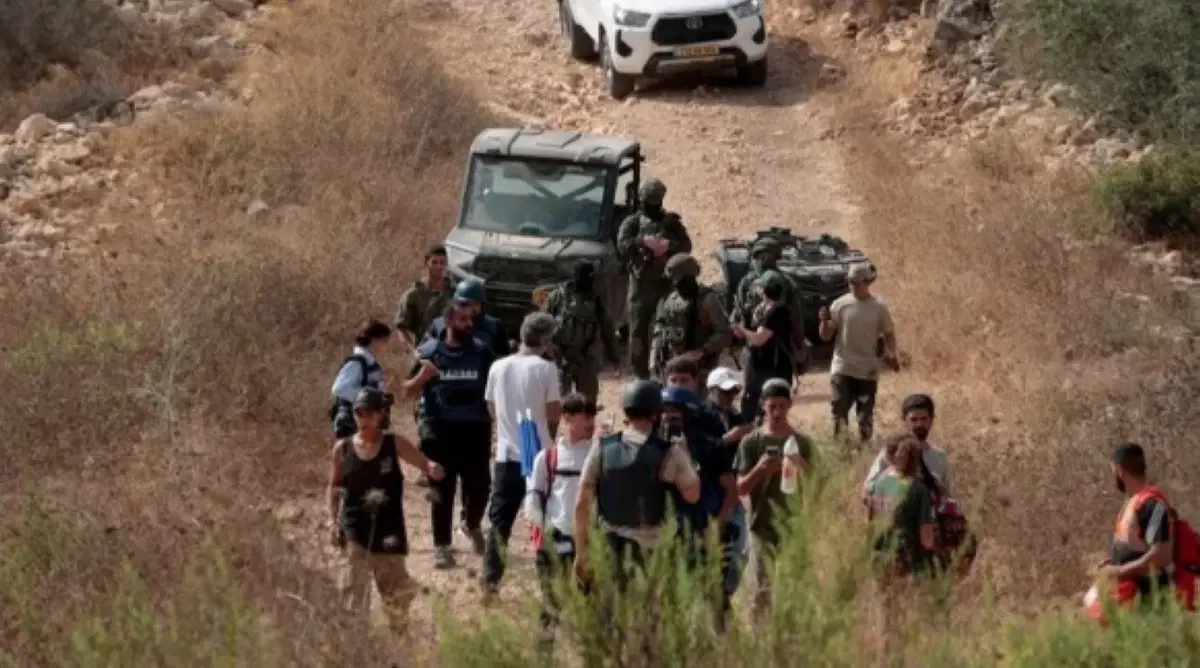
"Eye on Jerusalem" discusses the terrorism of the Israeli occupation during the olive harvest season
Agencies5 min read
Share
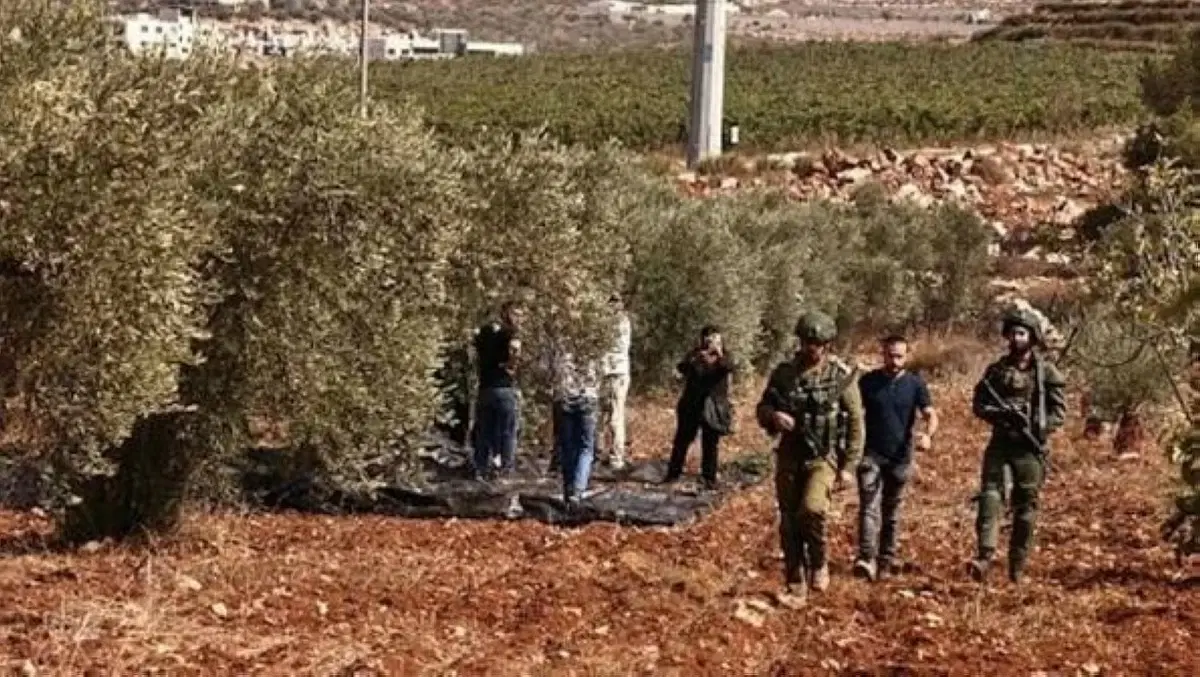
The "Eye on Jerusalem" program, aired by Jordan Television yesterday, Monday, discussed the terrorism practiced by the Israeli occupation and settler gangs against Palestinians during the olive harvest season, and the steadfastness of olive grove owners in the face of the occupation's efforts to pressure them and attempt to displace them by targeting their sources of livelihood.
The program's report described this year's olive harvest season as having begun "dipped in blood and pain," noting that the dangers surrounding the olive harvest season are increasing year after year from the north of the West Bank to its south, in light of the escalation of attacks by extremist settlers on Palestinian farmers and their lands.
The report indicated that the village of Deir Abu Mash'al, northwest of Ramallah, embodies a model of the attacks carried out by settlers with the participation of Israeli occupation forces, where the village residents and those in solidarity with them were subjected to live ammunition, rubber bullets, and tear gas canisters, coinciding with the settlers' attack on farmers who decided to head to their lands to harvest olives, which led to the injury of a number of them and prevented them from reaching their lands.
It added that the noticeable escalation of settler attacks on Palestinian farmers this year comes in light of the significant increase in the number of settlement outposts recently established near Palestinian agricultural lands, from which settlers launch to steal olives from Palestinian lands.
The report documented video footage of settlers stealing olives and hiding them in settlement outposts built on Palestinian lands.
The head of the Deir Abu Mash'al council, Jamil Atta, said that the village residents are determined to harvest their olives no matter the cost, even if they "lose a drop of blood for every drop of oil," because they rely on the olive season to secure their daily needs and manage their personal affairs, such as educating their children, marrying them off, or building, pointing out that the occupation state and the settlers want to ruin the lives of Palestinians in the village, as they steal their livestock, olives, and lands to push them to leave.
In turn, the Assistant Director of the Wall and Settlement Resistance Commission, Saleh Al-Khawaja, said that Palestinians have been subjected to more than 128 attacks by settlers in the last five days, coinciding with the Commission's launch of a national campaign to help farmers who are being attacked and prevented from accessing their lands, especially in areas called (C), noting that these attacks are continuous and are not limited to the olive harvest season only, as part of the occupation's targeting of the Palestinian people's resources, including land, water, pastures, and other assets.
He explained that more than 100,000 Palestinian families rely entirely on olives as a primary source of livelihood, while more than 300,000 families rely partially on the olive harvest season. He added that this targeting comes in conjunction with the escalating pace of seizing lands near "security and military" areas that Smotrich called "settlement envelope areas," where a Palestinian is now forbidden from reaching his land if it is about 300 meters away from colonies and military zones.
Al-Khawaja confirmed the escalating pace of uprooting olive trees under the pretext of their proximity to military zones and for "security reasons," as 55 decisions were issued this year to cut down olive trees in more than one area in the West Bank, noting in this regard a decision issued by the occupation to uproot olive trees and all plants on the land in the town of Al-Mughayyir, and within 72 hours, more than 10,500 olive trees were uprooted.
He pointed to the occupation's isolation of the village of "Umm Safa" northwest of Ramallah, surrounding it with settlements, closing it completely with military gates, besieging its 700 residents, and then confiscating their lands so that only 100 dunams remain for them out of the 4,700 dunams they used to own.
For his part, political analyst and expert on Palestinian affairs Hamada Fara'neh explained that the "ruling team of the Israeli colony" is clinging to two issues: that "the colony of Jerusalem is the capital of the Israeli state," and that "the Palestinian West Bank is neither Jordanian, nor Palestinian, nor Arab," but rather "Judea and Samaria," and that the occupation government has approved Smotrich's plan, which he called "decisive," which is based on liquidating the Palestinian countryside—which constitutes 62 percent of the West Bank—of Palestinians by depriving them of housing, agriculture, and construction.
The plan also focuses in another axis on "attacking Palestinian villages," deporting their residents to cities, limiting Palestinian gatherings to cities, and creating an environment that expels Palestinians in all Palestinian areas.
Fara'neh stressed that the occupation's policy is based on killing and exterminating Palestinians, as happened in the Gaza Strip, warning that it is trying to transfer its experience in targeting humans from Gaza to the West Bank, in what he described as an attempt to erase the Palestinian presence in all Palestinian territories, whether by killing or displacement.