Dawoodiyeh: The Jordanian Identity Combines National Belonging, National and Human Dimensions
Amman4 min read
Share
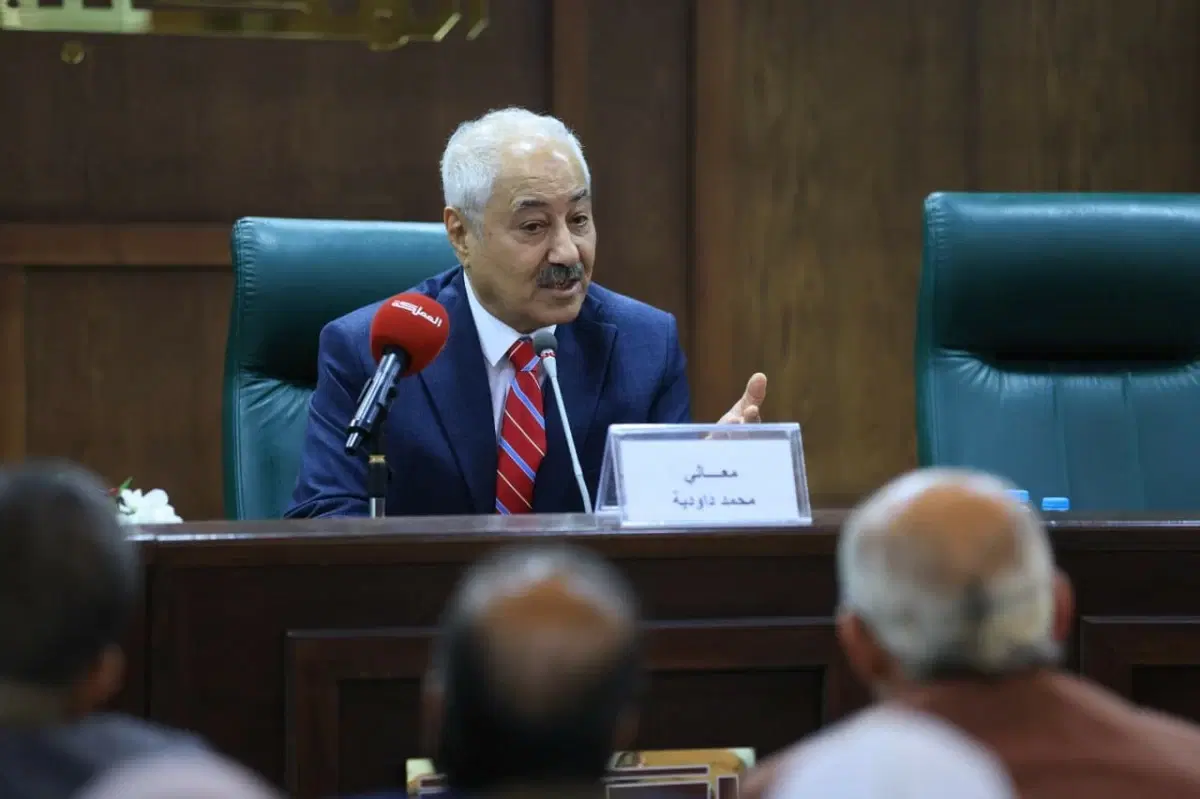
The Chairman of the Media and National Guidance Committee in the Senate of Jordan, Senator Muhammad Dawoodiyeh, said that the Jordanian identity is the product of a deep-rooted national and historical journey, which has been built by various components of Jordanian society, and through which the values of belonging, citizenship, and pride in the nation and its achievements have been established.
This was during his participation, today Monday, as the main speaker in the seminar «Pillars of the Jordanian Identity», which was held at the National Library, as part of the cultural program of the Amman International Book Fair 2026, and moderated by Dr. Linda Obeid, who holds the Arar Chair for Cultural and Literary Studies at Yarmouk University.
Dawoodiyeh stressed that understanding the Jordanian identity is linked to understanding the history, journey, and development of the Jordanian state, explaining that knowledge of the national and historical milestones that the Kingdom has passed through contributes to strengthening the awareness of identity among generations and enhancing their connection to their homeland.
He said that the Jordanian identity has the ability to interact with changes while preserving its core elements, emphasizing the importance of combining pride in national specificity with openness to the world and other cultures.
Dawoodiyeh pointed out that the Jordanian identity carries national, national, and humanitarian dimensions, and is reflected in Jordanian positions towards Arab and humanitarian issues, foremost of which is the Palestinian issue, which constitutes a strong presence in the minds of Jordanians and in the official position of the Jordanian state.
He recalled in this context the speech of His Majesty King Abdullah II before the United Nations General Assembly, considering it a model for expressing the Jordanian position towards the Palestinian issue, and what it included of affirmation of the legitimate rights of the Palestinian people and rejection of Israeli policies aimed at expansion at the expense of these rights.
He said that Palestine is present in the minds of Jordanians, and that Jordanian positions towards it reflect the overlap of the national dimension with the national and humanitarian dimensions in the Jordanian identity, pointing out that the presence of Jordanian medical cadres in hospitals in the Gaza Strip to provide care and support represents a practical model of this humanitarian dimension.
He stressed that state institutions play an integrated role in expressing the identity and Jordanian position, foremost of which is the Ministry of Foreign Affairs and Expatriates, which conveys Jordanian positions to regional and international forums, and defends national interests, constants, and Arab and humanitarian issues.
He also stressed the importance of Jordanian media in expressing national identity and protecting collective memory, by conveying Jordanian positions, documenting them, and providing reliable content capable of confronting misinformation and enhancing awareness of national, national, and humanitarian issues.
He called for the wider use of digital platforms and social media to present history and national and cultural content to new generations, with modern methods that suit the nature of the digital space and the development of communication tools.
Dawoodiyeh pointed out the importance of the complementary roles of the family, educational, cultural, and media institutions in strengthening awareness of national identity, and presenting Jordanian history to generations in a way that enhances belonging, citizenship, and responsibility.
He stressed that citizenship represents the practical expression of national identity, through respect for the law and state institutions, participation in public life, assuming responsibility, and promoting values of solidarity, respect, and diversity.
The seminar witnessed a discussion on the pillars of the Jordanian identity and ways to enhance its presence in cultural, educational, and media fields, and the role of national institutions in preserving the national heritage and transferring it to future generations in line with rapid changes.
The seminar is part of the cultural program of the Amman International Book Fair 2026, which includes a group of intellectual, cultural, and literary seminars and events.