Chinese President meets Trump in bid to ease tensions between the two countries
Amman3 min read
Share
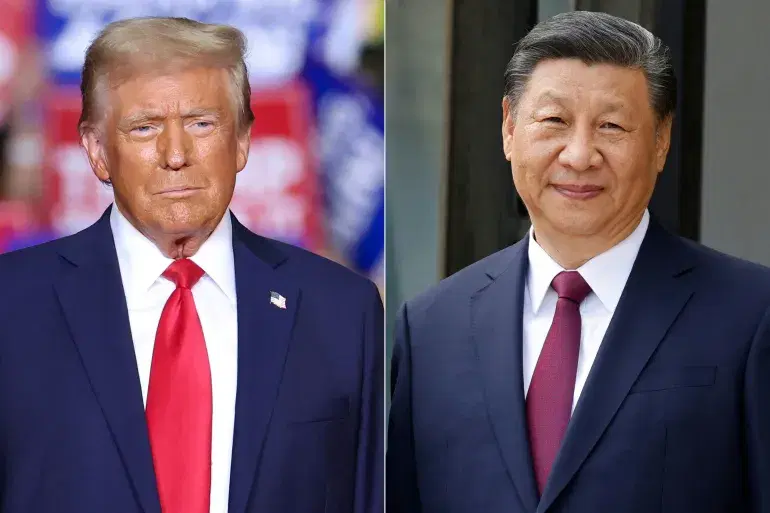
Beijing confirmed on Monday that Chinese President Xi Jinping will visit the United States this week for talks with President Donald Trump, expressing its hope that the visit will contribute to strengthening "strategic stability" between the world's two largest economies.
Washington had announced that Trump and Xi would meet this week in an attempt to ease tensions over trade, technology, and strategic issues.
A government statement said that Xi will pay a state visit to the United States from Wednesday to Friday.
Chinese Foreign Ministry spokesperson Geng Shuang said the two presidents will hold an "in-depth exchange of views on major issues related to China-US relations and global peace and development."
He added that China "will work with the United States to enrich the substance of the constructive strategic stability relationship between China and the United States, enhance dialogue and cooperation, and properly manage differences."
A US official confirmed that Trump will personally welcome Xi at Joint Base Andrews on Wednesday, ahead of their meetings the following day.
The Chinese Vice President had welcomed Trump upon his arrival in Beijing for a state visit in May.
Trump told reporters aboard Air Force One on Sunday, "I will discuss almost everything with him."
The ongoing trade war between the two countries is a major source of concern, as despite both sides maintaining a tariff truce for about a year, they have yet to reach a permanent agreement.
Meanwhile, China's top trade negotiator, Vice Premier He Lifeng, is holding talks in the United States with US Treasury Secretary Scott Bessent.
During their first meeting on Sunday, the two sides discussed establishing a communication channel regarding concerns related to artificial intelligence.
Warnings of a potential catastrophe caused by artificial intelligence weigh heavily on the upcoming meeting, at a time when both countries are racing to achieve technological superiority.
The war the United States is waging with Iran also casts a shadow over relations between the two countries, as Beijing seeks to avoid US sanctions imposed on countries that deal with Tehran, and amid reports that China provided Iran with intelligence to launch a strike on US forces.
China is considered one of Iran's most prominent economic partners and diplomatic supporters, purchasing a large portion of Tehran's oil production, and has also sought to mediate in the war, which has entered its seventh month.
However, analysts warn that expectations for the Trump-Xi summit are limited.
Former US Deputy Secretary of State Kurt Campbell said, "One of the few things we can hope for in the short term is to reach a truce, and it is likely to last until the end of this year."
The threat of military confrontation also looms over Taiwan, the self-governing island that China claims sovereignty over.
In July, Chinese Foreign Minister Wang Yi told his US counterpart Marco Rubio that improving relations between the two countries "requires action," while simultaneously issuing a warning regarding Taiwan.
Taipei relies heavily on Washington's support in the face of increasing pressure from China.
In June, Rubio said a massive $14 billion arms deal for Taiwan was "under review," while Trump described it as a "very good bargaining chip" in dealing with China.
Among China's bargaining chips is its dominance over the supply of rare earth metals, which are vital materials for the manufacture of advanced technology products and on which US manufacturers rely.
Beijing succeeded last year in pressuring Washington to back down from its high tariffs after it imposed strict restrictions on exports of rare earth elements.