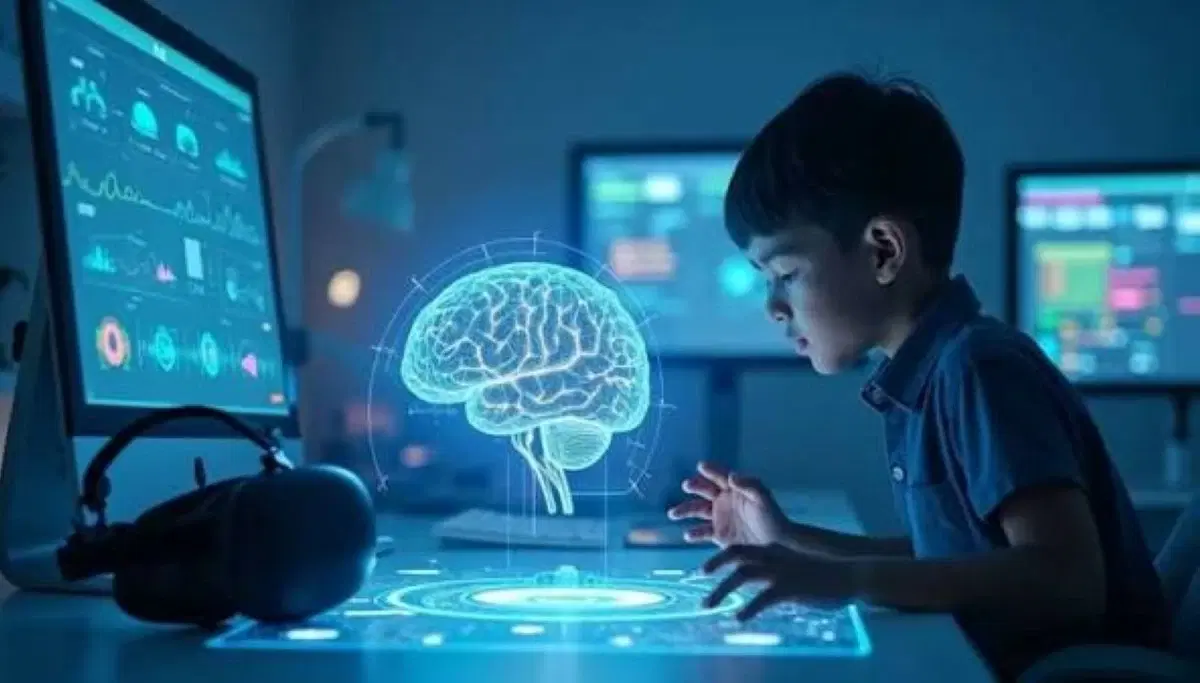
Children's secrets in the age of artificial intelligence.. A digital friend or a substitute for human relationships?
Amman6 min read
Share
The relationship between children and artificial intelligence is no longer limited to solving homework or searching for information; it has extended into a more private space: feelings, secrets, and problems they might hesitate to share with parents or friends.
A survey conducted in Finland revealed that 78 percent of children and adolescents aged 11 to 17 use artificial intelligence tools, while one in five of them talks to these tools about matters they do not wish to discuss with others.
These results open a wide door to questions about the nature of the relationship forming between children and technology, and whether conversations with intelligent systems are just an easy way to express themselves, or if they have begun to occupy a space of human relationships in their lives.
The survey, conducted with the support of the Finnish foundations "Etla" and "DigiRuoho," showed that about 20 percent of participants turn to artificial intelligence to discuss personal topics they do not want to talk about with others.
This percentage rises to more than 25 percent among older adolescents, while about 7 percent said they use these tools because they cannot find anyone else to talk to.
These figures reveal a different side of the spread of artificial intelligence; it is not just about getting answers, but also about seeking a space to confide and express feelings.
Conversing with an intelligent system seems like a comfortable option for some children, as it is available at any time, answers quickly, and does not show disapproval or embarrassment in the way a child might expect from others.
However, feeling comfortable while talking does not mean that the system understands human emotions as a close person does, or that it is capable of providing appropriate support in sensitive situations.
The use of artificial intelligence is no longer limited to adolescents, as the survey showed that 71 percent of students in grades four to six use it as well.
Uses include completing homework and searching for information, alongside personal conversations that may address daily problems or topics that are difficult to discuss face-to-face.
Mobile phones play a major role in this spread, as 94 percent of artificial intelligence users use these tools via their phones, while about half of users turn to them daily.
It is noteworthy that more than half of the participants learned to use these technologies on their own, which highlights the speed of their spread compared to the ability of some families and schools to keep pace with their developments.
This poses an important educational challenge: how can children be helped to benefit from these tools without them turning into a space that is not subject to guidance or supervision appropriate for their ages?
The challenges do not stop at using artificial intelligence for personal conversations, but extend to the extent of children's trust in the information it provides.
The survey showed that 57 percent of participants trust the information they receive from these systems completely or to some extent.
The problem lies in the fact that artificial intelligence tools may provide inaccurate information in a confident and convincing manner, which makes discovering errors difficult, especially for children who have not yet developed sufficient skills to verify sources.
About a third of participants also pointed to the difficulty of distinguishing between real photos and videos and those produced using artificial intelligence.
The importance of this issue increases when conversations relate to health, relationships, or psychological problems, as a child might treat an inaccurate answer as reliable advice, or base decisions on it that do not suit their situation.
During a conversation with an intelligent system, a child might share details about their family, friends, or feelings, without fully realizing the nature of the data they are providing or how it is handled.
Therefore, teaching children to protect their privacy is no less important than teaching them how to use technology. This includes avoiding sharing passwords, addresses, and sensitive personal details, and not assuming that digital conversation enjoys the same confidentiality they imagine.
It is also important for the child to understand that artificial intelligence is not a person who can take responsibility for their safety, and that it may make mistakes or provide an inappropriate response, even when its answer seems empathetic.
The survey results do not prove that using artificial intelligence necessarily leads to loneliness or a decline in social relationships, but they do indicate that it has become part of the personal lives of some children, and not just a tool for study.
Digital conversations may be an additional way to express oneself, but the danger appears when a child relies on them increasingly, or turns to them alone when facing problems that require real human support.
Friendship and family relationships are not based on the exchange of words only, but include shared experiences, mutual interaction, human presence, and the ability to provide help and take responsibility.
These are aspects that cannot be assumed an intelligent system is capable of providing in the same way.
Faced with this reality, the role of the family and school is not limited to determining the time a child spends in front of the screen, but extends to building awareness that helps them use technology responsibly.
This begins with opening a calm dialogue about the tools they use, and what drives them to talk to them, while avoiding turning every digital conversation into a cause for punishment or blame.
They should also be encouraged to verify information, distinguish between possible answers and confirmed facts, and turn to a trusted adult when they face a problem that worries them or they feel they are unable to handle alone.
For the true test of artificial intelligence is not just what it can offer children, but how it can be employed without diminishing their need for friendship, trust, and human support.