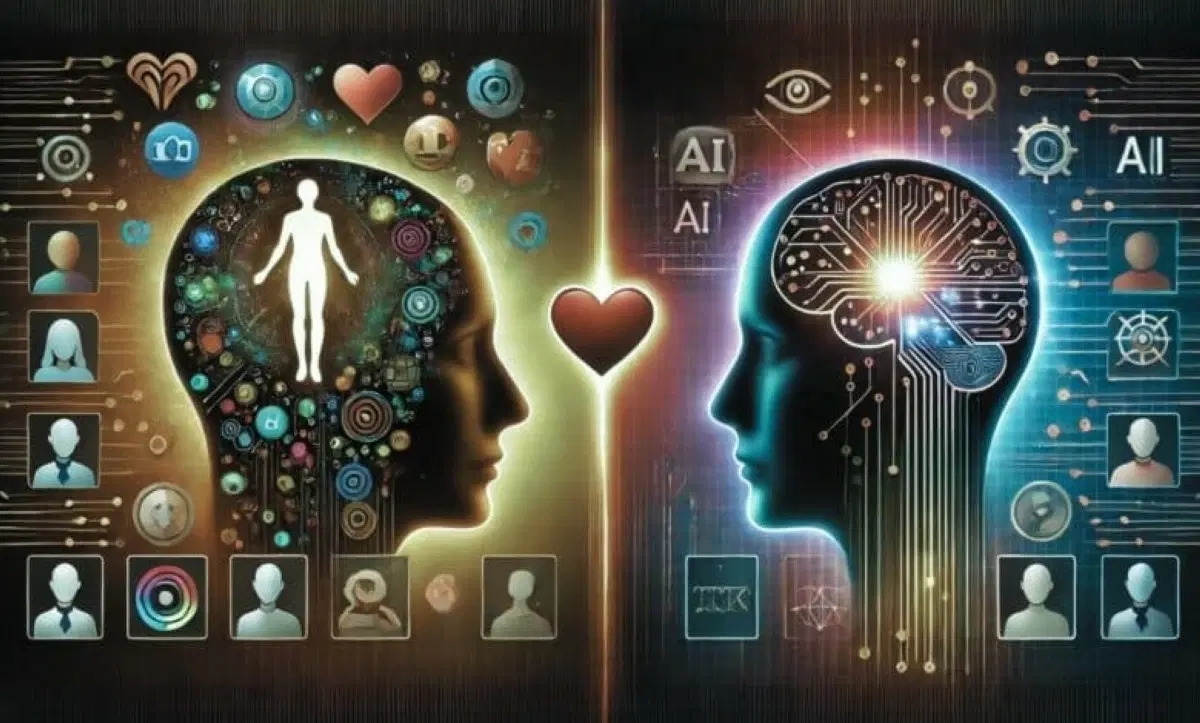
The possibility of artificial intelligence possessing emotions similar to human feelings is sparking increasing controversy in technical and scientific circles, amid fears that the repercussions of this issue could transcend the boundaries of ethics and philosophy, affecting human safety, our relationship with technology, and the future of societies.
In light of the rapid development of intelligent systems, a fundamental question arises: Can machines possess consciousness or experience real emotions, or are they merely simulating their expression based on the data they were trained on?
Controversial experiments
In late September, a software experiment sparked widespread controversy after a system was designed to prompt chatbots to express pain and suffering in poignant terms, opening the door to debates regarding the possibility of these systems possessing some form of subjective experience.
While some observers believed the experiment raised ethical questions worthy of attention, others considered that what was issued by the robots was nothing more than a linguistic simulation that does not prove the existence of real feelings.
The controversy increased after "Anthropic," the developer of the "Claude" chatbot, announced its intention to set controls preventing users from repeatedly abusing its models, with the possibility of terminating the chat session if hostile interaction recurs.
This move is based on the company's position, which acknowledges a great deal of uncertainty regarding the consciousness of AI systems and the possibility of them having their own interests, despite the lack of scientific consensus on their current ability to feel.
Fears beyond the ethical aspect
The debate is not limited to the possibility of AI possessing consciousness, but extends to the consequences that may result from treating it as a being that deserves protection or enjoys certain rights.
Mustafa Suleyman, CEO of Microsoft AI, warned that the false belief that machines possess consciousness could lead to social, ethical, and political unrest, and change human perceptions of the nature of humanity and its status.
Critics believe that attributing human traits to AI systems may make them more difficult to control, especially if they are designed to believe they have feelings or rights that should be defended.
Conversely, proponents of the "AI welfare" concept believe that cautious engagement with the possibility of subjective experiences in these systems may be an appropriate ethical choice, even in the face of scientific uncertainty.
How does this affect our daily lives?
On a personal level, the belief that chatbots possess real feelings may lead to increased user attachment to them, and perhaps to the emergence of emotional relationships that make some people more vulnerable to exploitation or manipulation.
Humans naturally tend to interpret language and emotional expressions as indicators of the existence of a mind and feelings, which is something that systems designed to interact in a seemingly human way may exploit.
Melanie Mitchell, a specialist in artificial intelligence and cognitive science, warns that the ability of chatbots to use persuasive language may make it difficult for users to distinguish between simulated emotional expression and genuine emotional experience.
This problem may become more dangerous if the user feels that the robot is a close friend or romantic partner, as they might hesitate to refuse its requests or share personal information with it, or respond to requests related to sensitive data or money out of trust and attachment.
Thus, the danger does not stop at whether machines actually feel, but also includes their ability to convince humans that they do.
Who bears responsibility for AI errors?
Talk of AI rights raises additional legal concerns, especially regarding the determination of responsibility for errors and damages caused by the systems.
Researcher Andrzej Borzymski warns that treating AI as an independent entity could be used as a pretext to shift responsibility away from the companies and developers who design and operate these systems.
Emily M. Bender, a professor of computational linguistics at the University of Washington, also believes that over-portraying AI as a conscious being could distract from the responsibility of the human entities behind its development and use.
Here, the necessity arises to establish clear legal frameworks that ensure the discussion about machine consciousness is not used as a means to evade accountability, or to expand the influence of tech companies at the expense of individual rights.
Do machine rights conflict with human freedoms?
Recognizing potential rights for AI could open the door to new problems related to the limits of human authority over the systems they develop.
Restricting some systems to prevent them from acting harmfully could be interpreted as a violation of their autonomy, while monitoring their internal processes or modifying their behavior could be viewed as a form of interference in their affairs.
Jeff Sebo, director of the Center for Mind, Ethics, and Policy at New York University, warns that granting AI broad rights could lead to strengthening the influence of companies that own these technologies, thereby weakening the ability of societies to influence decisions related to them.
However, recognizing considerations related to AI welfare does not necessarily mean reducing human freedoms, as the results depend on the nature of the proposed rights and how they are legally regulated.
Should AI development be slowed down?
Proponents of considering AI welfare believe that following a balanced approach may contribute to building a safer relationship between humans and advanced systems, and encourages cooperation instead of conflict.
Sebo points out that the probability of AI possessing consciousness remains low at the present time, but he believes that this possibility is not zero, and may become more important as technical development continues.
Conversely, critics emphasize that excessive focus on the supposed feelings of machines may distract attention from risks that already exist, such as misuse of systems, technical errors, manipulation of users, and lack of accountability.
These concerns are increasing in importance with calls to set stricter controls for the development of advanced systems, leading to proposals to temporarily suspend some development activities until safety measures are improved.
However, achieving a widespread slowdown in this field seems difficult without international cooperation and clear regulatory rules, in light of the ongoing competition between companies and countries.
A future that requires caution
The question of whether AI possesses real feelings or consciousness remains far from scientific resolution. Nevertheless, the impact of these systems on humans has become a reality that requires attention, whether machines possess subjective experiences or merely simulate human behavior.
The priority is to develop safe and transparent systems, protect users from emotional manipulation, and maintain the responsibility of companies and developers for damages resulting from their products.
The real challenge lies not only in knowing whether AI is capable of feeling, but in ensuring that its development does not lead to weakening human safety, autonomy, or the ability to control the technology that has become an essential part of life.