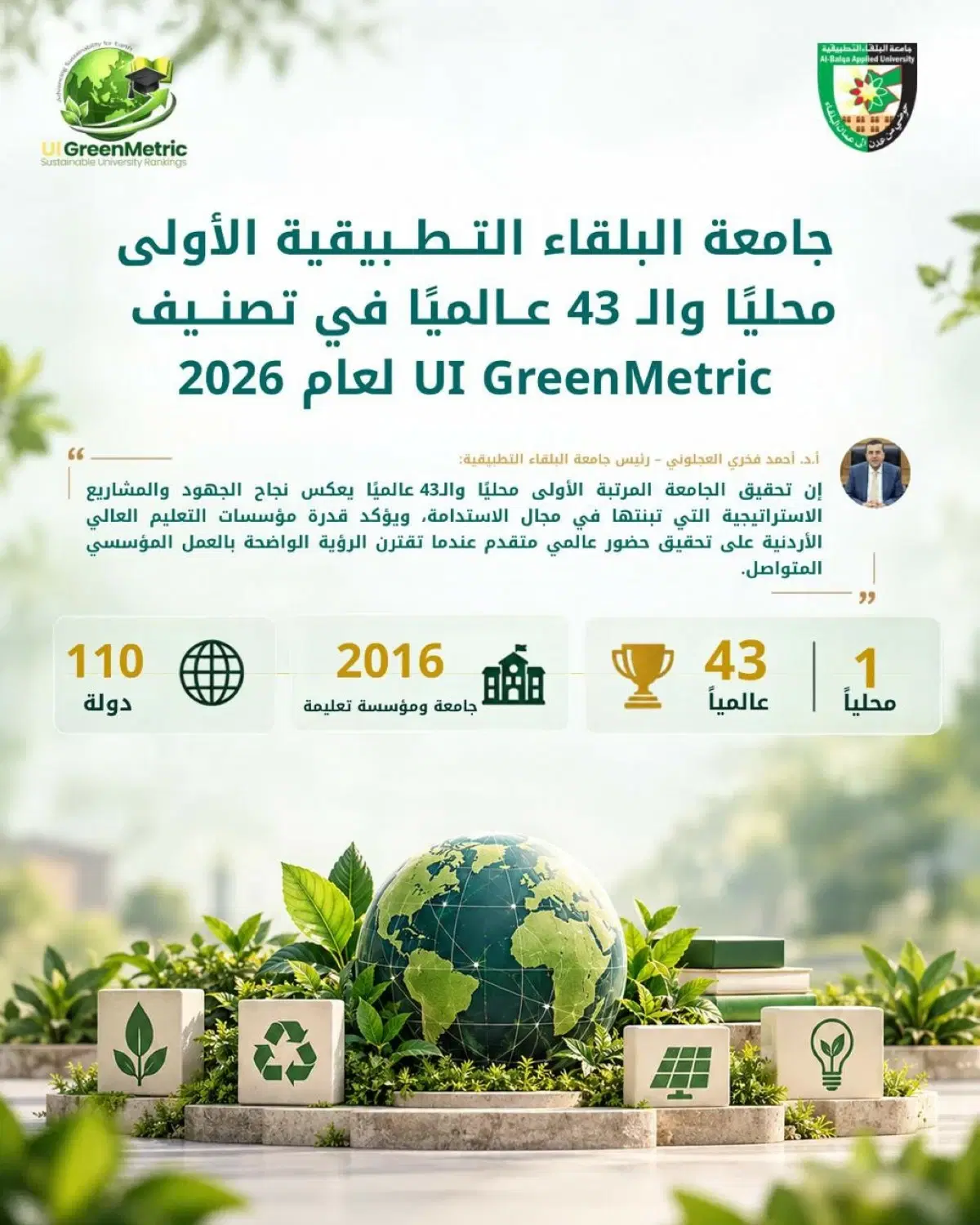
The 2026 ranking methodology adds the governance and digitalization axis to its previous six axes, to include seven axes: infrastructure and university environment, energy and climate change, waste, water, transportation, education and scientific research, and governance and digitalization. This addition highlights the role of institutional policies and digital systems in improving resource efficiency and monitoring the impact of sustainability initiatives.
The President of Al-Balqa Applied University, Professor Dr. Ahmed Fakhri Al-Ajlouni, said that achieving the first rank locally and the 43rd rank globally reflects the success of the strategic efforts and projects it has adopted in the field of sustainability, and confirms the ability of Jordanian higher education institutions to achieve an advanced global presence when a clear vision is combined with continuous institutional work.
Ajlouni added that this achievement is the result of joint efforts made by the university's faculties, units, and centers, and contributed by faculty, administrative staff, and students, stressing that the university views sustainability as part of its educational and practical mission and its responsibility towards society, and as a fundamental element in its planning and development of facilities and management of resources.
Ajlouni pointed out that the university continues to work on improving energy and water efficiency, expanding solar energy projects, improving waste management, and developing university spaces and facilities, alongside supporting digital transformation and enhancing initiatives related to environmentally friendly transportation. He explained that the impact of these efforts extends to the quality of the educational environment and the services provided to students and staff, and to the role the university plays in the local communities where its faculties are spread.
Ajlouni confirmed that the university will continue to build on this achievement by expanding the participation of students and researchers in sustainability projects, supporting scientific research and practical solutions related to environmental challenges, and strengthening partnerships with national and international institutions. He said the goal is to establish a university model that links applied education with the responsible use of resources, and aligns with national trends towards clean energy, green economy, and sustainable development.
For his part, the Vice President for Planning and Quality Assurance, Professor Dr. Haitham Hamoud Al-Shbouli, said that the university's achievement of the 43rd rank globally and the first rank locally came as a result of participatory and cumulative institutional work, focusing on developing the university environment, improving resource management, enhancing energy and water efficiency, developing waste and transportation management, and supporting education and scientific research linked to sustainable development goals.
Al-Shbouli explained that the university treats the UI GreenMetric results as a tool for measuring performance and guiding continuous improvement, by studying the results of each axis, identifying strengths and opportunities for development, and linking them to executive plans and measurable indicators. Al-Shbouli added that the inclusion of governance and digitalization in the 2026 methodology enhances the importance of integrating institutional data, policies, and procedures in supporting sustainability and demonstrating its impact.
The university confirmed that it will continue to develop its projects and initiatives in its various faculties and facilities, and expand the participation of students, faculty members, staff, and the local community in them, to enhance its environmental, social, economic impact and presence at the international level.