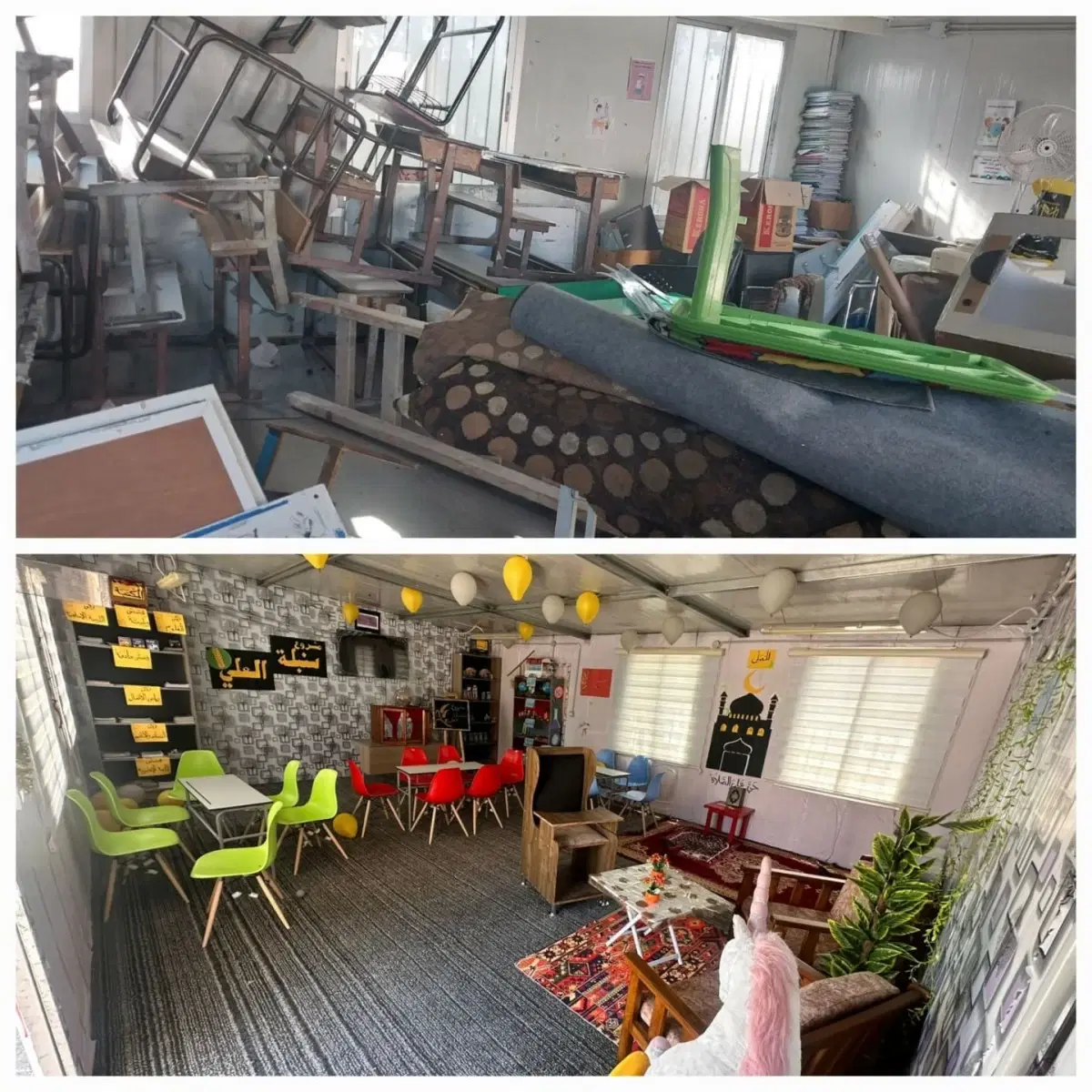
The Sanabla initiative, one of the initiatives of the Al-Joud Foundation for Scientific Care, a non-profit organization, believes that its role is to enhance the status of schools in producing a conscious, confident, and creative generation, capable of making a positive difference in their society.
This is achieved by supporting school projects that have brought about tangible change in public schools, whether by introducing a new project or developing existing ones, thereby enhancing students' sense of belonging and motivating them to work as a team, as many schools have participated in this creative initiative, which has achieved pioneering achievements.
The Silent Challenge Club project at the Haritha Comprehensive Secondary School for Girls, affiliated with the Directorate of Education of the Bani Kenana District, won first place at the directorate level. It involves the establishment of a sports hall within the school.
The project coordinator, Teacher Najwa Ibrahim Abaydat, explained that the idea was initiated by the school principal, Hanaa Majid Abaydat, who saw an opportunity in one of the unused rooms to create a hall that would serve the female students.
With joint efforts from the municipality, the Haritha Charitable Association, and the local community, the room was transformed from a storage space into an equipped sports hall.
Abaydat confirmed that the project faced challenges, most notably the limited time, as work was done outside of official hours to complete it. She pointed out that the hall provided a safe environment for training in games such as table tennis and badminton, and became a place for discovering talented female students in sports, away from the constraints of weather or limited outdoor play areas.
The Nahwand Basic Mixed School in the Irbid Citadel was keen to provide a healthy and safe school environment through its project, 'An Environment Worthy of Us,' which aimed to rehabilitate and maintain the sanitary facilities for females.
The project included improving floors, walls, doors, sinks, sanitation work, and painting, ensuring adequate and safe sanitary facilities, promoting healthy behaviors among students, and reflecting the image of the school as an institution that cares about the health and well-being of its students.
The project served as a living model of partnership between the school and the local community, affirming that real cooperation can turn challenges into opportunities.
The Khariba Basic Mixed School in Irbid Bani Kenana participated in the 'English Language Club' project, led by the principal Lubna Abaya and a team of teachers.
Teacher Maisa Al-Khatib, the liaison officer, explained that the project faced challenges, most notably the existence of an unused room and the need for a modern educational environment that helps employ active teaching strategies and technology, breaking the traditional learning pattern and increasing student interaction.
She praised the moral support and continuous motivation from the Al-Joud Foundation, which boosted the team's motivation and helped them continue and achieve.
In the Rafida Islamic Basic Mixed School in Bani Obaid, the Educational Resources Room project was launched due to the need to support students with learning difficulties and inclusive education. Teacher Wisal Al-Amri, the liaison officer, explained that the project was carried out in cooperation with the Wasan Educational Center for People with Special Needs to diagnose students and develop treatment plans, along with learning communities with parents and teachers.
Despite the difficulties represented by the lack of money and time, the team worked outside of working hours and on holidays to make the project a success, which also served as a continuous charity for the soul of the educational professor Ali Al-Amri.
The 'Skills Development Studio and Educational Podcast' project at the Amana bint Wahb Basic School for Girls in the Ramtha District provided a modern educational space that created confident voices.
Teacher Nadia Faisal, the project coordinator, explained that the idea was to create a studio that allows students to prepare and present educational programs, participate in writing dialogues, and practice speaking, filming, and recording, employing technology and artificial intelligence in an educational and purposeful manner.
The studio has become a vital platform for showcasing educational plays and organizing meetings and dialogues, contributing to the development of communication skills, teamwork, and self-confidence. These efforts culminated in the project winning at the northern regional level, serving as a motivation for further innovation.
The Sanabla initiative has proven that successful projects do not always require large resources, but rather a clear idea, a strong will, and a smart investment of available resources.
The initiative has opened up broad horizons for creativity and innovation for schools, transforming educational ideas into sustainable, practical projects that touch the lives of students, showcase their potential, and enhance the role of the school in producing a confident and creative generation capable of making a positive impact in their society.