((Sunbula Initiative)) Ideas from the heart of schools turn into projects that make an impact
Amman5 min read
Share
The Sunbula Initiative for the year 2026, one of the initiatives of the non-profit Al-Jood Foundation for Scientific Care, embodies a prominent role through the achievements and partnerships it has accomplished inside public schools, forming an ideal model of giving, creativity, and excellence, as it seeks to invest in empty spaces in schools and develop them to suit the needs of students and launch their creativity
Among these participations is Al-Hussein Comprehensive Secondary School for Boys, affiliated with the Directorate of Education of the Amman Qasabeh District, which excelled in utilizing school facilities through the "Smart Theater" project, which repurposed the theater to become an effective educational and awareness space serving students during the school day.
Teacher Alia Al-Ayyes spoke about the launch of the project, saying: The idea came from observing the waiting time of the evening shift students before their shift begins, and turning this time from a waiting period into an opportunity to learn and benefit, by displaying purposeful educational, health, and cultural content inside the theater, in addition to activating extracurricular and school activities on a larger scale.
The project was distinguished by the simplicity of its idea and its sustainability, making the theater a space that can be continuously employed in awareness, education, and developing students' knowledge,
The impact of the project reached a wide segment of the school community, benefiting about 400 students in the morning shift and 300 female students in the evening shift, reflecting the ability of Sunbula projects to start from simple needs within the school environment and turn them into practical solutions that make a tangible difference in the students' experience.
The "Smart Theater" represents the essence of Sunbula's methodology in encouraging schools and teachers to view daily challenges as opportunities for development, and turning ideas into applicable and sustainable projects whose impact is present in the lives of students and the school.
Shatna Bani Obaid School also participated in the "Sunbula" project, and its principal, Dr. Sawsan Ababneh, spoke about the school winning the project
, stressing that this achievement constitutes an important milestone in the school's journey and reflects the magnitude of the efforts exerted by the teaching staff and students in turning ideas into realistic initiatives with a tangible impact.
Ababneh explained that the win did not come out of nowhere, but rather was the result of teamwork characterized by persistence, planning, creativity, and a true belief that the school is not just a place for learning, but a space for generating ideas, building initiatives, and enhancing a sense of responsibility among students. She pointed out that the "Sunbula" project embodied the school's ability to present an educational model that goes beyond the boundaries of classrooms to reach the community and leave a positive and sustainable impact. She emphasized that true success is not measured only by receiving an award, but by the impact the initiative leaves in the lives of students and the community, and by the new horizons it opens up for them to create, participate, and make change.
Ababneh appreciated the efforts of all those who contributed to the success of the project, including teachers, students, and partners
Muthallath Al-Aridha School participated with the "Canopies" project,
and teacher Reham Al-Faqir said
Observing the real need within the school environment for shaded spaces for students was evident, especially since the school is located in an area experiencing a noticeable rise in temperatures, making their provision an important and necessary matter. The project aimed to provide more comfortable and safe places for students during breaks and school activities, and to protect them from direct exposure to sunlight.
Al-Faqir pointed out that the importance of the project is not limited to adding canopies inside the school alone, but rather lies in finding a practical solution to a challenge facing students on a daily basis. The project embodies the idea that successful school initiatives start from observing the details and surrounding needs, and then working to find simple and implementable solutions
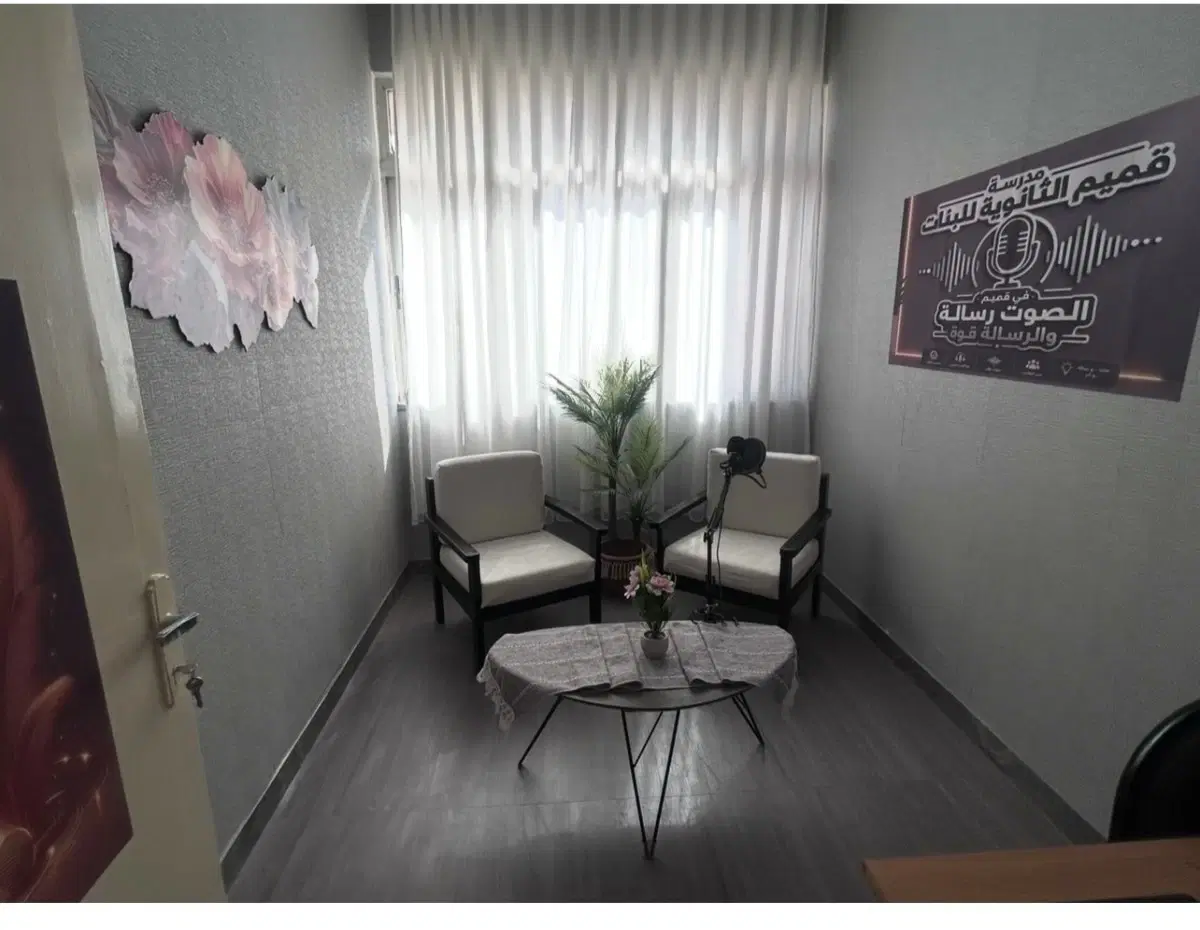
The school podcast "School Stories" is a school project launched by Qumaim Comprehensive Secondary School for Girls in Al-Taybeh and Al-Wastiyyah District,
And
School Principal Enas Hassan Ali Matalqa pointed out the importance of the project, the desired goals, and the mechanism of achievement and implementation
To be an educational and creative audio platform that allows female students to express their ideas and opinions, present purposeful content related to their daily lives and educational and pedagogical issues, and enhance dialogue among them
With the aim of developing students' communication and expression skills in a creative and modern way, boosting self-confidence, employing technology in the educational process, spreading the culture of dialogue and respect for other opinions, highlighting students' talents in recitation, writing, and media preparation, connecting learning with daily life, and enhancing the role of the school as a center for creativity, innovation, and initiative.
Matalqa said: The project began by preparing the appropriate environment for recording by rehabilitating a space inside the school, installing curtains and lighting, and equipping the place to suit recording
, The project contributed to providing an audio space to express the ideas and creativity of the female students, supported the documentation of the school's achievements and activities, enhanced communication between the school, parents, and the local community, and opened the door to hosting experts from the local community to support partnership and enhance the role of the school as a cultural and educational platform.
The project faced challenges represented in providing appropriate devices and equipment, the weak technical experience of some female students, the need to control sound quality, and preparing appropriate content that requires planning, in addition to training female students on recitation, dialogue, and dealing with stage fright in front of the microphone. These were dealt with through preparing a suitable space, gradual training, improving the recording environment, organizing content, and continuing production and publication.