When children become more aware than their parents
Amman7 min read
Share
What happens when a son becomes more knowledgeable about a tool than his father? And who leads the educational process when the educator loses their cognitive superiority in the world of technology? Perhaps these questions have become some of the most pressing issues today in light of the rapid digital revolution that has reshaped the nature of knowledge, learning methods, and patterns of human communication.
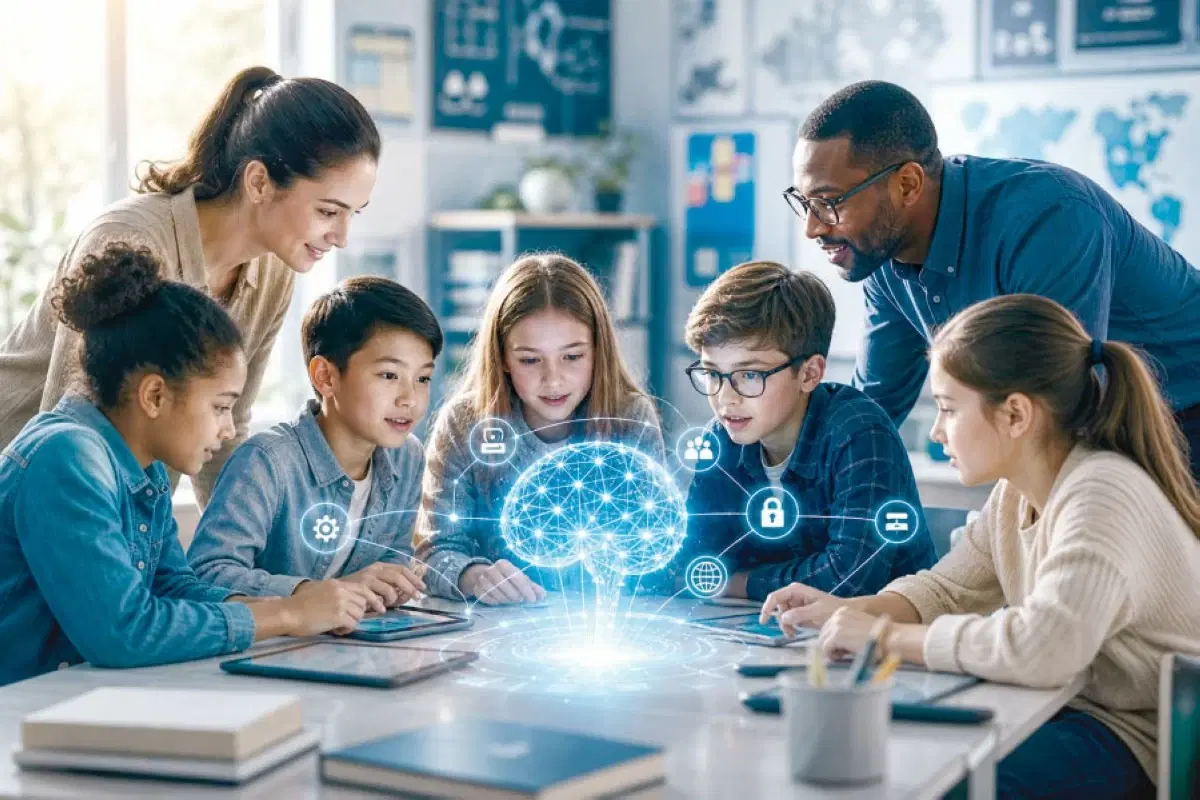
The world is witnessing a pivotal stage in the history of education imposed by the digital revolution, as many children now possess technical skills and digital capabilities that exceed those of their parents. This superiority is no longer limited to using smartphones or artificial intelligence applications, but has extended to the speed of accessing information and interacting with the digital world.
In my view, many of the problems plaguing our societies today are not, in their origin, security problems as much as they are educational problems resulting from the family's failure to keep pace with rapid technological transformations. The wider the cognitive gap between parents and children, the weaker the family's ability to guide, and dealing with technology becomes based on prohibition or intimidation rather than understanding and containment.
Educational literature emphasizes the importance of developing digital awareness, critical thinking, and digital citizenship among families and educational institutions, ensuring the safe and responsible use of technology.
The issue is not that our children have become more aware of technology, but that we have not prepared ourselves educationally to accompany them in this new world. Therefore, our question should shift from: How do we prevent our children from using technology? To: How do we qualify ourselves to lead them in using it?
Perhaps the first thing that should be realized before talking about solutions is that technical superiority does not necessarily mean possessing awareness in its use. Children possessing skills to use technology does not mean they possess the ability to evaluate the information it provides or verify its credibility.
Educational literature indicates that critical thinking and digital awareness have become among the most important skills of the twenty-first century, because the abundance of information does not mean its accuracy, but rather requires possessing skills to verify sources, analyze content, and make evidence-based decisions.
We may see this in everyday life situations; a student might be able to complete their homework in minutes using an artificial intelligence application, but they may be unable to distinguish between documented information and misleading information, or between a personal opinion and a scientific fact. Here, the importance of education, not technology, becomes clear.
From this standpoint, I believe that one of the most important concepts we should instill in our children is that artificial intelligence is not a source of science and knowledge, but a tool that helps humans process and organize information according to the inputs they provide. It does not produce truth on its own, nor does it possess the ability to make scientific judgments; rather, it reorganizes information according to the commands and data it receives. Therefore, the quality of its output remains linked to the user's awareness, the accuracy of their inputs, and their ability to analyze and critique the results.
For this reason, authentic scientific references—such as peer-reviewed books, rigorous scientific research, and specialized scholars—in addition to religious and cultural references, remain the foundation for building knowledge, while artificial intelligence tools remain auxiliary means that help humans learn, but they do not replace the mind, nor do they negate the value of original sources.
If children have surpassed their parents in using technology, the solution does not lie in resisting it, but in qualifying the family to keep pace with this development. Therefore, I believe it is necessary for parents to be keen on learning technology and artificial intelligence, whether before their children or with them, because an educator who is ignorant of the tool cannot lead its use, and will often find themselves caught between unjustified rejection or unconscious acceptance.
Role modeling also remains the fundamental pillar of education; we cannot demand that our children use technology rationally if we do not provide them with a conscious model in using it. Social cognitive learning theory has confirmed that many behaviors are acquired through observation and imitation, and that parents represent the primary model from which children derive behavioral patterns and values (Bandura, 1986).
Education for immunization... not for prohibition
The role of parents in the digital age is no longer limited to monitoring or restricting their children's use of technology, but has become about building the intellectual immunity that enables them to deal consciously with the vast amount of information they are exposed to daily.
In my view, true education is not based on prohibition, but on empowering children with critical thinking tools that help them question, analyze, compare, and verify information before accepting or circulating it. A child who learns how to think will be more capable of protecting themselves from misinformation, even in the absence of parental supervision.
Therefore, the responsibility of the parent does not lie in keeping their children away from technology, but in accompanying them while using it, teaching them how to verify the accuracy of information, distinguish between facts and opinions, and between reliable and unreliable sources, and guiding them to refer to peer-reviewed scientific references, rigorous books, specialists, and authentic religious and cultural sources when the need for knowledge or verification arises.
As for settling for a policy of prohibition, it may achieve a temporary response, but it does not build lasting awareness. Here, the family has lost a precious opportunity; it has not prevented technology from reaching its child, and at the same time, it has not given them the intellectual and cognitive tools that enable them to use it consciously, analyze what is presented to them, distinguish between right and wrong, and refer to authentic references when needed.
Immunizing children with knowledge, critical thinking skills, and digital awareness is the true educational investment; because it provides them with the tools that enable them to make conscious and responsible decisions, and makes them capable of evaluating what technology presents instead of accepting it as an absolute truth.
The goal of education is not for children to obey in the presence of a supervisor, but for them to possess enough awareness and knowledge to be able to control themselves, distinguish between right and wrong, and choose the correct knowledge themselves, based on their values and authentic references, not on what algorithms impose or what digital platforms display.
If we want to restore the role of the family in leading education, we must first develop ourselves, learn before we teach, be role models in dealing with technology, and instill in our children that artificial intelligence is a means of learning, not a substitute for the mind, the book, the teacher, or the rigorous scientific reference.
It is a sincere call to every father and mother: Teach your children how to think before you teach them how to use, how to verify before they believe, and how to choose before they follow.
The future of our children will not be determined by technology as much as it will be determined by the education we instill in them. Tools change, and platforms shift, but a conscious human remains capable of making every technology a means for construction, not a cause for loss. Therefore, our responsibility today is not to prepare our children for the world of yesterday, but to prepare them for a future in which tools may change, but values, science, and critical thinking will remain the compass that guides them to the right path.