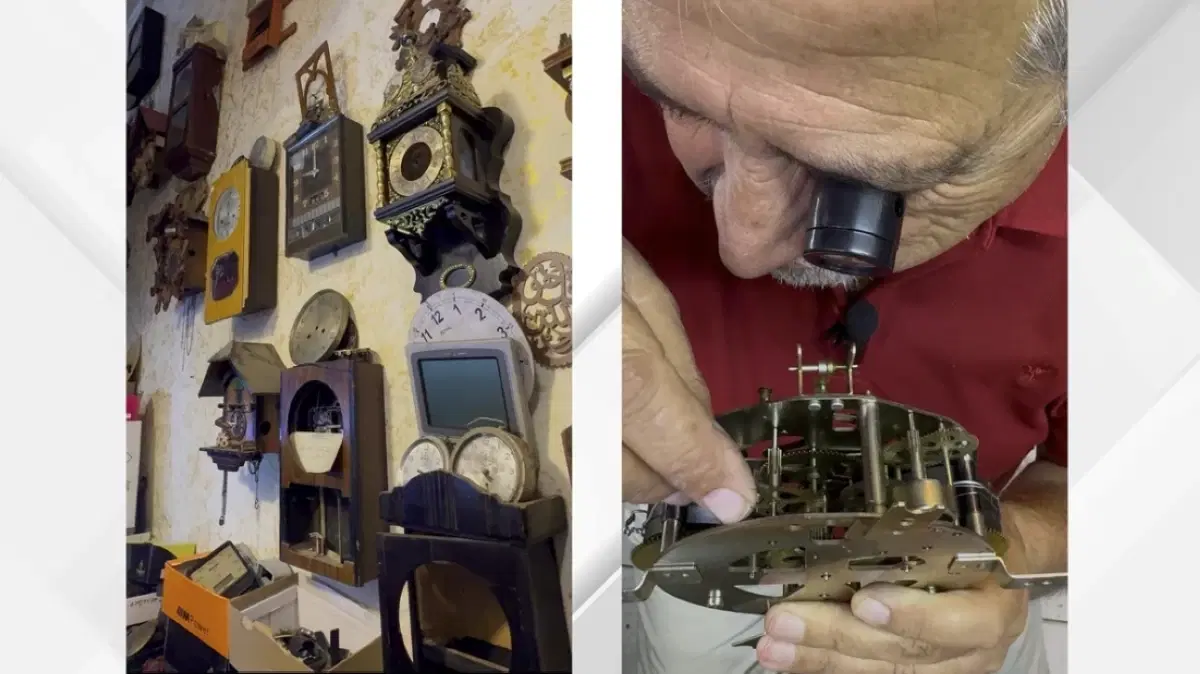
"Ticking" of Time.. The Story of Abu Darwish Al-Awali with Old Clocks
Amman5 min read
Share
The "ticking" of an old clock may seem like a passing sound, but for its owners, it carries the memory of a father or grandfather and stores years whose echo remains present despite the passage of time.
This sound is known to Mazen Mustafa Al-Awali, nicknamed "Abu Darwish the Horologist," who spent years repairing clocks, preserving a profession inherited from his father and transformed by him into stories that go beyond measuring time.
Al-Awali tells the Jordan News Agency (Petra) that his father began working in clock repair in Beirut, then moved to Haifa before settling in Jordan, where he opened his first shop in Aqaba in 1948, and later moved to Amman and opened several branches there before settling his last one in the Nablusi market, the entrance of the former "Al-Salam Restaurant."
He adds that his father chose Jordan because of the security and safety he found there, and the kindness and generosity he observed among its people, affirming that this journey continues to this day under the Hashemite leadership.
He recalls the beginnings of his relationship with the profession from his childhood, when he watched his father and brothers as they dealt with clocks and their precise parts, before learning their secrets through observation and practice. He was the youngest of his siblings to learn the trade, so the family's expertise was passed on to him and the craft became part of his life, a continuation of his father's name, which is a source of pride and honor for him.
He recalls what his father used to tell him about the clock market in downtown Amman in the past, when the number of professionals did not exceed the fingers of one hand. They were united by a professional and human relationship based on cooperation and sharing of sustenance, away from monopolizing customers or exclusive work.
He narrates that the watchmakers used to share breakfast daily, eating it at one of their places every day, and they were keen to distribute customers among themselves. If one of them "opened" with a customer and then another came, he would direct him to a colleague who had not yet received a customer, so that everyone would get their share of work and income and each of them could support his household and children. They saw this as a door to blessing in sustenance and an embodiment of solidarity. For them, the profession was a source of livelihood that extended to everyone, not a field for greed and monopolization of customers.
He explains that the watchmaking industry has undergone transformations with the emergence of new types, from electronic and "quartz" watches to battery-operated and automatic watches, while repairing some old pieces has become more difficult after factories stopped producing parts and spare parts for them.
He points out that the clocks that reach his shop may be stopped due to dirt, neglect, or damage to some of their parts, but some come loaded with a story that goes beyond the malfunction itself. It may be a father's or mother's or grandfather's clock, and its owner requests its repair to restore a sound associated with his memory.
He notes that the return of the hands to movement can move the feelings of their owners to the point of crying, especially when the clock is associated with a dear person or an important stage in their life, considering these moments as some of the most beautiful that the profession grants.
He believes that the value of a clock is not always related to its price, as some pieces gain their value from their memories and the people they were associated with, in addition to the fact that their temporal value as rare artifacts is sometimes priceless. Therefore, he treats old clocks with care and does not consider them merely as tools for measuring time.
He links the acquisition of a clock with the meanings of precision, discipline, and respect for time, considering it still holds a special presence in people's lives, not only as a means of knowing the time but also as a symbol of commitment and elegance, affirming that the profession of a watchmaker requires patience, precision, and a love of detail, calling on young people to learn this craft, while expressing his readiness to welcome any young person who wishes to acquire its skills and secrets without any financial compensation.
He reveals an idea he seeks to implement in the future, which is to establish a specialized center or institute for training those interested in repairing old clocks, including wall clocks and alarm clocks, with the aim of transferring expertise to a new generation and preserving the profession from extinction.
In his shop in downtown Amman, old clocks continue to resist the silence of time. Abu Darwish Al-Awali places his hand on their stopped hands, returning them to motion as if giving past moments another chance at life, while the hands of the era accelerate, he remains attached to an old sound, fearing that it will fall silent one day.