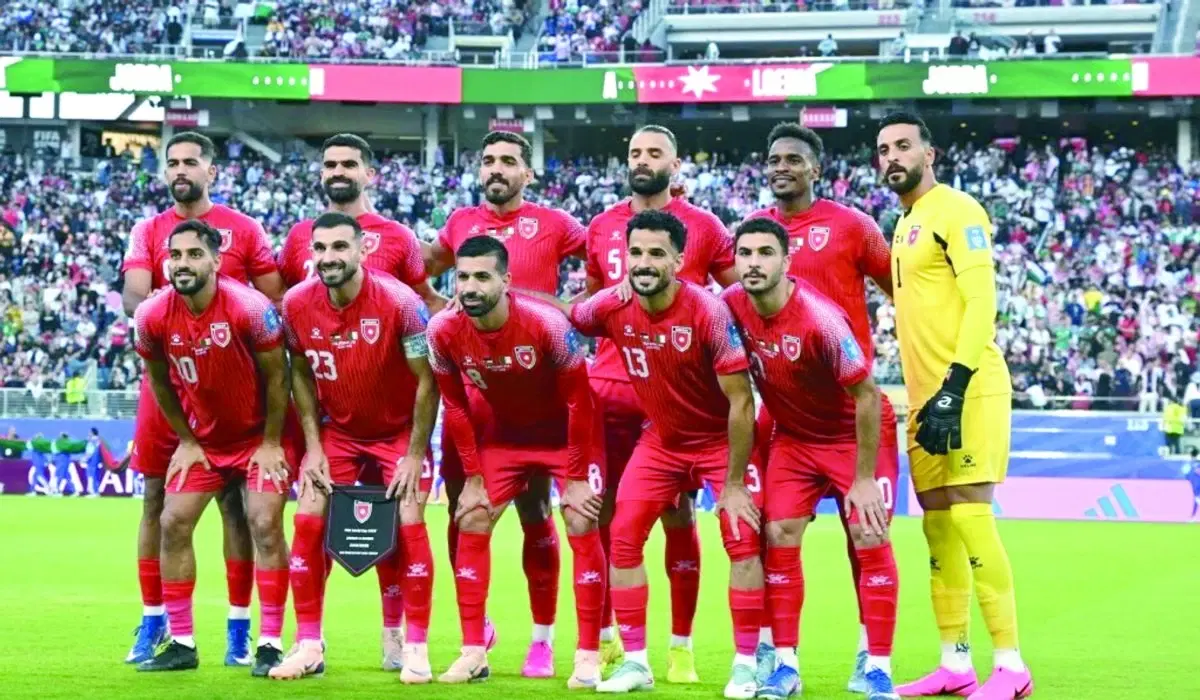
The Jordanians and Venezuela: A Test of Strength and Opportunity for Progress
Zaaki Refuses to Underestimate the Importance of the Match
Amman11 min read
Share
The eyes of the fans are set on the King Abdullah II Stadium in Al-Quwaismeh at eight in the evening today, where the national football team will meet its Venezuelan counterpart in the second and last friendly match during the current international break, in a new stop of the preparation program for the upcoming commitments, foremost of which are the Asian Cup finals 2027.
The match, which brings together two teams from different continents and football schools, comes days after the first appearance of Moroccan coach Badou El-Zaaki with the Nshamy, which ended in a 1-1 draw against Syria 1-1Today's match is an opportunity for the technical staff to move from the initial acquaintance phase to a more difficult test against a South American team with different technical and physical characteristics.
The team ended its first experience with El-Zaaki with a draw against Syria, a match that gave the new coach a wide opportunity to watch a large number of players and get to know their abilities, more than being a test of the result.
El-Zaaki got an initial picture of the group, and noted a number of positives and negatives, before starting to address the observations during the past days, in preparation for a stronger match against Venezuela.
Although the result of the first match was not entirely satisfactory to the fans who are waiting for the return of the Nshamy to the path of victories, its basic value was in giving the coach a chance to test the options, which makes today's match different, as El-Zaaki enters it with more information about his players.
A real test
The importance of the match against Venezuela is not only linked to the result, but also to the nature of the opponent itself.
The Nshamy will face a South American team, with the Latin school's speed of performance, individual skill, ability to play in spaces, and speed in transitioning from defense to attack, in addition to the physical aggression that El-Zaaki himself pointed out when talking about the match.
El-Zaaki had described Venezuela as possessing distinctive characteristics, most notably speed and physical aggression, considering that the match will form a real test that reveals to the technical staff new aspects that need to be addressed and worked on.
This type of match serves the Nshamy a lot in the construction phase, especially as the team is heading to the Asian Cup, where it will face teams with different styles and schools, and therefore diversifying opponents in friendly matches gives the technical staff more space to test the team's ability to deal with different playing styles.
El-Zaaki: Absences are a side issue
The most important thing that the media got out of the open training session yesterday was El-Zaaki's position on the controversy that accompanied Venezuela's decision to release 12 players from their camp before facing the Nshamy.
The decision opened a wide door for comments, and the matter reached the point of describing the Venezuelan team that will face Jordan as a reserve team, which began to take a direction that reduces the value of the match in the eyes of some, but El-Zaaki put an end to this controversy when he described the matter as “a side issue”Confirming that the players present with Venezuela represent the first team, regardless of whether they were in the starting lineup or substitutes.
This position should be the basis for reading the confrontation, as the Venezuelan team did not withdraw, did not cancel the match, and did not come to Amman with a group of players from age categories, but its technical staff made a prior decision to grant a number of players rest and return to their clubs after playing against Japan and South Korea.
Technical impact
It is true that the Venezuelan decision has a technical impact that cannot be ignored, especially since a number of the players who were released participated mainly in the match against South Korea, but on the other hand, the presence of an alternative list does not necessarily mean that the opponent has become weak or that the match has lost its value.
On the contrary, the players who will play against the Nshamy will have a great opportunity to prove themselves in front of their coach, and the nature of the international match gives them an additional incentive to give their best.
Here, the Nshamy must deal with the matter more intelligently; if the opponent is less cohesive or has more players looking to prove themselves, this is an opportunity for the Nshamy and not a reason to belittle the match.
If the match is considered among the official international matches for FIFA classification purposes, the difference in classification between the two teams makes the victory important for the Nshamy.
The result itself should also be a legitimate goal for the team, especially as the Nshamy are looking to regain the tone of victories after a long series of friendly matches in which they did not achieve victory.
Therefore, what is required is not only to win, but to win with a convincing performance, and if the opportunity arises to score more than one goal, it should not be missed, as friendly matches are not just experiments, but also an opportunity to build confidence, raise morale, improve classification, and send a clear message that the Nshamy is capable of imposing its presence against teams from different schools.
About the guest
Venezuela enters the match after an intensive Asian tour that began with a match against Japan, where they lost 1-2 and then drew with South Korea, before heading to Jordan for their third and final match in this tour.
Thus, the Venezuelan team enters the match at the end of a relatively challenging Asian journey, making physical condition and recovery an important factor in the match.
As for the coach, the team is led by Oswaldo Vizcarrondo, a former Venezuelan international defender who took over permanently in January 2026 after a temporary period, and he is working on building a new identity for the team. His technical data shows a frequent reliance on 4-4-2 with two midfielders, with flexibility in changing the shape according to the opponent.
His squad includes professional players in Europe, the United States, and South America, including names such as Yangel Herrera, Telasco Segovia, Cristian Cáseres, Kevin Kelsy, and others, although some of the most prominent names left the camp before the match against Jordan.
Venezuela is not a team that relies solely on possession, but can be dangerous when they find spaces in front of them, which is why the duties of the Jordanian midfielders will be very important, especially in preventing quick transitions and not giving the opponent spaces behind the midfield and defense.
The wingers and full-backs will also face a real test, as the Venezuelan team can exploit the speed of transition, which is a point that the Jordanians need to handle with discipline and proper positioning.
In return, the presence of Temouri, Alwan, Marzi, Abu Taha, and other elements capable of moving behind the lines, gives Zaki offensive options that can be dangerous if the Jordanians succeed in building attacks faster.
Al-Fakhouri is absent
Regarding the lineup, yesterday's training brought bad news in the form of the absence of Al-Fakhouri from the training session.
Al-Fakhouri came to the field, but stayed out of the group, before Zaki confirmed that he suffered an injury related to the previous injury he suffered in Egypt with Pyramids FC.
Thus, he joins the list of absentees from the match, along with Aliek Samir and Yousef Abu Jalbush «Saysa».
Goalkeeping
Zaki did not reveal during his talk yesterday the identity of the goalkeeper who will start the match, especially after Aliek Samir's injury.
The coach expressed his confidence in the trio, Abu Layla, Al-Fakhouri, and Al-Jaidi, leaving the decision to the last moments.
This also reflects the nature of the current stage, where Zaki does not want to close the door to competition early, but wants readiness and performance on the field to be the decisive factor in determining the options.
Expected changes
In one of the most important technical messages Zaki launched yesterday, he confirmed that the real changes in the ranks of the Jordanians will be during the international break in November, explaining that the current camp was mainly intended to get to know the players and give the opportunity to the largest number of them.
This means that the match against Venezuela will not necessarily be a match to find the final lineup, but rather a new episode in the evaluation process that the technical staff began.
From here, every player who gets a chance against Venezuela will be required to invest it, because the door is still open for change and addition, as Zaki confirmed since announcing his list.
The Jordanian list includes: Yazeed Abu Layla, Abdullah Al-Fakhouri, Ahmed Ja'idi, Yazan Al-Arab, Abdullah Naseeb, Muhammad Abu Al-Nad, Saad Al-Roussan, Hadi Al-Hourani, Mohannad Abu Taha, Ihsan Haddad, Ahmed Assaf, Anas Badawi, Nour Al-Rawabdeh, Nizar Al-Rashad, Ibrahim Saada, Yousef Qashi, Amer Gamous, Mahmoud Shawkat, Yousef Abu Jalbush, Anas Al-Awdat, Musa Temouri, Mohannad Marzi, Tamer Bani Awada, Ahmed Arsan, Ali Azaizah, Abdullah Al-Fakhouri, Muhammad Abu Zariq, and Ali Alwan.
The list lacks goalkeeper Samir, Sayca, and Abdullah Al-Fakhouri due to injury, which reduces the options available to Zaki.
Venezuela's list
The Venezuelan list that came for the Asian tour includes a group of goalkeepers, defenders, midfielders, and forwards, before the decision to release 12 players after the matches against Japan and South Korea.
Among the most prominent elements that remained within the group are names in the back, midfield, and attack, including Christopher Varela, Joel Gratheroul, Carlos Vivas, Daniel Pereira, Wikleman Carmona, Edson Tortoledo, Giovanni Bolivar, and others, alongside young elements that Vizcarrondo seeks to test.
The current list does not mean that Venezuela has lost its identity, but the coach will try to take advantage of the match to give new opportunities and conduct a final evaluation of his players before returning to their clubs.
References
All indications point to one result; there is no room for the team to underestimate the match.
If the Venezuelan team participates with a different group, this should push the team to impose a stronger personality, not to approach the match with relaxation.
If the opponent has played two matches in Japan and South Korea, this gives the match additional physical and technical value.
If the team is looking for a win, facing a South American team gives it an important opportunity to test its ability to handle speed, skill, tackles, and transitions.
If the match is part of the ranking calculations, achieving a win with as many goals as possible, whenever it is available without disrupting the balance, will be an additional gain.
Away from the match
Away from the match, it remains unfortunate that the current break did not include a third match for the team.
The group needed more playing minutes under Zaki's leadership, especially since the coach has started a new phase and needs time and matches to establish his ideas.
However, the matches against Syria and Venezuela give him a good platform to start, especially since the opponents are different in terms of school and style.
After the break ends, the technical staff will review what happened, determine the elements that have approached fixing their positions, and those that need more work, before returning in November with more clarity.
Today, the team is not just looking for another friendly match, but for a new test of their character at the beginning of Badou Zaki's phase.
Venezuela, even with the absence of 12 players, remains a South American team, and the match against them is an opportunity to be invested, not an occasion to look for excuses or underestimate the value of the opponent.
The most important message that Zaki came out with yesterday was clear, as the Venezuelan absences are a side issue, and those present represent their team, and the team is required to approach the match with all seriousness.
After the final whistle, the team will close the page of this break, hoping to have emerged from it with real technical gains, before the journey renews in November, where the team awaits two matches against Indonesia and Australia in Amman on 13 and17 November, according to the announced program, to be a new station on the way to preparing for the Asian Cup.
At every station, the team still needs its fans, their support, and their trust, because the new phase is still at the beginning, and the road to the Asian Cup requires a team that evolves from match to match, benefiting from every break, every experience, and every player, reaching the big continental date.