Railways.. An opportunity to transform Jordan into a regional hub for transport and trade
Amman6 min read
Share
Economic experts emphasized that the government's move to present the national railway network project, which plans to extend for about 1,000 kilometers, during the Jordan-Europe Investment Conference scheduled for November 19 at the Dead Sea, represents a strategic opportunity to develop infrastructure, strengthen Jordan's position as a regional hub for transport, trade, and logistics, and attract long-term investments.
In interviews with "Alrai," they stated that the project could contribute to reducing the costs of transporting goods and raw materials, especially in the mining, industrial, and trade sectors, and improving the competitiveness of Jordanian products in foreign markets, in addition to easing pressure on the road network and providing job opportunities, provided it is implemented according to accurate feasibility studies and phases commensurate with the volume of expected demand.
The government intends to present the project to establish a national railway network approximately 1,000 kilometers long, dedicated to transporting goods and connecting major logistics centers and border crossings in the Kingdom, as part of the investment opportunities offered to European investors.
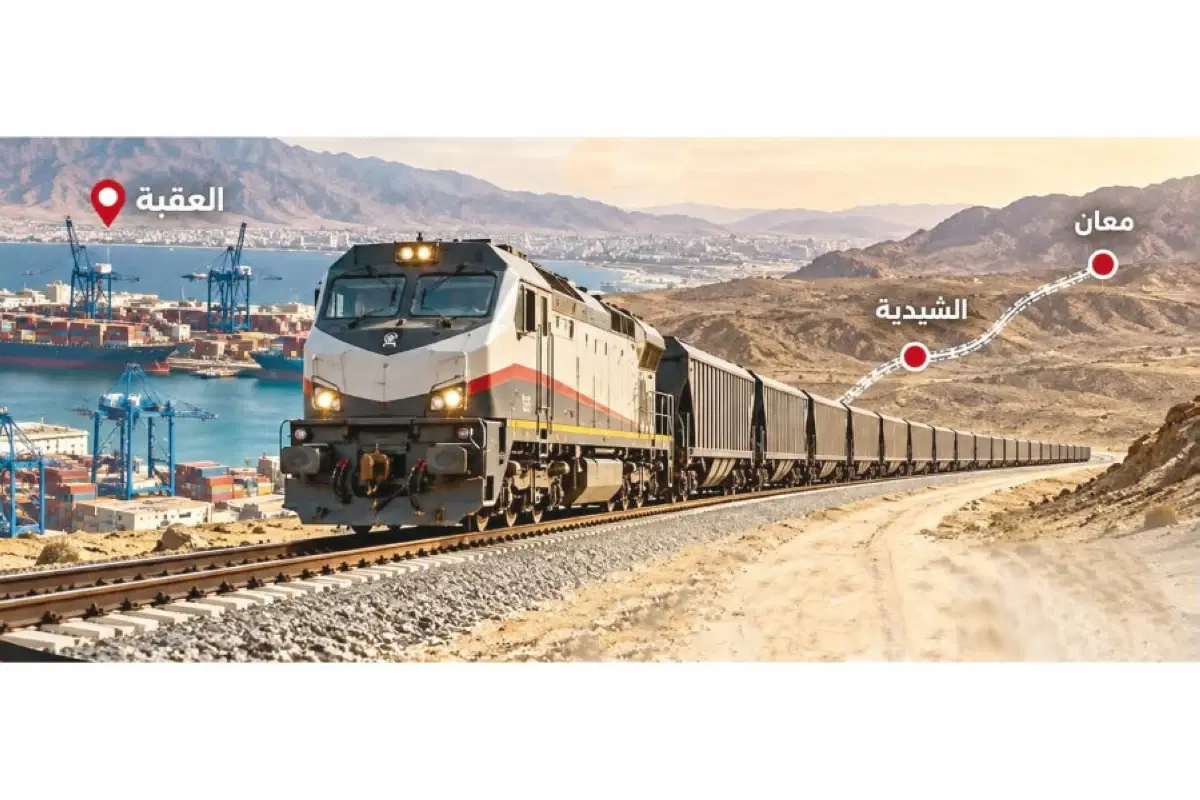
The project includes establishing a single-track network with a standard international gauge, with the possibility of connecting it in the future to railway networks in neighboring countries. The plans aim to implement it in phases, starting with a 42-kilometer line connecting the Shidiya area to the city of Ma'an, followed by a phase to extend the line from Ma'an towards Al-Madouna and Jaber, forming the basis for a regional corridor for freight transport.
Economic expert Hossam Ayesh said that the railway project represents a strategic shift in the national economy's infrastructure and an opportunity to turn the transport sector into an engine for economic growth, rather than limiting its role to fuel consumption and providing logistics services.
He added that the project could turn into a cross-border trade corridor, especially with its presentation to European investors, noting that the transport of raw materials and mining products, especially phosphate and potash from the Shidiya and Ma'an areas, relies heavily on trucks, which increases transport costs.
He explained that transporting large quantities of goods via railways could reduce shipping and fuel costs and support industrial exports by providing greater transport capacity and more stable costs, thereby enhancing the competitiveness of Jordanian products and opportunities for the expansion of local industries and exports.
Ayesh pointed out that the project enhances supply chain efficiency by connecting major centers with border crossings and ports, and also eases pressure on roads and limits the damage caused by heavy truck traffic, thereby reducing infrastructure maintenance costs borne by the government.
For his part, economic expert Wajdi Makhamreh said that establishing a national railway network represents a strategic step to develop infrastructure and strengthen Jordan's position as a regional hub for transport, trade, and logistics.
He explained that the project could reduce the costs of transporting goods and raw materials, improve the efficiency of trade movement, and ease pressure on the road network. Furthermore, connecting the Port of Aqaba to industrial and commercial centers and border crossings allows for the development of an integrated system for transport, storage, and distribution, and attracts transit traffic between regional markets, thereby enhancing revenues generated from transport, customs clearance, and storage services.
Makhamreh emphasized that achieving these gains requires completing the connection with neighboring countries and providing a commercial and customs environment that facilitates the movement of goods across borders, in addition to connecting stations to production areas and encouraging the establishment of warehouses, logistics centers, and industrial projects near them.
He added that the project opens the door for new investments in industrial and logistics zones, supports the mining, manufacturing, and trade sectors, provides job opportunities during construction, operation, and maintenance, and contributes to stimulating economic development in the governorates through which the lines pass.
He pointed out that presenting the project during the Jordan-Europe Investment Conference reflects the government's orientation towards attracting long-term investments to develop productive infrastructure, noting that the European partnership may provide opportunities for financing, transferring technical and technological expertise, and developing operation and management systems.
Makhamreh stressed the necessity of estimating the volume of goods expected to be transported and comparing railway costs with available alternatives to ensure sufficient commercial demand that achieves financial sustainability, warning against burdening the general budget with unstudied liabilities or guarantees. He called for implementing the project in phases, starting with the most commercially viable routes, then expanding according to operational results and actual demand.
In turn, financial and economic expert Dr. Mohammed Al-Hadab Al-Sarhan emphasized that the importance of the project goes beyond establishing new infrastructure for transporting goods to include leveraging Jordan's geographical location to support industry, trade, and logistics, and enhancing productivity and competitiveness in line with the goals of the Economic Modernization Vision.
Al-Sarhan noted that the Jordan-Europe Investment Conference provides an opportunity to present the project as part of an integrated investment package that is not limited to financing railway lines, but includes establishing industrial and logistics zones and facilities for storage, assembly, distribution, and customs services, which may encourage investors to make Jordan a base for production and distribution to the markets of the Gulf, Iraq, and the Levant.
Al-Sarhan emphasized the importance of implementing the project in phases according to economic feasibility and expected trade volume, while evaluating the financial return and risks for each phase before moving to the next, and designing investment partnerships that distribute risks fairly between the state and investors and protect public finances from unstudied obligations.
He also called for including programs for technology transfer and qualifying Jordanian competencies in operation, maintenance, and management of logistics systems within the European partnerships to ensure that local companies and labor benefit from the project and build national expertise capable of regional competition.
Al-Sarhan concluded by emphasizing that the success of the project is not measured by the length of the lines implemented or the volume of announced investments alone, but by what it achieves in terms of reducing transport costs, increasing exports, attracting industrial investments, and providing sustainable job opportunities, calling for the adoption of clear indicators to measure results and linking expansion phases to their achievement.
He stressed that the opportunity before Jordan lies in transitioning from being a geographical corridor for the movement of goods to a regional hub for production, trade, and logistics, which expands the value-added to the national economy and enhances growth prospects.