Economists: The King is establishing a long-term investment approach for international relations
The Jordanian-Emirati partnership is moving towards strategic economic assets
Amman9 min read
Share
Economic experts confirmed that laying the foundation stone for the Aqaba–Shudayrat–Ma'an railway project represents an important transition from the stage of agreements to the stage of productive assets on the ground. The project, with investments estimated at about $2.3 billion, constitutes nearly 42 percent of the value of the Jordanian-Emirati investment package amounting to about $5.5 billion.
Experts pointed out in interviews with (Alrai) that the presence of His Majesty King Abdullah II and His Highness Sheikh Khalid bin Mohamed bin Zayed Al Nahyan, Crown Prince of Abu Dhabi, alongside the Prime Minister and officials from both countries, reflects the transition of the Jordanian-Emirati partnership from strong political and investment relations to a partnership in strategic assets that will affect the structure of the Jordanian economy for decades to come.
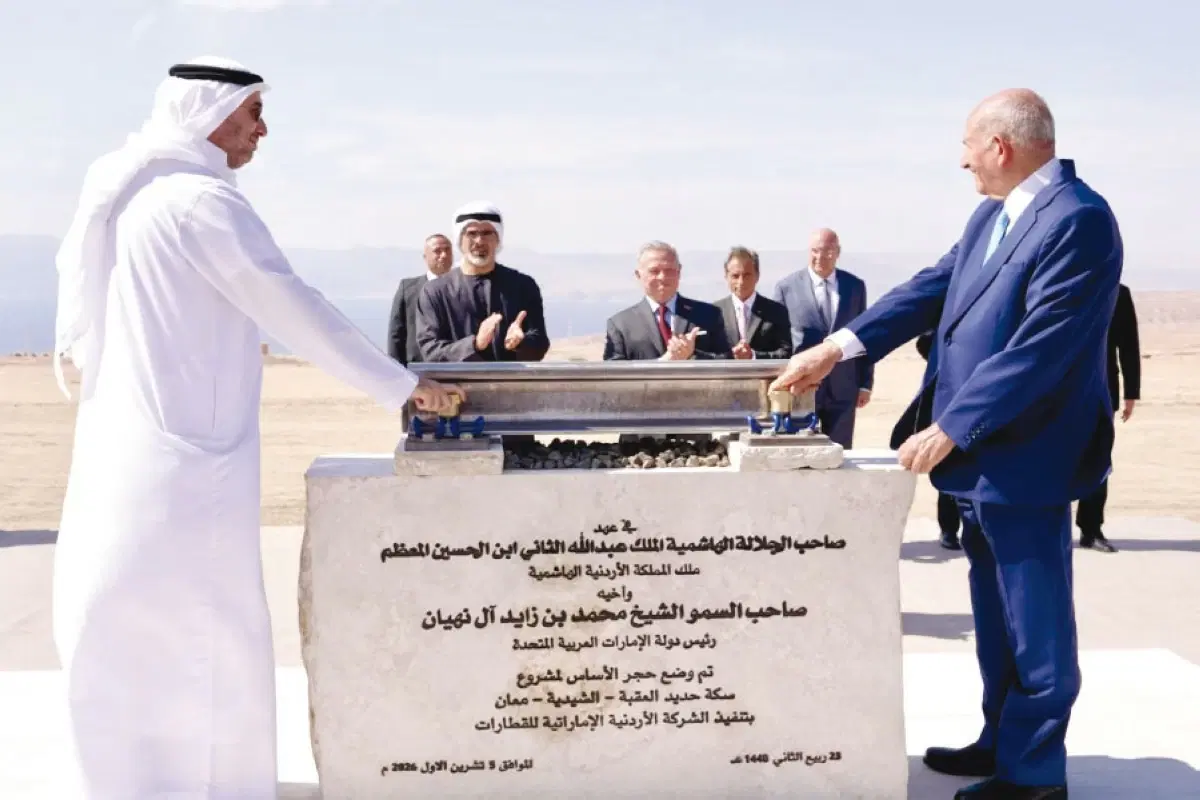
His Majesty King Abdullah II and His Highness Sheikh Khalid bin Mohamed bin Zayed Al Nahyan, Crown Prince of Abu Dhabi and President of the Executive Council of Abu Dhabi, on Monday, laid the foundation stone for the Aqaba–Shudayrat–Ma'an railway project, one of the most prominent railway transport projects in Jordan.
The project aims to improve the efficiency of transporting mining products and reduce transportation costs, thereby enhancing the competitiveness of Jordanian exports and establishing the port of Aqaba as a regional hub for transportation and logistics services.
In its first phase, the project is expected to transport about 13 million tons of phosphate annually from Shudayrat to Aqaba, achieving integration with the Ma'an land port project by enabling the efficient transportation of various goods between Aqaba and Ma'an.
The project is a key part of a broader plan to establish a national railway network and is one of the most prominent projects of the Economic Modernization Vision.
Commenting on the laying of the foundation stone for the Aqaba–Shudayrat–Ma'an railway project, economic expert Wadi Mukhaimar noted that the project represents a strategic step in developing the infrastructure for transportation and logistics services in Jordan, especially since the project goes beyond being a means of transporting phosphates, but forms part of a broader national system for connecting production centers with the port of Aqaba and foreign markets.
Mukhaimar added that the importance of the project lies in reducing transportation costs and improving the efficiency of supply chains, which enhances the competitiveness of Jordanian mining exports, especially phosphates and potash. The transportation of about 13 million tons of phosphate annually in the first phase via the railway can also relieve pressure on roads and trucks, reduce maintenance costs, fuel consumption, and emissions associated with land transport.
He pointed out that the project provides an important dimension by enhancing the role of Aqaba as a regional hub for transportation and logistics services by connecting mining and production areas with the port, which may open the way for increased handling, storage, logistics services, and re-export.
Mukhaimar also added that the project could be a catalyst for attracting new investments along the railway route, especially in the mining, manufacturing, logistics, and industrial zones sectors, in addition to creating direct and indirect job opportunities.
He mentioned that the importance of the Jordanian-Emirati partnership in implementing the project is highlighted as a model for attracting capital, expertise, and regional investment to Jordanian infrastructure projects, with the possibility that this partnership could form the basis for other projects within the national railway network.
For his part, financial and economic expert Dr. Mohammad Al-Hadb Al-Sarhan confirmed that laying the foundation stone for the Aqaba–Shudayrat–Ma'an railway project represents an important transition from the stage of agreements to the stage of productive assets on the ground. The project, with investments estimated at about $2.3 billion, constitutes nearly 42 percent of the value of the Jordanian-Emirati investment package amounting to about $5.5 billion.
Al-Sarhan believes that this transition reflects the importance of the efforts led by His Majesty King Abdullah II in transforming international relations and partnerships into long-term investments, and confirms that the true value of economic diplomacy is shown when the agreement turns into a project, then into production, exports, and job opportunities.
Al-Sarhan explained that the first impact of the project will be on the economics of transportation and export. The targeted network extends for about 360 kilometers, and its capacity upon completion of its routes will reach nearly 16 million tons annually of phosphates and potash, of which about 13 million tons are phosphates. Transporting these quantities by rail means increasing the efficiency of handling and reducing dependence on long-distance road transport, and improving the regularity of product arrival at the port of Aqaba. This is not just a logistical issue; every sustainable reduction in the cost of transporting a ton increases the competitiveness of Jordanian mining exports and improves their ability to reach global markets and maintain profitability margins during periods of falling prices or rising shipping costs.
Al-Sarhan pointed out that the greatest opportunity lies in not ending the economic impact of the project at transporting raw materials from the mine to the port. Jordan has an important base in phosphates, potash, and fertilizers, and the improvement in logistics infrastructure should be invested to attract new industries that use these resources and add value to them before exporting them. The more the exports shift from raw materials to manufactured or specialized products, the more value remains within the economy in the form of wages, profits, local purchases, taxes, and services. Hence, the railway can serve a broader industrial policy that attracts investments in mining, manufacturing, and related services, instead of viewing it as a transport means independent of the rest of the economy.
Al-Sarhan explained that the project's connection to the Ma'an land port may be one of its most important developmental dimensions. Government plans speak of a land port covering an area of nearly 4,000 dunams, connected to the railway by a link about 42 kilometers long, around which storage, customs clearance, distribution, maintenance, industry, and service activities can be formed. If this system is developed in an integrated manner, Ma'an will not just be a station where the train passes, but can become a logistics and industrial center serving the south and attracting new investments to it. Here, the impact of the project on the governorates becomes more sustainable than the temporary jobs created during the construction phase.
He added that the broader dimension of the project appears when it is placed within the planned national railway network. Jordan seeks to enhance its role as a link between the port of Aqaba and regional markets, and with the future expansion of the network, the railway can become part of a trade corridor linking the Gulf to Aqaba, then towards neighboring markets and the Mediterranean. This is important for an economy whose total exports reached about 6.4 billion dinars during the first seven months of 2026, while the trade deficit still exceeds 5 billion dinars; hence, any infrastructure that reduces the cost of exports and opens the way for new production has a direct impact on trade, growth, and foreign currency inflows.
Al-Sarhan concluded by saying that the project embodies the depth of the economic partnership between Jordan and the UAE, and provides an important model for transforming joint investment into infrastructure that serves the economy for decades. He added that the train will start carrying millions of tons of phosphates and potash, but the greater economic bet is on what will be established along its route: factories, warehouses, services, companies, and new investments. If Jordan succeeds in achieving this, the Aqaba railway will not just be a cheaper means of transporting what we produce today, but an infrastructure that helps us produce and export more tomorrow, and gives the south a greater role in the map of investment and economic growth of the Kingdom.
The representative of the clothing and knitwear sector in the Jordan Chamber of Industry, Engineer Ehab Qadri, said that the economic importance of laying the foundation stone for the Aqaba–Shudayrat–Ma'an railway project is not only read in the size of the investment or the length of the railway and its ability to serve the mining sector, but also in the political level that hosted the launch of the project.
He pointed out that the presence of His Majesty King Abdullah II and His Highness Sheikh Khalid bin Mohamed bin Zayed Al Nahyan, Crown Prince of Abu Dhabi, alongside the Prime Minister and officials from both countries, reflects the transition of the Jordanian-Emirati partnership from strong political and investment relations to a partnership in strategic assets that will affect the structure of the Jordanian economy for decades to come.
He added that this is a very important point in reading foreign investment; because long-term capital does not just look for a profitable project, but for stability, trust, continuity of policies, and the ability of the state to complete major projects. Therefore, the project carries a message beyond its financial value: that the political relations built by Jordan, under the leadership of His Majesty the King, can be transformed into economic capital and long-term productive investments, which is the model we need to expand with our strategic partners.
Qadri pointed out that the most important thing is that the project reflects a required shift in the philosophy of investment in Jordan; from attracting individual investments to building partnerships that finance the infrastructure that, in turn, opens the way for new waves of investment.
He added that the railway is not the final return, but what can emerge around it: mining, manufacturing, logistics, production areas, exports, and development opportunities in the south, and what can be paved in the future within a more integrated national and regional transport network.
It was mentioned that here the project directly meets the vision of economic modernization, through the state's use of strategic investment to raise the productive capacity of the economy, and turning Jordan's geographical location, natural resources, and political relations into productive economic assets. The most important message today is that the success of economic diplomacy is not measured by the number of agreements signed, but when we see the political relationship turning into a project, the project into infrastructure, and the infrastructure into investment, production, job opportunities, and sustainable growth.