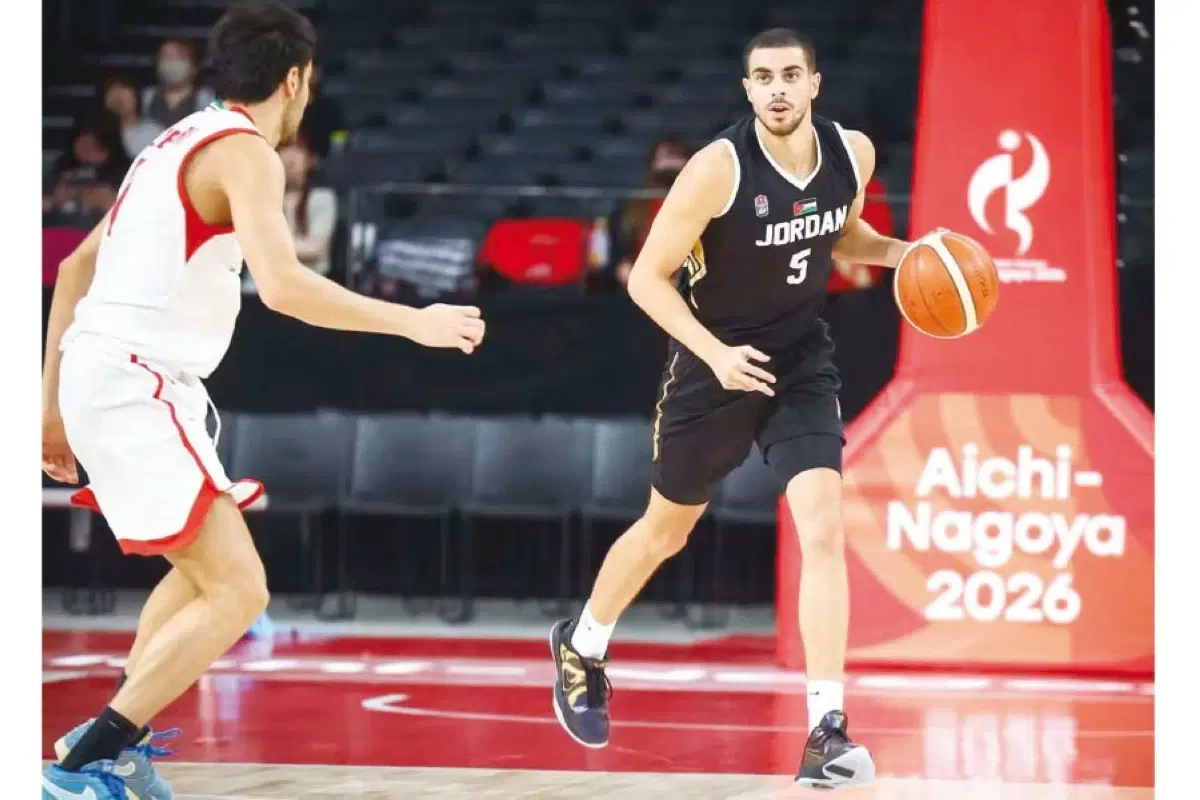
The national basketball team, the "Jordan Falcons," has secured qualification for the quarterfinals of the men's basketball tournament at the 20th Asian Games "Aichi-Nagoya 2026" as the best third-placed team across the three groups, despite their final group stage defeat to the Iranian team with a score of 81-68.
Qualification was confirmed following a series of decisive results announced yesterday in Groups A and B. Chinese Taipei defeated Qatar 91-69 in the final match of Group B, leaving the final standings as follows: Iran first (two wins and one loss), Chinese Taipei second on head-to-head record, the "Jordan Falcons" third with one win and two losses, and Qatar fourth based on the head-to-head record.
Consequently, Iran and Chinese Taipei automatically qualified for the quarterfinals as the first and second-placed teams in the group.
As for the third and final qualification spot among the third-placed teams in the three groups, it was secured by the Saudi team's 100-89 victory over Indonesia in Group A. Saudi Arabia finished third in their group with 4 points—the same points tally as the "Jordan Falcons"—but with a much worse point differential of -11 compared to -5 for the national team.
Since the "Jordan Falcons" hold a superior point differential over Saudi Arabia among the third-placed teams, their qualification is confirmed regardless of the Group C results scheduled for today. The worst-case scenario is that the third-placed team in that group surpasses the "Jordan Falcons" in point differential, moving that team to first place among the third-place finishers while the "Jordan Falcons" drop to second. This leaves Saudi Arabia out of contention, thus officially guaranteeing the "Jordan Falcons" one of the two "best third-place" spots qualifying for the quarterfinals.
Strong Start
This qualification follows a tough final match that the "Jordan Falcons" lost yesterday to Iran 81-68.
The "Jordan Falcons" had a good start, winning the first quarter 20-19. However, the tide turned afterwards as Iran won the second quarter 17-16, tying the game at halftime (36-36). The Iranians then dominated the third quarter by a large margin of 27-16, which proved to be the decisive turning point in the match.
The Iranian team maintained their control in the final quarter, winning 18-16 and securing a full 13-point victory.
A Loophole Exploited by the Iranians
Technical analysis of the match revealed that the root of the problem was the absence of players Abdullah Olajuwon and Ahmad Al-Dwairi due to injury, leaving the national team with no real rim protection.
This was clearly reflected in the statistics: the "Jordan Falcons" failed to record a single blocked shot throughout the match, while the Iranian team efficiently exploited the paint, converting 12 of 32 attempts for a 38% shooting percentage from that specific area.
Their absence also impacted rebounding, as the "Jordan Falcons" lost the battle of the boards by a wide margin, 45 to 35 in favor of Iran. Furthermore, the Iranians dominated in assists, almost doubling Jordan's tally (24 to 15), reflecting smoother team play compared to Jordan's greater reliance on individual efforts.
The analysis noted that player Matin Aghajanpour was one of Iran's most prominent offensive weapons, attempting 12 shots from beyond the arc out of the team's total 27 three-point attempts, making 4 of them for a 33% success rate.
The analysis also showed a clear weakness in the Jordanian defense's coverage of the three-point line and corners, with delayed closeouts and slow defensive rotations, particularly from players Pery Buford and Ahmad Al-Hamarsheh, who were preoccupied with interior help defense, leaving open shooters on the perimeter.
Regarding bench points, the difference was significant and clear in favor of Iran, with 48 points compared to just 21 for the "Jordan Falcons," reflecting greater depth in the Iranian roster for this particular match.
Unbalanced Offensive Distribution
Dar Tucker was the most prominent offensive performer, scoring 19 points with an excellent shooting percentage of 70% (7 of 10 attempts), followed by Freddy Ibrahim with 14 points (56%), Ahmad Al-Hamarsheh with 13 points (44%), and Pery Buford, who scored 11 points but with a low shooting percentage of just 20% from 15 attempts, reflecting a tough shooting night despite numerous tries. Ruhi Al-Kilani added 9 points, while Mohammad Shaher scored only 2 points, and Amin Abu Hawwas remained scoreless across 4 attempts.
It was noted that the offensive distribution was uneven, heavily relying on Buford and Freddy, with a limited number of assists (only 15). This highlights the need to diversify offensive options and increase the assist rate in the future.
Statistical Indicators
The "Jordan Falcons" made 23 of 58 field goal attempts for a 40% shooting percentage, the exact same percentage achieved by the Iranian team (29 of 72), but the latter benefited from 14 more shot attempts.
Jordan had a higher two-point shooting percentage (52% compared to 47%), while three-point percentages were close (28% for Jordan compared to 30% for Iran). At the free-throw line, Jordan made 14 of 23 for 61%, compared to 15 of 21 for 71% for Iran.
In defensive indicators, the "Jordan Falcons" led in steals (6 to 3), but trailed in blocked shots (zero to one for Iran), while both teams committed similar numbers of team fouls (18 for Jordan compared to 20 for Iran).