The lineup of the eight teams qualified for the quarter-finals was completed yesterday, after China and Bahrain secured the direct qualification spots from Group C, following China's big 105-61 win over the Philippines, and Bahrain's 101-78 victory over Kazakhstan.
China's crushing victory over the Philippines contributed to giving Saudi Arabia the final ticket to the quarter-finals as one of the best third-placed teams.
In the quarter-finals, Iran (first of Group B) will meet Bahrain (second of Group C), and the winner will face the winner of the "Jordan Falcons" and South Korea match. The other two matches will feature China (first of Group C) against Saudi Arabia (third of Group A), and Japan (second of Group A) against Chinese Taipei (second of Group B), thus completing the decisive round matchups.
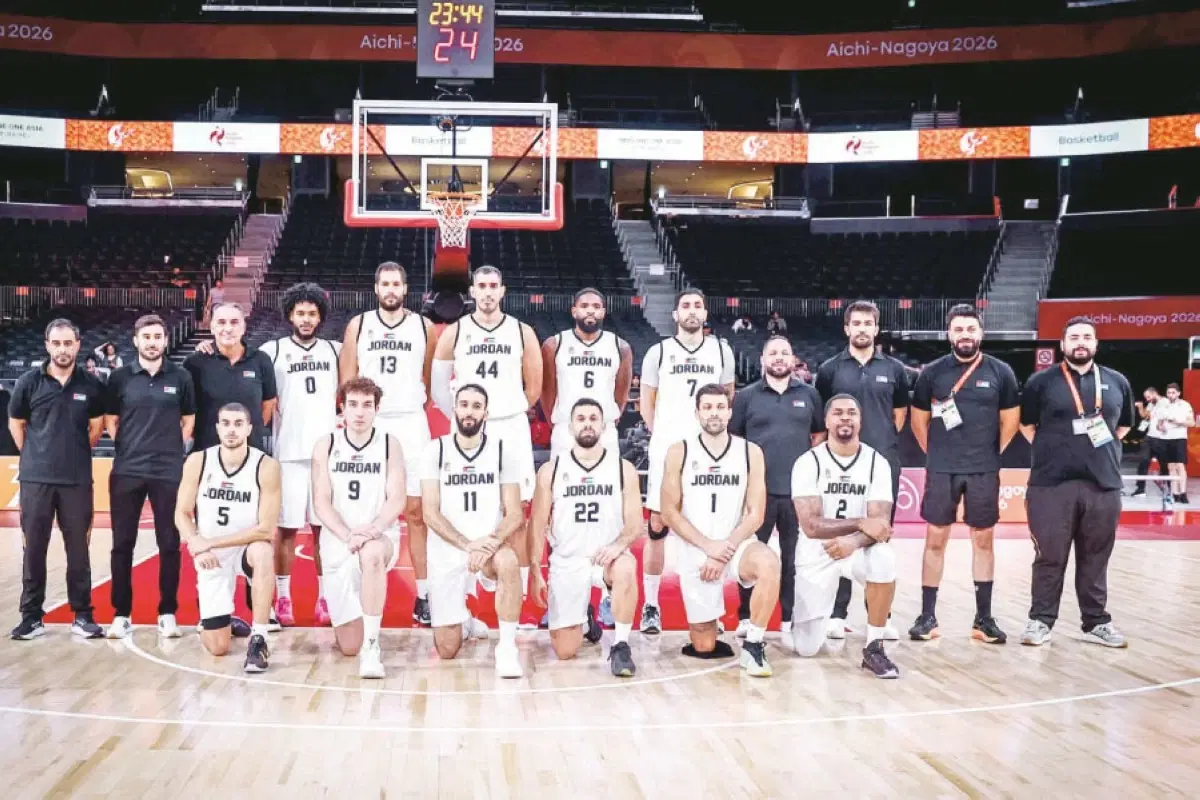
The match against South Korea forces the "Jordan Falcons" to quickly shift from group stage calculations to knockout matches, where there is no room for error. This makes reading the numbers recorded by the team in its three matches an important indicator of the aspects that need to be addressed before the confrontation.
Fluctuating offense and average defense
The "Jordan Falcons" scored 224 points in their three matches, an average of 74.7 per game, while conceding 229 points, an average of 76.3, with a negative difference of 5 points.
When comparing these figures to the averages of the participating teams, the national team ranked eighth in average points scored, and seventh in the list of teams that conceded the fewest points, reflecting a relatively better defensive performance than offensive production.
The team recorded 77 field goals out of 199 attempts at a rate of 39%, including 52 out of 112 two-point attempts at 46%, and 25 out of 87 three-point attempts at 29%, in addition to scoring 45 out of 71 free throws at 63%.
These figures reveal that three-point shooting was the most prominent offensive weakness, at a time when the team did not enter the list of the top eight teams in any of the overall scoring efficiency, two-point, three-point, or free throw indicators.
Good rebounding
The "Jordan Falcons" collected 118 rebounds, including 37 offensive and 81 defensive, an average of 39.3 per game, ranking fifth among the participating teams in this indicator, compared to 121 rebounds for their opponents.
As for assists, the team managed only 55, an average of 18.3 per game, which is the lowest average among the participating teams in this indicator.
This figure indicates a clear need to improve ball movement, teamwork, and reduce reliance on individual solutions.
On the other hand, the team showed good discipline in handling the ball, committing only 29 turnovers during their three matches.
Clear absence of blocks
The team recorded 21 steals at an average of 7 per game, coming in fourth place tied with the Philippines, an indicator that reflects good activity in defensive pressure.
However, the picture was different in defensive blocks, as the team recorded only two blocks throughout the tournament, missing out on the list of the top eight teams in this indicator, which reflects the team's need for a greater presence in protecting the area near the basket.
Bench.. an influential difference
The "Jordan Falcons" scored 25 second-chance points, an average of 8.3 per game, which is the same figure they allowed their opponents.
As for fast-break points, the team scored only 15 points at an average of 5 per game, compared to 31 points for their opponents at an average of 10.3.
The decline was repeated in the productivity of the bench, which scored 77 points at an average of 25.7 per game, compared to 111 points for their opponents at an average of 37.0.
On the other hand, the team excelled in exploiting opponents' mistakes, scoring 25 points from opponents' turnovers, compared to only 9 points allowed from their own mistakes.
Buford at the forefront
Perry Buford topped the "Jordan Falcons" scorers list with 49 points in three matches, an average of 16.3 per game, ranking eighth in total tournament points and ninth in scoring average.
Buford came third in the number of field goal attempts with 47 attempts, while he topped the list of two-point attempts with 38 attempts, in addition to being fouled 18 times by opponents, and being among the top ten players in rebounds and free throws made.
Abdullah Olajuwon scored 26 points in two matches, an average of 13 points per game, and was among the top three players in the tournament in terms of steals with an average of 2.5 steals.
As for Dar Tucker, he scored 38 points at an average of 12.7 per game, and achieved a field goal percentage of 54%, after scoring 14 out of 26 attempts, while his success rate in two-point shooting reached 78%.
Ahmad Al-Hamarsheh added 33 points at an average of 11.0 per game, with a distinctive shooting percentage of 60%, while Freddy Ibrahim provided a good average in playmaking of 6 assists per game, despite scoring 25 points and a shooting percentage of 27%.
Rouhi Al-Kilani scored 23 points at an average of 7.7, while Mohammad Shaher ended his participation with 14 points, with a shooting percentage of 56%.