Intaj: More than 60% of Jordanian tech companies integrate artificial intelligence into their services and products
Amman4 min read
Share
Ziad Al-Masri, Executive Director of Programs at the Information and Communications Technology Association (int@j), stated that more than 60% of Jordanian information technology companies integrate artificial intelligence into their products and services. Meanwhile, 20% of companies are working on developing Internet of Things (IoT) solutions, the growth of which is supported by the expansion of 5G networks. He noted that growth opportunities in the sector also include fintech, cloud services, and IT and business process outsourcing.
He pointed out that Jordan ranks 29th globally in the AI diffusion index, 49th globally and second in the Arab world in the Global Responsible AI Index. It is also classified in the "Role-Model" category in the Global Cybersecurity Index issued by the International Telecommunication Union, and ranks fifth in the National Cybersecurity Index with a score of 93.33 points.
This came during his participation in the "Discover Digital Jordan 2026" event, organized by the Ministry of Digital Economy and Entrepreneurship as part of the Jordan Source program, with the participation of 15 executive leaders, founders, and investors in the technology sector from four continents. Complementing the indicators of Jordan's digital position, Al-Masri indicated that the Kingdom ranks 21st globally and fourth in the Arab world in the World Bank's GovTech Maturity Index, 65th globally and sixth in the Arab world in the Global Innovation Index, in addition to ranking 44th globally in digital competitiveness and 15th in business agility.
At the beginning, Al-Masri expressed his gratitude to the Ministry of Digital Economy and Entrepreneurship for its role in organizing this event, hosting potential investors, and giving Jordanian companies the opportunity to network with them.
In his presentation on opportunities for expanding digital services, he explained that the increasing demand for cloud infrastructure, software-as-a-service (SaaS), and data centers in the region provides opportunities for Jordanian companies, in parallel with the expansion of digital payment solutions and financial inclusion initiatives, building on the experience of the mobile payment system.
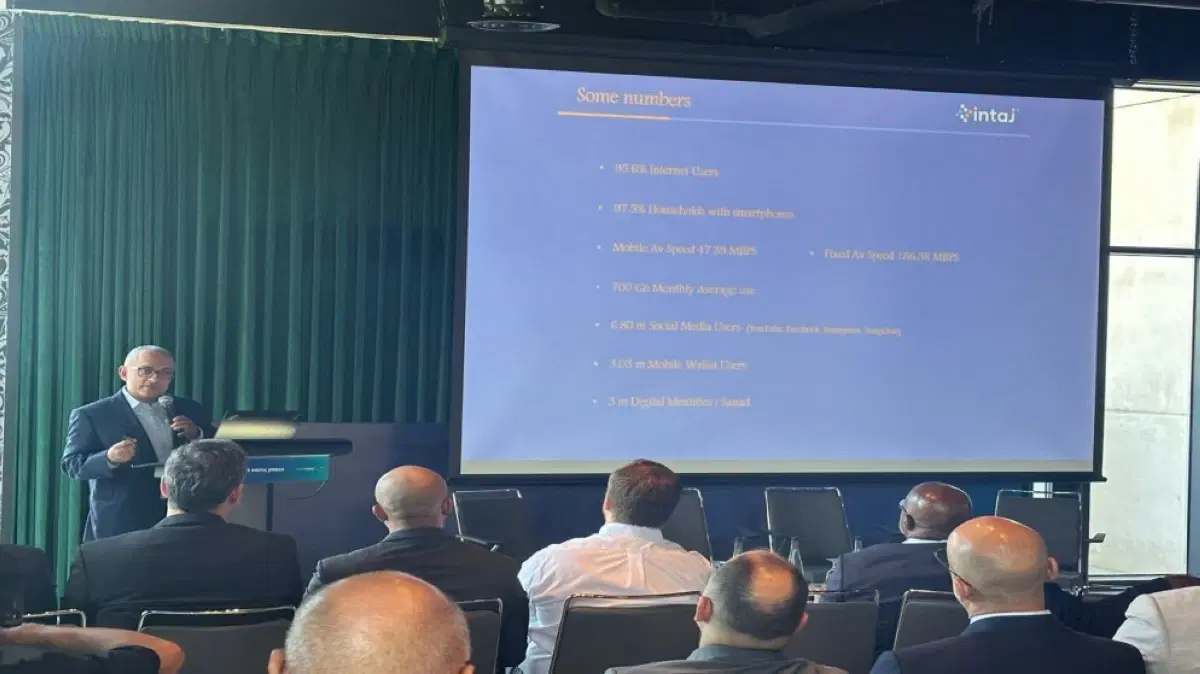
He stated that the digital services usage base in the Kingdom includes 3.03 million e-wallet users and three million digital identities via the "Sanad" application, while the number of social media users reaches 6.8 million, and the percentage of households owning smartphones is 97.5%.
He noted that this environment is based on investments in digital infrastructure, including the expansion of fiber-optic networks and data centers, and the commercial launch of 5G services in 2023. He explained that the average mobile internet speed is 47.39 Mbps, compared to 186.38 Mbps for fixed internet.
Regarding the size of the sector and its economic contribution, Al-Masri said that the ICT sector generates annual revenues exceeding $4.1 billion, contributes 4% to the GDP, includes more than 2,000 active companies, and provides more than 46,000 direct job opportunities.
He added that the sector constitutes one of the pillars of the Economic Modernization Vision and digital transformation in the Kingdom, noting that the vision aims to reach 101,000 employees in the sector by 2033, reflecting the potential for expansion in digital businesses and services.
Regarding the talent base supporting this expansion, he explained that 81% of universities offer programs related to information technology, and 22% of graduates hold degrees in IT, computer science, and engineering, while females make up more than 40% of ICT graduates.
He indicated that university programs cover a wide range of disciplines, as 28 universities offer computer science, 19 offer software engineering, 18 offer cybersecurity and network security, while 15 universities offer data science, machine learning, and artificial intelligence.
Al-Masri linked the availability of these skills to outsourcing expansion opportunities, explaining that the Jordanian services portfolio includes cybersecurity, data, business services, application and software development, and infrastructure, based on qualified competencies, a multilingual workforce, and expertise in providing services to global markets.
On the investment side, he pointed out that incentives for IT activities include reducing income tax to 5%, exempting export income from income tax, applying a zero-rate sales tax on local sales of IT services and on goods and services used in production, in addition to exempting production inputs from customs duties and canceling the minimum foreign investor capital contribution requirement.
Regarding the role of "int@j" in supporting the sector's growth, Al-Masri stated that "int@j," established in 2000, continues its role in representing companies and enhancing their contribution to the national economy through eight pillars: advocacy and influencing legislation and policies to serve sector growth, enabling the digital economy, providing data and information, supporting entrepreneurship and innovation, preparing competencies, market expansion, enhancing outsourcing services, and empowering women in technology.