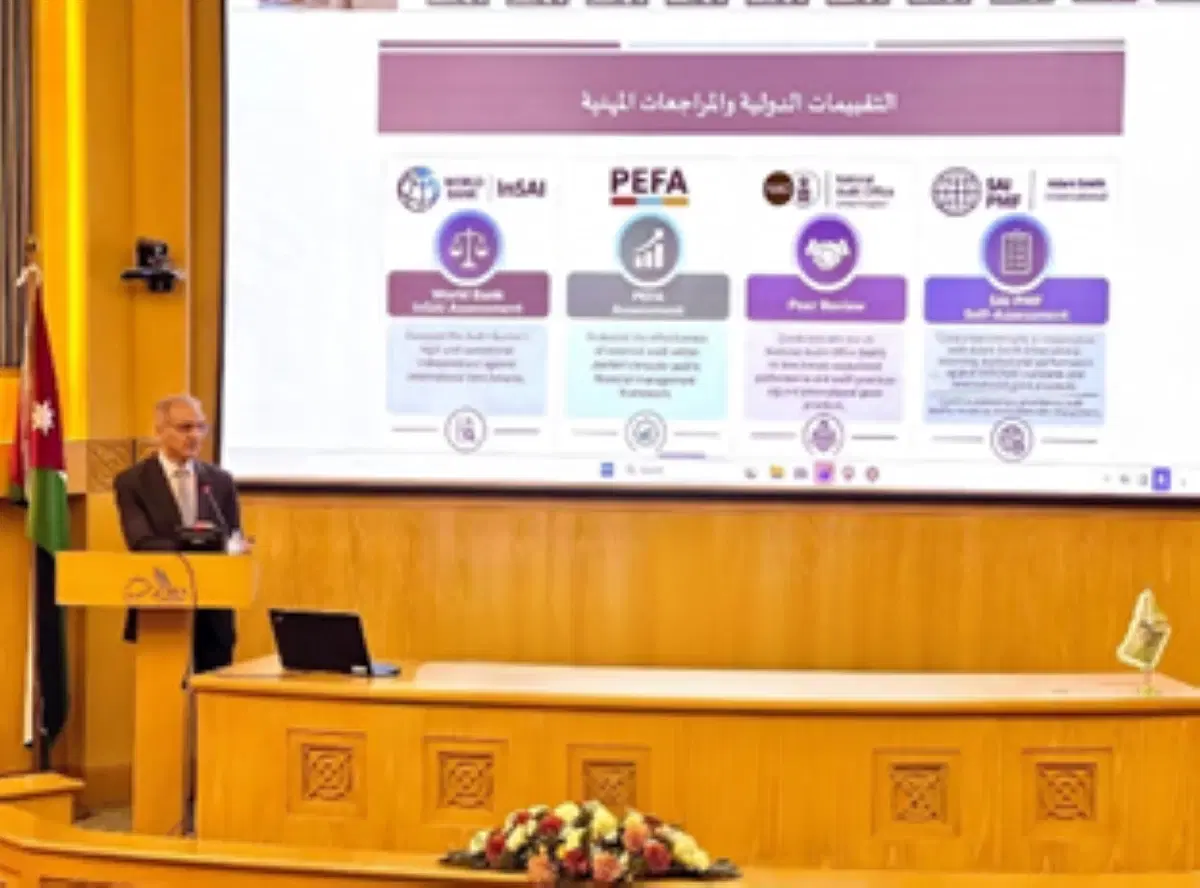
President of the Audit Bureau, Dr. Radi Al-Hamadeen, met with the Bureau's staff, in a meeting where he reviewed the journey of institutional transformation and sustainable development that the Bureau is witnessing, and the qualitative achievements made within the implementation of its strategic plan for the years (2024-2027). He also looked ahead to the next phase and future trends aimed at consolidating an advanced oversight model based on professionalism, independence, and innovation, and enhancing the Bureau's position as a robust oversight institution capable of supporting governance, raising the efficiency of public resource management, and maximizing the oversight impact in serving the citizen.
Al-Hamadeen emphasized that the Audit Bureau is moving towards a new phase of development based on a clear vision aimed at taking oversight work to more advanced levels, by combining professional experience, advanced data analysis, and modern technology. This enhances the Bureau's ability to provide greater oversight value, not only by discovering observations, but by contributing to improving institutional performance and anticipating future risks. He pointed out that this transformation is primarily based on the Bureau's staff, as they are the main engine of the development process, stressing the importance of investing in capacity building, enhancing professional, digital, and analytical skills, and creating a work environment based on knowledge, innovation, and continuous development.
Al-Hamadeen reviewed the advanced level of achievement in implementing the Audit Bureau's strategic plan for the years (2024-2027), which represents a comprehensive roadmap for developing the institutional and oversight work system. The cumulative completion rate reached 94%, confirming that the plan's targets are nearing completion about a year and three months before its timeframe, reflecting the efficiency of strategic planning, the effectiveness of implementation, and the commitment to achieving institutional priorities.
He explained that this plan formed an integrated framework for developing the Bureau's institutional capabilities and enhancing its future readiness, through developing human resources, raising the quality of oversight outputs, strengthening the principles of transparency and accountability, developing communication channels with stakeholders, and implementing high-value oversight and advisory work, which enhances the Bureau's position as a modern oversight institution with a sustainable impact.
Transition to smart oversight: Data and artificial intelligence as enablers for the future
The meeting addressed the Bureau's trend towards developing an oversight model that relies on technology and data as two of the most important enablers of modern oversight, as the Bureau is working to employ artificial intelligence and data analysis to enhance the efficiency of audit work and raise the quality of oversight results.
In this context, AI-Powered Audit represents one of the main paths for transformation, through the use of artificial intelligence tools in data analysis, detecting abnormal patterns and risk indicators, and supporting the speed and accuracy of the oversight decision.
From traditional oversight to proactive and predictive auditing
Al-Hamadeen emphasized that the future of oversight depends on the ability to anticipate risks before they occur, by applying Predictive Audit methodologies that move oversight work from following up on what happened to analyzing indicators and predicting future possibilities, and directing oversight resources towards the highest-risk and most impactful areas. He pointed out the importance of Continuous Audit as one of the modern trends that enhances the ability to continuously monitor operations and data, and detect deviations and abnormal indicators at early stages, which increases response speed and enhances the effectiveness of oversight.
Smart Audit Platform and Auditor 4.0: Pillars of the future oversight model
Al-Hamadeen reviewed the trends for developing the unified Smart Audit Platform, which aims to enhance integration between financial, oversight, and operational data, and provide performance indicators and advanced analytics that support data- and knowledge-based decision-making.
He also emphasized the importance of building the Auditor 4.0 model, which represents a new generation of auditors who possess a mix of professional experience and digital and analytical skills, qualifying them to deal with the requirements of the modern oversight environment.
Independence and international standards to enhance confidence in oversight work
In the axis of enhancing the Bureau's independence, Al-Hamadeen reviewed efforts to develop the institutional structure for oversight work, enhance operational efficiency, provide an independent work environment for auditors, expand the scope of oversight coverage, and support knowledge building and exchange of expertise. The meeting also addressed the Bureau's efforts to keep pace with international standards and practices, and to benefit from professional assessments and reviews in enhancing institutional performance and raising the level of oversight maturity.
Towards a more impactful and sustainable oversight future
Al-Hamadeen concluded by emphasizing the continued work on developing the legislative framework, strengthening digital infrastructure and cybersecurity, developing human resources, and improving the quality of oversight reports, which enhances the Bureau's ability to perform its national role with efficiency and competence. He stressed the Bureau's continued performance of its role in following up on national projects, developing internal audit units, strengthening oversight of government-owned companies, and supporting the implementation of modern digital systems, most notably the Enterprise Resource Planning (ERP) system in local administration, which contributes to consolidating governance principles, raising the efficiency of public administration, and improving the quality of services provided to citizens.