Aqaba Meetings - Paris.. Royal Presence Supporting Lebanon
Amman4 min read
Share
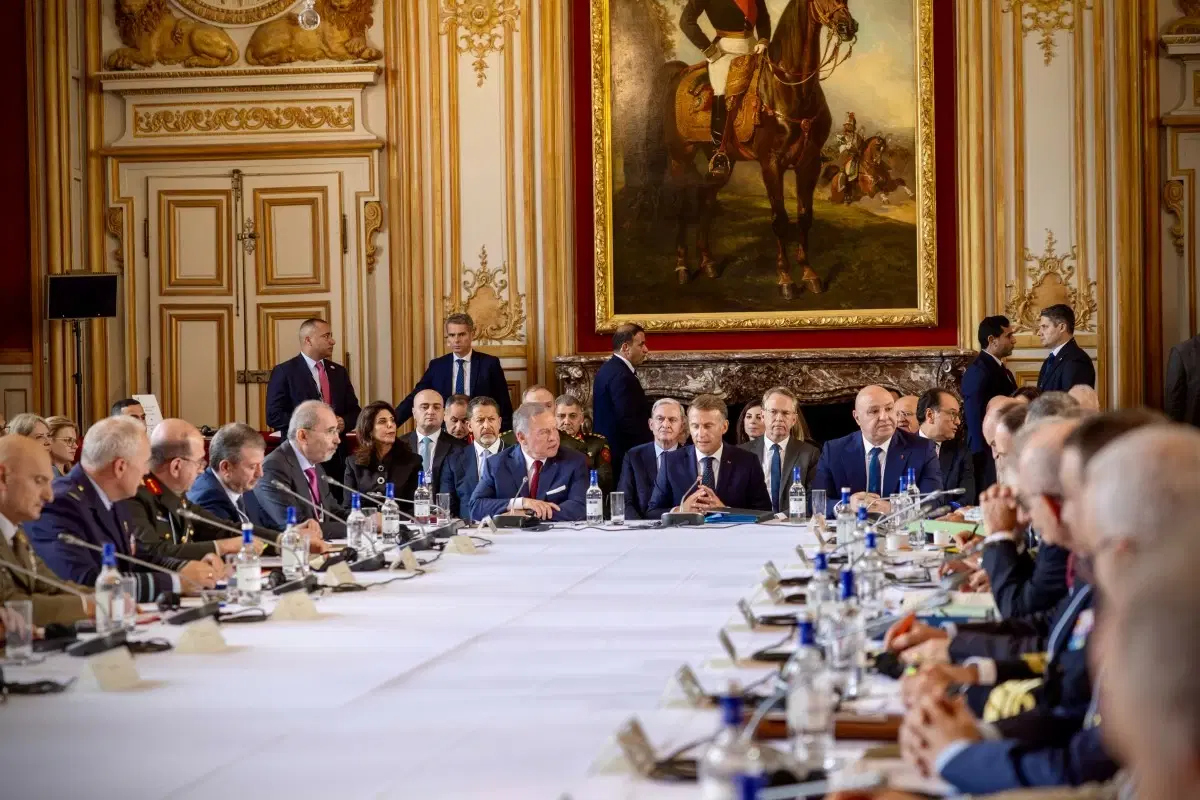
This year's Aqaba meetings in Paris come at a highly sensitive regional time, as the new round of Aqaba meetings, held in Paris to discuss the security situation in Lebanon, reaffirms Jordan's ongoing presence in efforts aimed at addressing regional crises through dialogue, international coordination, and support for national state institutions and their ability to protect their security and sovereignty.
His Majesty King Abdullah II chaired the Aqaba meetings at the Invalides Palace in Paris, alongside French President Emmanuel Macron and Lebanese President General Joseph Aoun, with discussions focusing on supporting the Lebanese army, enhancing its capabilities, and assisting Lebanon in maintaining its security and sovereignty and restricting weapons to the state.
The meeting between His Majesty the King and the French President in Paris provided an opportunity to reaffirm the importance of the Jordanian-French partnership in vital areas, with His Majesty stressing the need to intensify international efforts to restore calm and respect the sovereignty and security of Arab countries. The meeting also witnessed the signing of a defense cooperation agreement between Jordan and France.
Jordan's role in dealing with regional crises is ahead of others in the region, as the Kingdom does not view security as merely a military matter, but links it to the stability of the state and its institutions and its ability to enforce the rule of law and protect its citizens, an approach that was clearly evident in the Paris meeting agenda.
According to observers, the Aqaba meetings have given an additional dimension to UN coordination and consultation on various issues since their inception, as they are not limited to discussing a specific crisis but provide a framework for coordination between countries, institutions, and experts, allowing political dialogue to be transformed into practical cooperation mechanisms.
According to retired Major General and military expert Ali Salama Al-Khalidi, the central message of the Paris meetings was to support the Lebanese army and internal security forces and enhance their ability to perform their duties, pointing out that addressing the Lebanese crisis is not only related to immediate security arrangements but is also linked to the state's ability to extend its authority and strengthen its institutions.
He added, from here, one can read the Jordanian position in helping Lebanon build its national capabilities, noting that the Aqaba meetings in Paris demonstrate the ability of Jordanian diplomacy to combine the political and security tracks.
Khalidi continued, Jordan, under the leadership of His Majesty King Abdullah II, always emphasizes in regional files the importance of political solutions, respect for the sovereignty of states, and strengthening the capacity of official institutions, alongside international cooperation in facing security challenges.
He noted that the Aqaba meetings in Paris confirm the important Jordanian role in the region in supporting solutions that enhance the security and stability of states, highlighting that the initiative launched by His Majesty King Abdullah II more than a decade ago enabled Jordan to build a dialogue platform that brings together regional and international parties around common security and stability challenges, which was evident again in Paris through the wide international participation in the meetings.
For her part, political writer and researcher Dr. Daniela Al-Quraan said that the Aqaba meetings in Paris are of particular importance as the presence of His Majesty King Abdullah II in the Aqaba meetings is an extension of an initiative launched by His Majesty in 2015, noting that it aims to enhance coordination, cooperation, and exchange of expertise between countries and institutions concerned with facing security challenges and terrorism.
Al-Quraan added that over the years, the initiative has moved from regional meetings to a platform that brings together multiple international parties around shared security and political files, noting that the meetings confirm the Jordanian position, which is based on supporting the national state and its institutions, as enhancing the capacity of official institutions represents one of the main paths to maintaining stability and preventing internal crises from expanding into regional crises.
She pointed to His Majesty's affirmation of Jordan's support for Lebanon and the Kingdom's keenness to provide the necessary support to maintain its stability and capabilities, in addition to the meetings addressing the needs of the Lebanese army and internal security forces, alongside international support mechanisms according to specific needs.