Democratic lead nationally in the "congressional ballot"
A month before the US midterm elections, President Donald Trump faces unfavorable polls that portend the loss of his Republican allies in Congress, which could obstruct his political agenda and redraw the power map in Washington for his remaining two years in the White House.
The November 3 elections will serve as a judgment on a presidency considered one of the most volatile in US history, which Trump approaches with historically the lowest level of popularity for a president by such a milestone.
Democrats hold high hopes of regaining control of the House of Representatives, and perhaps the Senate or both.
If that happens, they will be able to block bills backed by Donald Trump and launch parliamentary investigations against him and his associates accusing them of corruption.
House Democratic leader Hakeem Jeffries has vowed to "hold the swindlers accountable."
Consequently, defeat in the midterm elections would severely curb Donald Trump's ambitions during the final two years of his term.
At present, virtually all polls point in this direction.
A recent Emerson College poll showed Democrats leading Republicans by 11 points nationally.
Spencer Kimball, executive director of Emerson College Polling, believes that although this type of general poll "does not reflect the fine details of each individual election, it is considered an important indicator."
Kimball points out in particular that "among Latino voters, who shifted toward Trump in 2024, 64 percent today favor a Democratic candidate, compared to 31 percent favoring a Republican candidate."
Donald Trump's personal popularity is also seeing a decline to its lowest levels.
In this context, Julian Zelizer, professor of political history at Princeton University, explains that "the opposition party is usually in a good position" ahead of midterm elections. He adds, "Furthermore, the president is currently facing very negative and historically unprecedented numbers" in terms of public approval.
The latest Wall Street Journal poll revealed that the percentage of favorable opinions toward Donald Trump has dropped to 37 percent.
The New York-based newspaper notes that this is "the lowest level for any president ahead of a midterm election" throughout the history of polling it began 36 years ago.
Americans particularly fault him for his failure to lower the cost of living, even though that was his main electoral promise.
Trump campaigned pledging not to entangle the United States in new foreign military interventions, but he later launched, alongside Israel, a war against Iran that he is currently unable to exit.
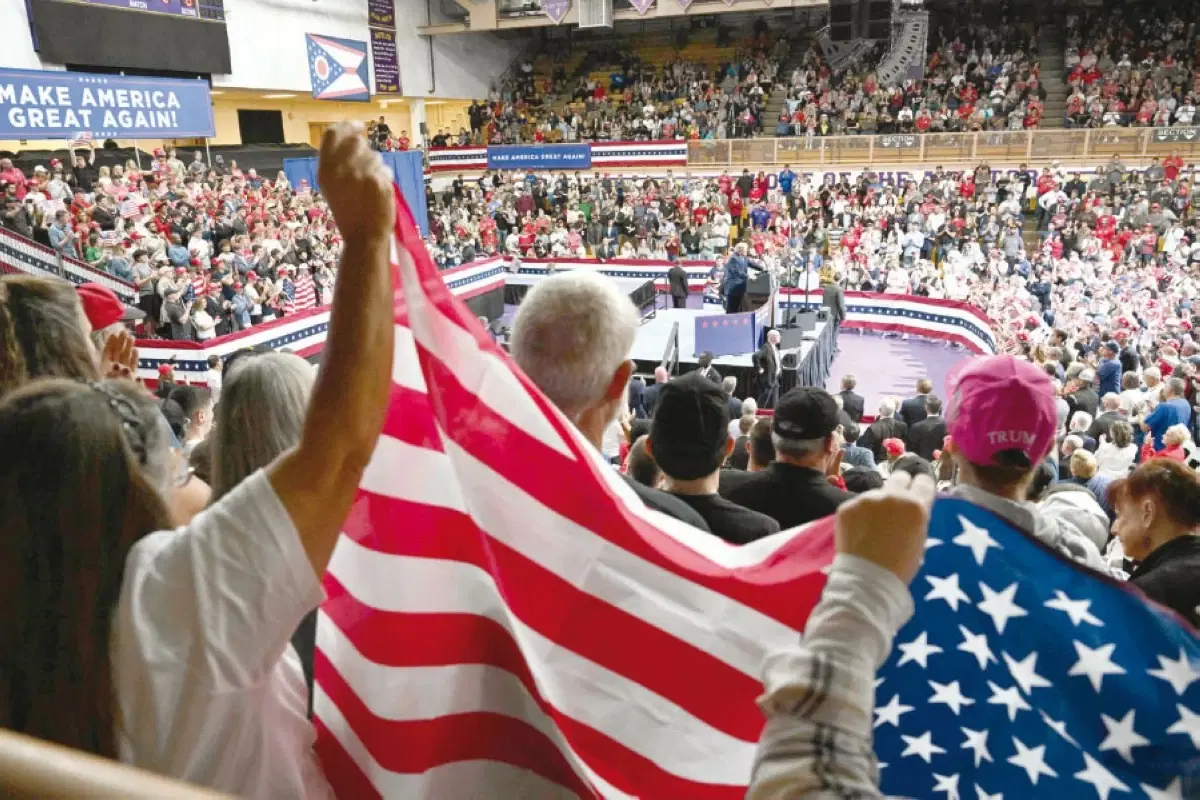
Despite the sharp decline in his popularity, he is doing his utmost to turn the vote into a referendum on his person, telling his supporters in Dallas in mid-September, "You have to act as if I am the candidate."
He also promised to make a sweeping nationwide tour to promote Republican party candidates and rally support for them.
However, a growing number of Republicans are now distancing themselves from Trump, demanding an end to the war with Iran and greater efforts to lower the cost of living.
In this context, Republican Representative María Elvira Salazar of Florida stated in a campaign video, "Mr. President, some of your border enforcement measures have crossed reasonable bounds."
In Texas, Iowa, Ohio, and even Alaska—states where Donald Trump won by comfortable margins in the presidential election—the opposition has begun dreaming of winning a Senate seat.
However, despite the worrying indicators currently facing the right-wing camp, a Democratic electoral sweep is by no means guaranteed, as Republicans enjoy a significant financial advantage allowing them to flood television screens with supportive ads during the final weeks of the campaign.
The redistricting process that began over a year ago in many Republican states has also reduced the number of House seats for which Democrats can realistically compete.
The only certain thing is that following these midterm elections, Donald Trump will begin to envision the end of his political career, as he will not be able to run again in 2028.
At that point, a frantic race will kick off, both among Democrats and Republicans, to search for his successor.