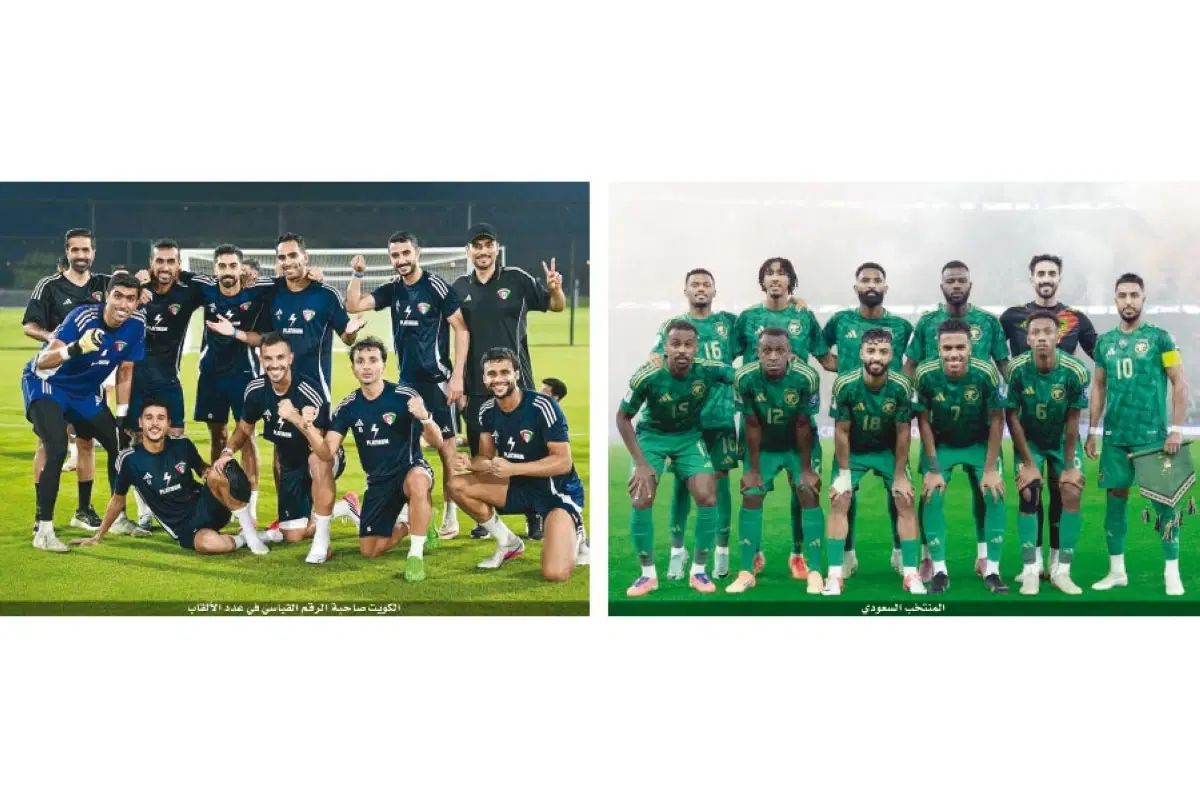
Jeddah awaits the battle of the giants.. The Green to break the fast and the Blue to reclaim the title
Strong competition in Gulf Cup 27
Amman8 min read
Share
The Saudi national football team is preparing to take on an anticipated challenge and end a two-decade-long title drought when it hosts the 27th Gulf Cup in Jeddah between September 23 and October 6.
The "Green" is looking to secure its fourth Gulf title and end a drought from Gulf podiums that has lasted for about 23 full years, specifically since the last title the team won in 2003.
We will not settle for anything less than gold
The draw placed Saudi Arabia at the head of Group A, which is described as the "group of death," as it includes strong teams with a long history in the tournament: Iraq, the four-time champion; Kuwait, the record holder for the number of titles (10); and Oman, a two-time champion.
The Saudi squad aspires to leverage the home-field advantage to top its group, advance to the knockout stages, and subsequently embrace the cup.
Former international playmaker Saeed Al-Owairan told Agence France-Presse (AFP): "The time for excuses is over, and the Saudi sports public will not settle for anything less than gold on home soil."
He added that the Saudi national team "does not enter any regional or continental tournament just for preparation or to test players; the Green always enters competitions as a top-tier favorite, and the technical management and players must realize that the Gulf title is the first and only goal at this stage."
Led by Donis, Saudi Arabia enters the Gulf tournament in the absence of two key pillars among eight players who participated in the World Cup and were excluded by the Greek coach: its captain, Al-Hilal star Salem Al-Dawsari, who is recovering from an injury, and Lens defender Saud Abdulhamid, who has been absent from his French team's ranks in recent weeks due to injury.
For his part, former Saudi and Al-Ettifaq captain Saleh Khalifa confirmed to AFP that "it is wonderful to see our country preparing for an exceptional continental event like the Asian Cup finals in a short time, but this anticipated organization must be a catalyst that doubles the responsibility placed on the players and the technical staff now, not an excuse for relaxation or treating Gulf Cup 27 with tactical coldness."
He added, "The biggest mistake we could make is deferring goals and saying that we are building for 2027. A great edifice is only built with solid foundations laid today, not tomorrow, and great teams do not grow in closed experimental rooms, but rather hone their strengths in official confrontations and under crowd pressure."
He continued, "The Gulf tournament is the real test that will show us the extent of these players' maturity and their ability to withstand sports pressures. If we cannot instill a culture of winning and a hunger to touch gold in this regional tournament, how will we demand that the players stand firm and ascend the continental podium? Creating a champion requires achieving successive successes and making victories a daily habit and a deeply rooted culture in the mentality of every player who wears the national emblem."
A rich history
The Saudi national team possesses a rich history in the Gulf Cup linked to the beginnings of the competition itself. Since the first edition of the tournament in 1970 in Bahrain, and up to the last edition in 2025 in Kuwait, the "Green" has maintained an almost constant and influential presence in all tournaments.
It has not missed the Gulf celebration throughout its history spanning more than half a century except on one occasion, which was in the tenth edition in Kuwait in 1990 when it withdrew before it started for organizational reasons at that time.
During this long journey, Saudi Arabia succeeded in writing its name in the record of champions, as it won the title three times in 1994 in the UAE, 2002 on its home soil in the capital Riyadh, and 2003 in Kuwait, before a strange fasting phase began that the current generation is trying to end in Jeddah.
Numbers and statistics issued from the Saudi national team's confrontations in the Gulf tournaments prove the offensive power and solidity it enjoys. The "Green" has played a total of 119 matches throughout its participation history, achieving victory in 61 of them, against 26 draws and 32 losses.
On the scoring level, the Saudi school has always been distinguished by providing enjoyable attacking football, which is translated by the nets, as it has scored 179 goals, a huge scoring rate that reflects the quality of the strikers and playmakers who have passed through the team's lineup.
One cannot talk about Saudi Arabia's history in the Gulf Cup without mentioning the stars who led the Green to these achievements and left a scoring mark.
Topping the list of Saudi national team scorers is former star Majed Abdullah, who succeeded in scoring 17 goals and has become a milestone in the history of the competition.
Following him in the ranking is the exceptional striker and former captain Yasser Al-Qahtani with 10 goals, alongside Saeed Ghorab and Mohammed Al-Ghanem, nicknamed "The Rocket," as each of them has 8 goals to their credit.
Kuwait to reclaim a missing title
For 16 years
Kuwait is looking in the Gulf Cup, which kicks off Wednesday in Saudi Arabia, for a new title missing from its trophy cabinet since 2010, to strengthen its record in the regional tournament.
The "Blue" holds the record for the number of titles with ten championships, including four consecutive ones between 1970 and 1976, but it has been away from the podium since its last title in Yemen, 16 years ago in "Gulf Cup 20".
Its retired top scorer Jasem Yaqoub also holds the record for the tournament's top scorers with 18 goals.
Portuguese leadership and lack of continuity
The draw placed Kuwait in Group A alongside Saudi Arabia, Oman, and Iraq, and it begins its journey against Saudi Arabia on Wednesday in Jeddah, before facing Iraq (26th) and Oman (29th).
Kuwait is relying in "Gulf Cup 27" on Portuguese coach Hélio Sousa, who took over the task in July 2025, succeeding Spaniard Juan Antonio Pizzi.
This experience brings back to the tournament a coach who knows the path to the title, after he led Bahrain to its first Gulf crown in 2019, and also won the West Asian Championship title with it in the same year.
Regarding the reason for its absence from the podium, Jasem Yaqoub, the historical top scorer of the Gulf Cup with 18 goals, believes in a statement to AFP that "Kuwaiti sports lack continuity of work and long-term plans."
Yaqoub, nicknamed "The Terrifying," emphasized the difficulty of achieving the desired results "as long as work continues in the same way."
Yaqoub considered that the Gulf tournaments "have a special flavor, and they are the gateway to fame for the Gulf player and the key to reaching the biggest tournaments, whether the Asian Cup or even the World Cup."
Yaqoub tipped Saudi Arabia to win the title "based on the competitions being held in Jeddah and the crowd support," and did not rule out the Omani and Bahraini teams from the title race, noting their development "from one match to another" in combined tournaments.
Ali Marwi, who won the "Gulf Cup 13" title with Kuwait in Oman, also believes that Saudi Arabia and the UAE are candidates to compete for the title, but he did not downplay Kuwait's chances, saying that "the 'Blue' has a chance to appear in a good image, based on coach Sousa's combination that brings together experience and youth."
The start against Saudi Arabia charts the path
Faraj Laheeb, who shone in the Gulf tournaments with Czech coach Milan Máčala, warned of the difficulty of the Kuwaiti mission in light of the participation of strong teams.
Laheeb told AFP that the "Blue's" mission "will not be easy, but it is not impossible," stressing that facing Saudi Arabia in the first round "will be important to chart the features of Kuwait's path in the tournament."
The first meeting against Saudi Arabia takes on special importance for the Kuwaiti national team, not only because it is the beginning of its journey in the tournament, but because it is one of the important classic confrontations in Gulf football.
Kuwaiti player Mohsen Falah said that "the start in Gulf Cup 27 will be through the Saudi confrontation," praising the high level that Saudi football has reached and the development that its local competitions are witnessing.
Kuwait won the titles of the first four editions in 1970, 1972, 1974, and 1976, before adding 6 other titles in the years 1982, 1986, 1990, 1996, 1998, and 2010.
The "Blue" reached the semi-finals in its last participation in the previous edition it hosted.