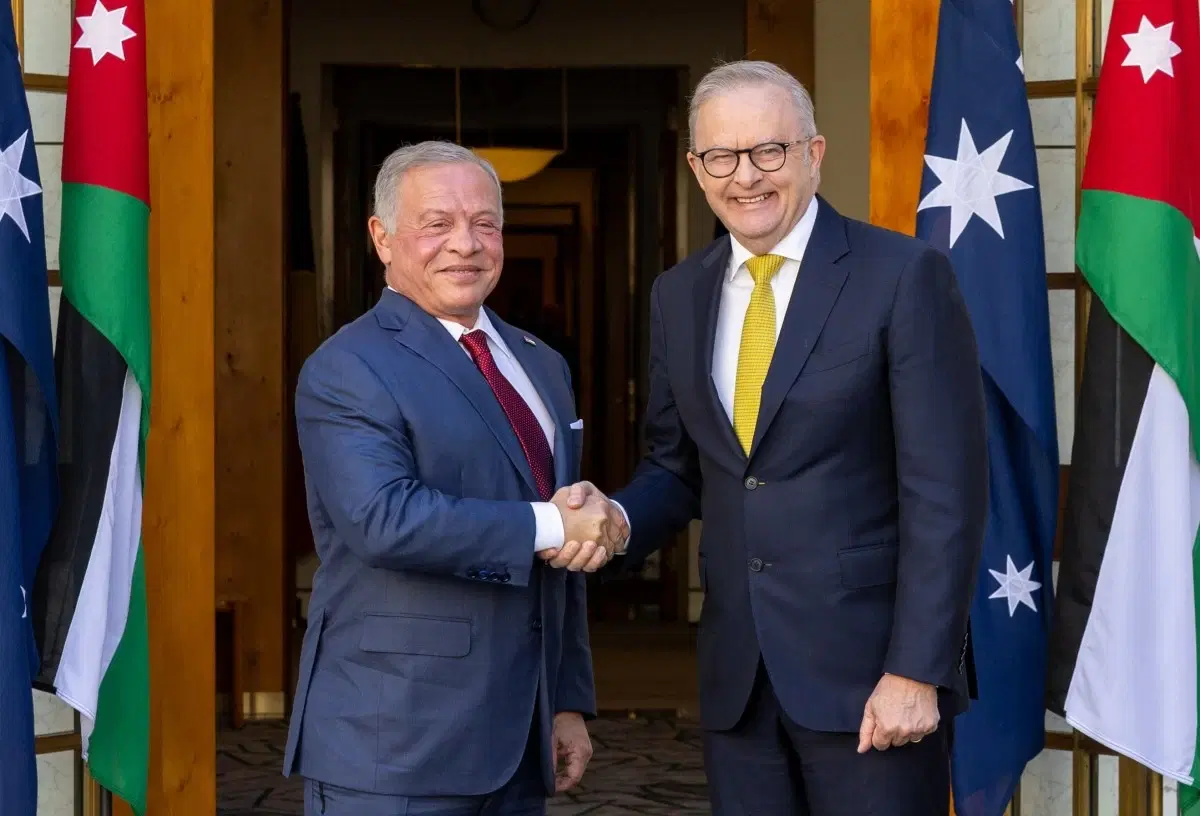
Experts: King's talks with Albanese open horizons for broader economic partnerships
Opportunities to expand the Jordanian-Australian economic partnership
Amman7 min read
Share
Australia is a promising partner for diversifying raw material sources and opening new markets
Economic experts confirmed that the talks held by His Majesty King Abdullah II with Australian Prime Minister Anthony Albanese in Canberra carry strategic and economic dimensions that go beyond strengthening bilateral relations, paving the way for expanding Jordanian partnerships with influential economies in the Asia-Pacific region, attracting quality investments, and opening new markets for national exports.
In statements to (Alrai), they said that the King's moves enhance the Kingdom's position on the international investment map by discussing cooperation opportunities directly with leaders and decision-makers, noting the importance of translating political understandings into economic projects that contribute to developing national industries and transferring technology and expertise, in addition to expanding cooperation in the fields of education, security, and water resource management.
The Hashemite Kingdom of Jordan and Australia issued a joint statement yesterday, Wednesday, at the conclusion of the royal talks, affirming the firm friendship between the two countries based on mutual respect and a shared commitment to peace, security, and prosperity. Both sides welcomed the establishment of an agenda to enhance cooperation, based on the joint declaration issued in 2016, reflecting the breadth of bilateral relations.
The Chairman of the Zarqa Chamber of Industry, Engineer Fares Hammoudeh, said that focusing on economic files in parallel with political and regional issues contributes to introducing the Jordanian investment environment and discussing cooperation opportunities in areas of mutual benefit, especially industries that rely on raw materials and mineral resources.
He explained that Australian expertise in gold and iron mining represents an opportunity to develop industrial and commercial cooperation and diversify the sources of raw materials needed for a number of Jordanian industries, including food industries and jewelry, especially in light of the global fluctuations that have affected supply chains.
He added that strengthening trade partnerships with Australia also provides opportunities to open new markets for national exports and attract Australian investments, particularly in defense, food, and other strategic industries. He pointed to the possibility of benefiting from the free trade agreements that Jordan enjoys with various countries and economic blocs to expand the access of Jordanian products to global markets and enhance their competitiveness.
Hammoudeh emphasized the importance of the private sector's role in translating political understandings into practical partnerships by building direct relationships between Jordanian and Australian companies, exploring investment opportunities, and developing cooperation in education, technology, and research and development, which supports productivity and provides job opportunities.
He pointed out that Australia possesses extensive expertise in water resource management and combating drought and desertification, in addition to sustainable agriculture techniques and enhancing food and water security, which allows Jordan to benefit from the Australian experience in dealing with water scarcity challenges and improving resource use efficiency.
For his part, financial and economic expert Dr. Mohammad Al-Hadab Al-Sarhan said that the King's talks with the Australian Prime Minister gain economic and humanitarian importance in light of the role Jordan plays in hosting refugees, providing humanitarian aid, and enhancing regional stability, and the accompanying pressures on public services, infrastructure, and national resources.
He explained that the continuation of these burdens requires expanding international partnerships and developing more sustainable support mechanisms, which helps protect national resources and enhance the Kingdom's ability to continue growing. He noted that the 2026 Regional Response Plan estimated the funding requirements for programs directed at refugees and host communities in Jordan at about $650.5 million, covering the sectors of education, health, water, protection, basic needs, and economic empowerment.
Al-Sarhan indicated that this amount represents the funding needs required for the programs and does not necessarily mean direct spending from the general budget, but it reflects the scale of needs that require a joint national and international response.
He emphasized the importance of moving from reliance on short-term humanitarian funding to multi-year support programs that allow for the development of schools, health centers, water networks, and services in host communities, thereby easing the pressure on infrastructure, achieving sustainable benefits for citizens and refugees, and helping the government with financial planning and directing resources toward economic and developmental priorities.
He noted that Jordanian-Australian cooperation in the humanitarian field has a foundation that can be built upon, pointing to Australia's allocation of about 20 million Australian dollars to UNRWA within its aid estimates for the 2026-2027 fiscal year, in addition to providing two million Australian dollars last year to the Jordan Hashemite Charity Organization to provide medical supplies for field hospitals in Gaza.
He explained that these contributions provide an opportunity to develop cooperation from providing urgent aid to more regular partnerships in medical services, humanitarian supply, and logistics management, with the need to distinguish between support directed to Gaza and aid aimed at easing burdens within Jordan.
He suggested studying the establishment of a specialized cooperation program for medical and humanitarian supply chains that benefits from the expertise of institutions in both countries and contributes to improving response speed, reducing the costs of transporting and storing supplies, and enhancing Jordan's readiness to deal with regional emergencies.
Al-Sarhan indicated that defense and security cooperation also carries economic dimensions, as regional tensions reflect on shipping and insurance costs, tourism and trade movement, and increase uncertainty for investors. He emphasized that strengthening cooperation with Australia in training, exchanging expertise, and security coordination supports the Kingdom's ability to protect the stability of its economic environment and deal with risks facing international supply and transport chains.
He pointed to the importance of what was included in the joint statement regarding freedom of navigation and the flow of trade, given their direct link to the interests of the Jordanian economy, which is open to foreign markets, explaining that the stability of trade routes and the reduction of regional risks help limit the additional costs borne by companies and consumers and enhance the ability of productive and tourism sectors to plan and expand.
Al-Sarhan stressed the need to develop a medium-term partnership program that links part of international support to projects that serve host communities, especially in education, health, and water, in parallel with expanding cooperation in medical and logistical crisis response. He emphasized the importance of measuring the results of the partnership by the volume of sustainable funding mobilized, the service projects that enter the implementation phase, and the extent of improvement in their ability to meet the needs of the population, rather than by the volume of announced pledges alone.
In turn, the representative of the clothing and garment sector at the Jordan Chamber of Industry, Engineer Ihab Qadri, said that the King's talks with the Australian Prime Minister reflect a trend toward diversifying economic partnerships and enhancing the resilience of the national economy at a stage witnessing changes in global economic balances, supply chains, and trade alliances.
He explained that Australia possesses advanced capabilities in mining, energy, technology, education, and services, which allows for opportunities for integration with Jordan's priorities in investment, value-added industries, and human resource development. He added that the political level of the talks reflects the importance of employing diplomatic relations and the Kingdom's international standing in building more diverse and sustainable economic partnerships.
Qadri noted that the interconnection between regional stability and economic interests is gaining increasing importance in light of the impact of geopolitical considerations and economic security on investment and trade decisions. He emphasized that Jordan's position as a reliable partner provides opportunities to develop cooperation with Australia, provided that steps are taken toward implementation that link institutions and companies in both countries and identify practical opportunities in manufacturing, technology, advanced training, services, and joint investment.
He added that what is required is not limited to opening new markets for Jordanian products, but includes building relationships that transfer knowledge, raise productivity, expand the export base, and attract high-value-added investments, in line with the goals of the Economic Modernization Vision.
Qadri emphasized that the strategic value of the royal tours lies in expanding Jordan's political and economic options, noting that diversifying partnerships and enhancing productive capabilities increase the resilience of the national economy and its ability to protect its interests and achieve sustainable growth in light of global fluctuations.