Crown Prince's meetings in New York and Croatia.. Partnerships serving the future of Jordan and its youth
Amman12 min read
Share
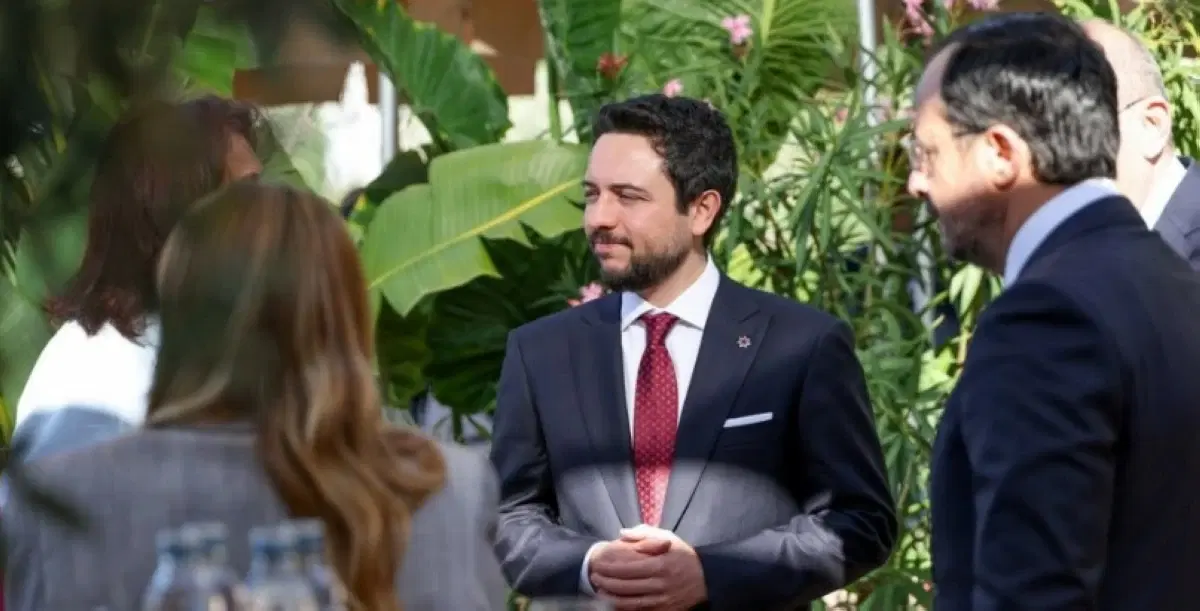
The meetings of His Royal Highness Crown Prince Al Hussein bin Abdullah II in New York and Croatia, during his participation in the "MED9" summit of Southern European countries, carried a purposeful technological diplomacy driven by a confident strategic vision at a pivotal moment in the history of the global economy. Artificial intelligence and technology have become the foundation upon which the economy is being rebuilt, and a new standard by which countries' competitiveness is measured. It is a moment in which Jordan is moving with confidence and under wise Hashemite leadership that reads the future before it arrives. Building on the international standing established by His Majesty King Abdullah II, His Highness personally leads the technology and artificial intelligence file, transforming this trust into partnerships that serve the future of Jordan and its youth.
His Highness held 7 meetings with leaders of nations, investors in technology and finance, and future projects over 10 days, during which he discussed 24 axes of importance to Jordan and the future of its youth and economy. Specialists in artificial intelligence, data science, politics, and society who spoke to the Jordan News Agency (Petra) described them as an integrated series that begins with readiness, passes through competencies, ownership, innovation, expertise, infrastructure, and financing, and ends with markets. If a single link were missing, the system would be disrupted; this is a level of planning that only comes from a leadership that knows what it wants and possesses the relationships that open doors for it.
The axes of His Highness's meetings consisted of 24 points, including cooperation in the field of Jordanian intellectual property rights, opportunities for developing technology and artificial intelligence in Jordan through the initiatives of the National Council for Future Technology, cooperation in the tourism services sector and coordination mechanisms with the "Jordan Source" initiative, strengthening cooperation with Ireland in the technology and digital transformation sectors, vocational and technical education and training, and exploring ways to enhance cooperation with Estonia in tourism, technology, education, and various fields.
The research axes led by His Highness included strengthening cooperation with the U.S. International Development Finance Corporation (DFC) on major and vital projects, investing in Jordan's geographical location as an integrated regional hub for exchange and connectivity in the fields of energy, logistics, water, railways, and the internet, and strengthening cooperation and partnerships with Jordan in the areas of developing systems and models related to artificial intelligence, developing digital government services, and improving the investment environment in Jordan. It also included cooperation in manufacturing and automating logistics operations in the city of Aqaba, and discussions regarding the Jordan-Europe Investment Conference, which the Kingdom will host next November, and its importance in consolidating partnerships between Jordan and European Union countries.
Dr. Ghaith Al-Mahadin, Assistant Professor of Data Science and Artificial Intelligence at Mutah University, told "Petra" that His Highness's meetings represent a purposeful technological diplomacy driven by a strategic vision, as we are living today in a pivotal moment in the history of the global economy, where artificial intelligence has become the foundation upon which the economy is being rebuilt, and a new standard by which countries' competitiveness is measured.
He indicated that in this moment, Jordan is moving with confidence, led by a wise Hashemite leadership that reads the future before it arrives. Building on the international standing established by His Majesty King Abdullah II, His Highness personally carries the technology and artificial intelligence file, transforming this trust into partnerships that serve the future of Jordan and its youth.
He noted that His Highness's recent meetings in New York and those held in Croatia on the sidelines of his participation in the "MED9" summit are a purposeful technological diplomacy driven by a strategic vision, where every meeting has meaning, purpose, and a future. His Highness began from within before leaving for New York, chairing a meeting of the National Council for Future Technology and following up on the readiness of the "Sanad" business application. This beginning is intentional, because the state cannot present itself to the world as a reliable partner before building a digital environment that facilitates business, which is the same environment upon which artificial intelligence applications will later be built.
He added that in New York, His Highness met with the CEO of Uber, and the essence of this meeting was not just about transportation services, but linking it to the "Jordan Source" initiative, which His Highness sponsored its launch in 2021 to present Jordanian competencies to global companies, thereby opening the door to technical jobs for young Jordanians working for a global company from within the homeland.
He pointed out that His Highness's meeting with Dr. Hamza Al-Sarhan, founder and CEO of OpsHeaven, focused on Jordanian intellectual property, which is one of the most significant aspects of the tour. In the artificial intelligence economy, value remains with those who own the models and data, not those who provide the service, and His Highness wants Jordan to be a producer and owner of technology, not a consumer of it.
He noted that His Highness did not overlook inspiring international experiences during his tour. Estonia, whose President Alar Karis he met, has become a global reference in digital government despite its small size, and Ireland, whose Prime Minister Micheál Martin he met, has transformed itself into a hub for major technology companies. Both embody what Jordan aspires to: a country that competes with the intelligence of its system, not its size, and completes what it started in "Sanad" and digital transformation.
He pointed out that His Highness's meeting with Ben Black, CEO of the U.S. International Development Finance Corporation, addressed making Jordan a regional hub for connectivity in energy, logistics, water, railways, and the internet. This is a deep reading of the nature of the current phase, because artificial intelligence is an energy- and computing-intensive industry, and there are no models without data centers, connectivity, and stable energy. Just as Jordan has historically been a transit point for trade, it can today be a transit point for data.
He indicated that in His Highness's meeting with leaders of technology institutions, he linked the development of artificial intelligence models to digital government services and the automation of logistics operations in Aqaba, shifting the conversation from technology as an idea to technology as a tangible application in the state and economy. His Highness concluded the tour in Europe by meeting Croatian Prime Minister Andrej Plenković on the sidelines of the "MED9" summit, which Jordan attended as a key guest for the third year, discussing the Jordan-Europe Investment Conference in November, turning this consistent presence into an economic path.
He said that when we put these meetings together, we find an integrated series that begins with readiness, passes through competencies, ownership, innovation, expertise, infrastructure, and financing, and ends with markets. If a single link were missing, the system would be disrupted; this is a level of planning that only comes from a leadership that knows what it wants and possesses the relationships that open doors for it.
He said that these meetings and the opportunities they open are phased over time, and each phase has its own nature. In the near term, technical service jobs come through "Jordan Source" and global companies. This sector is transforming today due to artificial intelligence, as traditional jobs are declining and being replaced by higher-value jobs, such as data processing for training models, evaluating their outputs in Arabic, and operating smart systems. These are jobs that specifically suit Jordanian youth, given their education, languages, and understanding of the Arab context. His Highness noted that 27 percent of technology pioneers in the region are Jordanians, even though Jordan's population is only 3 percent of the region's total.
He noted that in the medium term, engineering and infrastructure jobs will emerge with connectivity projects and the automation of logistics operations in Aqaba, in data engineering, cloud computing, data centers, and smart systems, many of which are outside the capital. Development financing here bears the risks of the beginning, reassuring and attracting private investors.
He emphasized that in the long term, the highest value comes from intellectual property and startups, when the job transforms from wages for hours worked into exported products and accumulating returns. This is complemented by investment in knowledge through educational cooperation with Estonia and access to European markets through the November conference. What connects all these opportunities is the trust created by the direct patronage of His Royal Highness the Crown Prince for this file. It remains for those in universities to qualify their graduates with the skills this market needs, from data engineering and machine learning to the security and governance of smart systems.
He said that the smart government stands on a foundation already in place through "Sanad," digital signatures, and electronic payments. The next step is proactive services that know the citizen's needs before they are requested. The Estonian experience proves that flexibility is more important than size. In artificial intelligence in Arabic, there is a clear gap, because global models are still weaker in Arabic than in English, which is a gap in a market of over four hundred million speakers, and Jordan possesses the linguistic and technical competencies to bridge it.
He noted that this is what qualifies Jordan's location and expertise in renewable energy to host regional data centers, which is consistent with the connectivity axes discussed by His Highness. Aqaba can become a smart logistics platform managed by predictive models and digital twins that simulate operations. Even the water challenge—Jordan being the second most water-scarce country in the world—can be transformed into exportable expertise, because solutions that succeed in the most difficult environments are suitable for every country facing the same challenge.
He stated that all of this is supported by His Highness's directive to the National Council to develop the scientific research and innovation ecosystem, so that research can be transformed into products and intellectual property. Jordan does not compete in the volume of spending, but rather in three advantages that are difficult to purchase: human competence, flexibility, and the international trust built by the Hashemite leadership; it does not need to be the biggest spender to be the most intelligently positioned.
He concluded his remarks by saying that what we see today is an extension of a wise Hashemite approach that reads the future before it arrives. His Majesty the King has established Jordan's international standing, and His Royal Highness the Crown Prince is transforming it into tangible opportunities. The future that His Highness is working on today is the future that our youth will live tomorrow.
Researcher at the Politics and Society Institute, Engineer Hussein Al-Saraira, told Petra that His Highness's recent meetings are more than just separate encounters with political, economic, and technological leaders; they reflect an integrated trend toward building what can be called Jordanian "technological diplomacy," meaning the use of international relations and partnerships with global companies and institutions to open new paths for the Jordanian economy in technology, artificial intelligence, and the digital economy.
He pointed out that this path is continuing institutionally from within Jordan through the National Council for Future Technology, meaning that the external meetings come in the context of an attempt to link the national vision with global opportunities, networks, and markets. Here lies the importance of these meetings, and countries like Ireland and Estonia carry significant meaning; these two experiences represent, each in its own way, models of small economies that have managed to make technology, skills, and innovation an essential part of their competitiveness.
He indicated that these meetings establish the generation of job opportunities for Jordanian talent and new investments, and this is perhaps one of the most important results that Jordan should target from this openness, provided that we do not treat attracting global companies as an end in itself.
The real value begins when the presence of these companies leads to the creation of quality jobs for Jordanians, the transfer of knowledge, the training of talent, the development of local companies, and the opening of external markets for Jordanian services and products.
He said that attracting technology companies can create a multiplier effect on the local economy when global companies connect with Jordanian companies, universities, research and development centers, and business incubators. Then, foreign investment does not become just capital entering the Kingdom, but a channel for transferring knowledge, technology, management standards, and global markets and networks.
He emphasized that His Highness knows that Jordan does not need to be merely a consumer of the latest artificial intelligence applications, but rather needs to employ technology in areas that directly affect its economic and developmental capacity: water, energy, transport, health, education, government administration, cybersecurity, supply chains, tourism, agriculture, and financial services.
He said that His Highness's talk about intellectual property, the legislative environment, digital government services, artificial intelligence, investment, and education and training, in closely related contexts, carries significant meaning; the requirement is to build a national technological ecosystem, not to import isolated technologies.
He pointed out that Jordan can build a competitive advantage in the field of "Arab Artificial Intelligence," not necessarily by competing with giant companies in building foundational models, but by developing applications and solutions that understand the Arabic language and the local and regional context, and serve sectors such as government administration, judiciary, education, health, media, and financial services.
He indicated that the greatest opportunity from these meetings lies in Jordanian human capital, as technology changes faster than the ability of traditional curricula to keep pace. Therefore, real investment must shift from merely increasing the number of technology graduates to building advanced, exportable skills, linking universities to the labor market, transforming graduation projects and research into products and companies, and expanding vocational and technical training in digital fields.
He explained that His Highness's meetings with global companies and institutions serve as a practical platform to link Jordanian talent to the global economy, not just to attract investments into Jordan. Remote work and digital export mean that the job itself can come to Jordan even when the company does not.
He noted that the strategic value of these meetings lies in the fact that they place Jordan before an important transition from talking about digital transformation to building a digital economy capable of exporting, from consuming technology to producing solutions, and from training individuals to use tools to building national capabilities in research, development, and innovation.
He said that Jordan's success under the leadership of His Highness in these areas means that future technology will not only be a new sector added to the economy, but can become a tool to reshape the Jordanian economy itself, raise its productivity, enhance its ability to face risks, create job opportunities, and transform the most important advantage Jordan possesses—the human being—into an economic and knowledge value capable of global expansion.