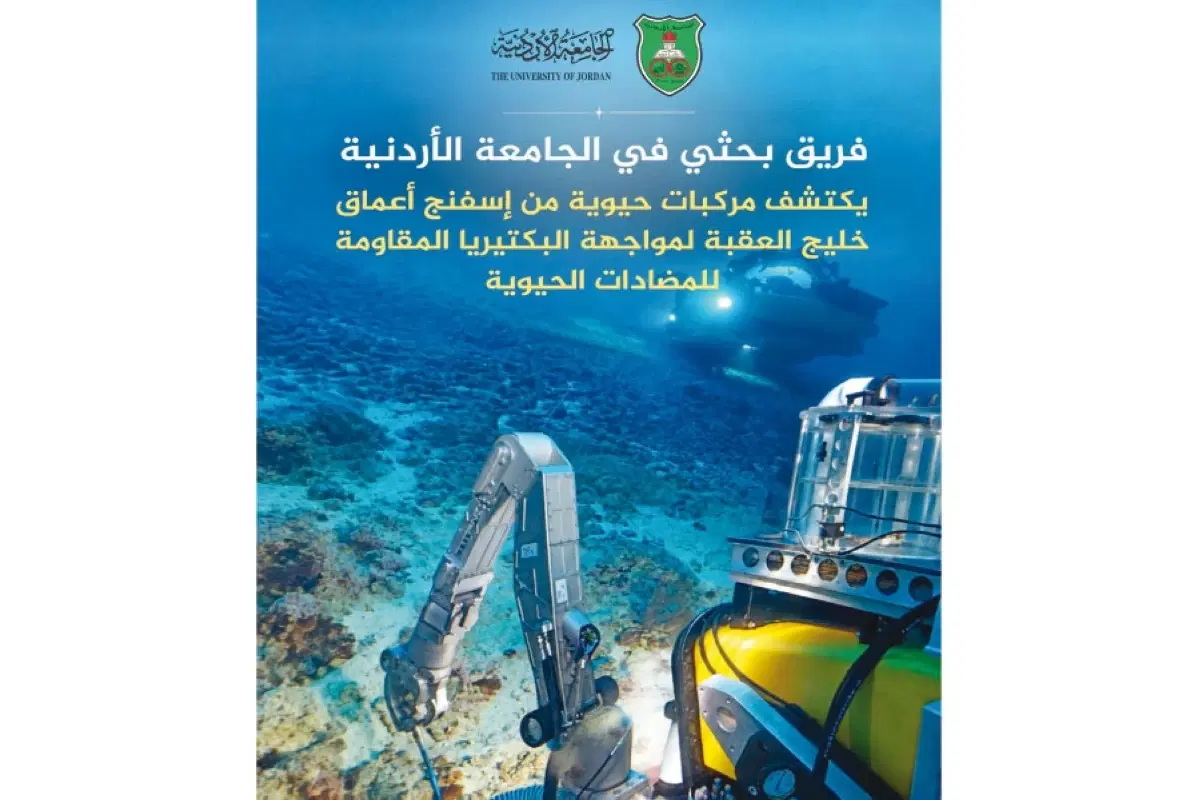
This success was achieved thanks to the close field and exploratory cooperation of the "Molecular Pharmacology in Personalized Medicine" research group at the University of Jordan with international and national institutions. Sea sponge samples were collected in July 2022 during an exploratory trip via the global "OceanXplorer" mission. The researchers used manned submersibles equipped with robotic arms to reach marine depths ranging between 140 and 362 meters below sea level, in thermal conditions ranging between 21.1 and 22.5 degrees Celsius.
The logistical support provided by the Aqaba Special Economic Zone Authority (ASEZA) contributed to the completion of the field mission, reflecting the importance of integration between national and international institutions in supporting scientific research and exploring natural resources and biodiversity in the Jordanian marine environment.
Regarding laboratory results and analyses, the samples were preserved at low temperatures in an ethanol solution, then subjected to precise genetic tests using DNA Barcoding technology and compared with global databases, which resulted in the identification of three main types of sponges: Stelletta sp., Dactylospongia sp., and Haliclona sp.
Tests showed that the Dactylospongia sp. sponge extract demonstrated high inhibitory efficacy against Gram-positive bacteria, particularly Methicillin-resistant Staphylococcus aureus (MRSA), with inhibition rates ranging between 6 and 21 millimeters.
The use of Liquid Chromatography-Mass Spectrometry (LC-MS/MS) technology also allowed for the detection of about 40 bioactive compounds, including gallic acid, caffeic acid, quinone compounds, and the marine alkaloid "Manzamine A".
The research team at the University of Jordan looks forward in the coming phase to obtaining financial support to fund future research projects, which will allow them the opportunity to move to more advanced stages including isolating the most effective compounds, studying their molecular structure and mechanisms of action, in addition to evaluating their toxicity and pharmacological safety, paving the way for studying their potential in therapeutic applications, while taking into account the requirements of production, investment, and protecting the marine environment from depletion.
In this context, the researchers pay special attention to developing sustainable production options for these compounds by employing genetic and chemical techniques to reduce the need to collect large quantities of sponges from the natural environment, preserve marine biodiversity, and enhance the chances of transforming scientific discoveries into sustainable applications. This confirms the University of Jordan's commitment to harnessing scientific research to serve society and develop biotechnology and the medical sector in the Hashemite Kingdom of Jordan, and to contribute to facing global health challenges.