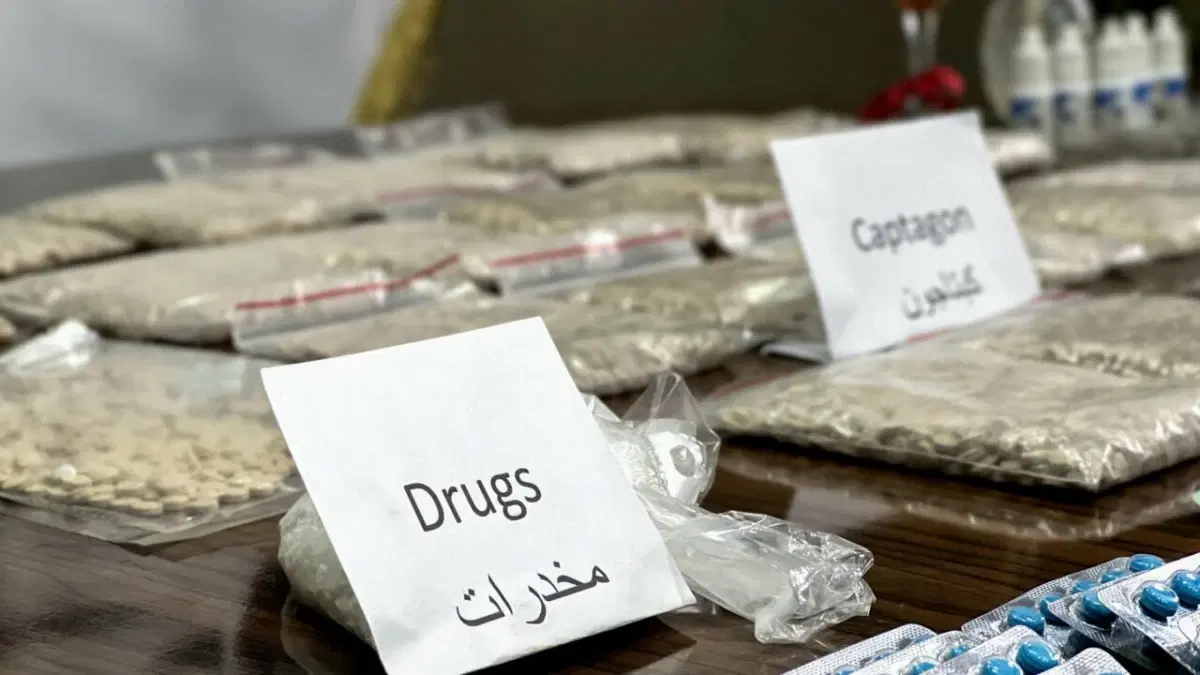
Jordan: A relentless war on drugs.. 500 substances prohibited from being traded, consumed, or possessed
Amman7 min read
Share
Jordan periodically monitors all substances that may fall under psychotropic substances and narcotic drugs that cause significant harm. Over the decades, the Jordan Food and Drug Administration (JFDA) has managed to identify more than 500 substances and classify them according to their degree of danger and impact into several schedules. These are continuously and periodically updated to hold traffickers, consumers, and promoters accountable with severe penalties to protect society from their danger.
Speakers told the Jordan News Agency (Petra) that penalties alone are not enough to solve the problem from its roots, believing that the basis of the problem and its solution lie first in the family's awareness—or lack thereof—of their children's friends and monitoring them, especially during adolescence.
Toxicology specialists indicated that the selection and monitoring of these substances in Jordan are carried out according to a precise institutional and systematic process, with decisions taken periodically and upon the recommendation of the Council of Ministers, noting that the JFDA keeps a constant eye on these substances and those that are misused.
The Jordan News Agency (Petra) reviewed the 12 schedules in which narcotic drugs, psychotropic substances, chemical precursors, and preparations were classified, revealing that the number of these substances exceeds 500.
The JFDA states that the number of substances listed in the schedules of narcotic drugs, psychotropic substances, and chemical precursors is more than 500, which are permanently published on the institution's website and updated according to numerous variables and precise monitoring of these drugs and substances in accordance with the law and regulations in force in Jordan to protect society from their scourges.
The institution indicated that the substances classified in these schedules vary in terms of their severity, as the most dangerous is Schedule 4, followed sequentially by: Schedule 1, Schedule 2, and Schedule 3, while the severity of psychotropic substances falls under Schedules 5-9.
The JFDA pointed out that it continuously studies, through specialized listing committees, the extent of addiction to substances, their effect on the body, the potential for addiction to them, and compares them with international schedules and their danger to society according to permanent scientific and institutional foundations and through specialists in these substances.
Dr. Moamen Al-Hadidi, Senior Consultant in Forensic Medicine and President of the Jordanian Society for Forensic Studies and Research, confirms that the consumption of narcotic drugs and psychotropic substances outside medical supervision causes physical and psychological damage, affects brain functions, cognition, mood, and behavior, leading to addiction, which is characterized by difficulty in controlling consumption and continuing it despite its harmful consequences.
Al-Hadidi explained the necessity of distinguishing between addiction and physical dependence; physical dependence is the body's adaptation to the repeated use of a specific substance, leading to the appearance of withdrawal symptoms when it is stopped or its dose is reduced. This dependence may occur with some medications used for treatment and does not alone mean the existence of addiction.
He indicated that withdrawal symptoms vary according to the type of substance, its dose, the duration of use, the individual's health status, and the consumption of other substances with it. Depending on the substance, they may include anxiety, irritability, nervousness, low mood, sleep disturbance, and poor concentration, in addition to sweating, tremors, palpitations, and headaches. They may be accompanied by an urgent desire to return to consumption, explaining that not all these symptoms appear in every person, nor are they sufficient on their own to diagnose withdrawal.
He added that each substance has a pattern of symptoms; withdrawal from opioids, such as heroin and morphine, may be accompanied by yawning, runny nose, tearing, dilated pupils, chills, muscle aches, abdominal cramps, and diarrhea. As for alcohol withdrawal and some sedatives, especially benzodiazepines, it can be dangerous and in severe cases lead to convulsions, and alcohol withdrawal may be accompanied by delirium; therefore, stopping them when physical dependence exists requires medical evaluation and supervision, and convulsions, severe confusion, or hallucinations require emergency care.
He emphasized that the harms of consumption are not limited to the individual's health but extend to family stability, the ability to work and produce, and economic and social conditions. The effect of some substances may be accompanied by impaired judgment or poor impulse control, increasing the risks of harmful behavior. However, it is not scientifically correct to consider violence or crime an inevitable result of consumption, or to generalize it to all those suffering from addiction; these are behaviors in which multiple factors overlap, and each incident requires an independent assessment.
Al-Hadidi stressed that confronting drugs is a national, religious, and moral duty, and a shared responsibility among individuals, families, educational, health, and media institutions, and state agencies. This confrontation is achieved through early scientific awareness, prevention, combating smuggling and promotion, facilitating access to treatment and rehabilitation, and supporting those recovering and integrating them into society.
He emphasized that addiction is a treatable disorder, and seeking help is an available step to protect oneself and the family, noting that an effective awareness message combines clearly stating the risks, respecting the dignity of the affected person, and encouraging them to seek treatment without stigma or humiliation.
To clarify, the JFDA reviews substances scientifically and regulatorily to distinguish between narcotics and psychotropic substances, and monitors their misuse, developments, and international recommendations. Under Article 37, the Council of Ministers, based on the recommendation of the Minister of Health, decides to amend the schedules for these substances by adding, deleting, or adjusting percentages, specifications, and conditions. The decision is published in the Official Gazette. Scientific considerations include the effect of the substance, the harms of its misuse, and the possibility of its entry into illicit manufacturing, while regulating legitimate medical and scientific needs. Therefore, listing a drug in the schedules does not necessarily mean prohibiting its medical use entirely, but rather subjecting it to the prescribed controls.
Al-Hadidi explained that not listing a substance in the schedules does not automatically mean its use is permitted; Article 14 also addresses the possession, consumption, or use of non-listed substances with the intent of inducing anesthesia or a harmful effect on the mind, according to the conditions of the text. The institution currently displays a version of the schedules dated up to last September 16; therefore, one must refer to the effective version when determining the status of a specific substance, and not rely solely on old lists or the name circulating among people.
He pointed out that the proof of a narcotic substance and its effect on humans from a medical and laboratory perspective is by distinguishing between screening and initial investigation, which is often done using immunological tests for urine; its result is indicative and may be affected by drug interactions. The confirmatory test is done by identifying the substance or its metabolites using more specific methods, such as GCMS analysis devices, especially when an important decision depends on the result, and clinical assessment where the result is interpreted with the person's condition, the medications they have taken, and the timing of the sample collection. Blood may be more useful in assessing recent exposure than urine, depending on the substance and context.
Al-Hadidi said, "We have full confidence in the JFDA's periodic reviews of the schedules for narcotics and psychotropic substances based on scientific evidence and international developments," noting that analysis identifies the substance, scientific assessment shows its properties, and the legal decision determines its inclusion by a decision of the Council of Ministers based on the recommendation of the Minister of Health and its publication in the Official Gazette.
Dr. Moamen Al-Hadidi gave a practical Jordanian example, saying, "The institution clarified that the inclusion of Pregabalin came after monitoring the misuse of its preparations, and it was found that tightening control over its dispensing since 2015 was not enough; so it was listed in 2017, meaning the basis was the pattern of misuse and regulatory evidence, not just the occurrence of drowsiness in a patient who took it therapeutically."
Al-Hadidi stressed that awareness is important in combating this scourge, which overlaps between medical symptoms and malicious uses, considering that the basis of the problem and its solution lie in the family's awareness—or lack thereof—of their children's friends and monitoring them, especially during adolescence.